A soc dashboard is the operational layer that turns security data into decisions. For SOC managers, analysts, and incident responders, its business value is simple: faster detection, smarter prioritization, cleaner handoffs, and more consistent response under pressure.
Without a well-designed dashboard, teams bounce between SIEM searches, EDR consoles, ticketing queues, email threads, and spreadsheets. That fragmentation creates alert fatigue, slows investigations, and makes it hard to answer basic questions like:
What needs attention right now?
Which incidents pose the highest business risk?
Where is the team getting stuck?
Are response times improving or slipping?
A strong soc dashboard solves those problems by centralizing risk signals, workflow status, and performance metrics into role-specific views that support action, not just observation.
What a SOC Dashboard Is and Why It Matters
A soc dashboard is a visual command center for security operations. It consolidates telemetry, alerts, case data, and operational metrics so security teams can monitor threats, triage incidents, and measure response performance in real time.
In daily operations, the dashboard helps analysts quickly identify what changed, what matters, and what should be worked first. Instead of manually collecting context from multiple tools, they can see alert patterns, asset criticality, user activity, investigation status, and team workload in one place.
This matters because the SOC rarely fails from lack of data. It fails from lack of clarity. Most teams already have logs, detections, and alerts. The challenge is turning that volume into a usable operating picture.
A practical soc dashboard helps teams:
Monitor current security posture
Prioritize the highest-risk alerts first
Reduce duplicate investigation effort
Track detection and response efficiency
Coordinate across shifts and teams
Communicate posture to leadership without exposing raw technical noise
Dashboard vs. SIEM console vs. reporting view
These terms are often used interchangeably, but they serve different purposes.
SOC dashboard
Designed for fast visibility and decision support
Aggregates key metrics, alerts, and workflow indicators
Tailored by role, such as analyst, manager, or executive
SIEM console
The technical system of record for log ingestion, detection logic, correlation, and raw event analysis
Used for searching events, tuning rules, and deep investigation
Often too detailed for broad operational monitoring on its own
Reporting view
Focused on historical summaries, compliance outputs, and stakeholder communication
Usually periodic rather than real time
Better for trend reviews than active operational response
A mature SOC uses all three. The dashboard sits in the middle, translating technical activity into operational awareness.
Core KPIs Every SOC Dashboard Should Track
If your soc dashboard tracks everything, it helps with nothing. The right approach is to focus on metrics that improve prioritization, response speed, team efficiency, and risk visibility.
Key Metrics (KPIs)
Alert Volume: Total number of alerts generated in a defined time period. Useful for spotting surges, noise, or ingestion issues.
Severity Distribution: Breakdown of alerts by critical, high, medium, and low severity. Helps teams allocate attention based on risk.
Detection Trends: Time-based pattern of alerts or incidents. Reveals spikes, recurring attack behavior, or rule changes affecting volume.
Mean Time to Detect (MTTD): Average time from threat activity to detection. Measures how quickly monitoring controls surface issues.
Mean Time to Respond (MTTR): Average time from detection to containment or remediation. Indicates response efficiency.
Escalation Rate: Percentage of alerts or cases escalated to higher-tier analysts or incident response. Helps identify tuning gaps or skill bottlenecks.
False Positive Rate: Percentage of alerts closed as benign or non-actionable. Critical for measuring alert quality and analyst fatigue.
Case Closure Rate: Number or percentage of investigations resolved within a given period. Reflects operational throughput.
Analyst Workload Balance: Distribution of alerts, cases, or investigations by analyst or team. Prevents burnout and uneven queue handling.
Asset Exposure Indicator: Risk view of vulnerable or high-value assets tied to current alerts. Supports business-based prioritization.
User Exposure Indicator: View of risky users, privileged accounts, or anomalous identity activity. Important for insider risk and account compromise.
Threat Exposure Indicator: Snapshot of active threat types, attack techniques, or recurring adversary patterns affecting the environment.
Alert volume, severity distribution, and detection trends
These are the baseline health indicators for any soc dashboard. Alert volume shows whether the environment is stable or flooding. Severity distribution helps leaders quickly assess whether the queue is mostly routine noise or contains meaningful risk. Detection trends show whether spikes are isolated events, seasonal patterns, or signals of deteriorating defenses.
The key is context. A spike in alerts is not automatically bad if it comes from a newly deployed detection rule that is working as intended. Likewise, low alert volume is not automatically good if detections are broken or logs are missing.
MTTD, MTTR, and escalation rates
These metrics tell you whether the SOC is moving quickly enough. MTTD reflects monitoring effectiveness. MTTR reflects operational discipline. Escalation rate shows whether junior analysts can resolve issues independently or whether too much work is being pushed upward.
Together, they answer a strategic question: is the SOC merely observing threats, or actually managing them efficiently?
False positive rate, case closure rate, and analyst workload balance
These metrics determine sustainability. High false positive rates drain time. Low closure rates signal backlog growth. Poor workload distribution leads to burnout, slow handoffs, and inconsistent case quality.
A strong soc dashboard should make these operational constraints visible before they become staffing or service-level failures.
Asset, user, and threat exposure indicators
Prioritization improves when alerts are tied to business context. A medium-severity alert on a domain controller or privileged admin account may deserve faster attention than a higher-volume issue on a low-value test system.
Exposure indicators help teams answer:
Which critical assets are under active pressure?
Which users show signs of compromise or misuse?
Which threat patterns are recurring across the estate?
That is how dashboards move from technical reporting to risk-based security operations.
The Most Useful Views Security Teams Rely On
A single all-purpose soc dashboard usually fails because different roles need different levels of detail. The better model is a set of purpose-built views connected by drill-down paths.
Executive overview
The executive view should translate technical activity into posture and business impact. It is not for active triage. It is for leadership alignment, investment discussions, and risk communication.
This view should emphasize:
Overall risk posture
Open critical incidents
Trend summaries over time
SLA adherence
Business-facing exposure indicators
Major incident status and impact
Executives do not need raw event lists. They need concise answers about whether security risk is rising, where controls are under stress, and whether the SOC is operating effectively.
Analyst triage view
The analyst triage view is where operational value becomes immediate. This dashboard must help an analyst answer, within seconds, what to investigate first and why.
It should include:
New alerts by severity and source
Correlated events and grouped detections
Enrichment context such as asset criticality, user role, geo data, and threat intel hits
Queue status by age and SLA
Duplicate or related alert suppression indicators
Incident investigation view
Once an alert becomes a case, the dashboard needs to shift from queue management to evidence correlation. Investigation views should connect timeline, entities, detections, and actions in one workspace.
Critical components include:
Event and response timeline
Involved entities such as users, hosts, IPs, and applications
Related detections and previous incidents
Evidence snapshots and analyst notes
Containment and remediation status
SOC operations dashboard
This view is for managers, shift leads, and team coordinators. It focuses less on threat details and more on service delivery and operational control.
It should track:
Shift handoff status
SLA performance
Open cases by stage
Queue aging
Analyst productivity and balance
Escalation patterns
Reopened cases or stalled investigations
How to Design the Right Dashboard for Your SOC
A successful soc dashboard is not built by asking what data is available. It is built by asking what decisions each role must make, then surfacing the minimum information required to make those decisions well.
Start with audience needs
Begin with the users:
Executives need posture, trends, and business risk
SOC managers need throughput, backlog, SLA, and staffing insight
Analysts need prioritized alerts and context
Incident responders need timelines, scope, and evidence
If one dashboard tries to satisfy all four audiences equally, it usually satisfies none of them.
Choose visualizations that support fast decisions
Use chart types based on actionability:
Line charts for trends over time
Bar charts for category comparison
Tables for active queue management
Timelines for incident reconstruction
Scorecards for top-line KPI monitoring
Avoid decorative visuals that look polished but add no operational value. In a SOC, clarity beats creativity.
Build for role-based access, drill-downs, and workflow context
Security data is sensitive. Your soc dashboard should support role-based access so executives see posture without case-level evidence, while analysts and responders can drill into the detail they need.
Drill-downs matter because no summary metric is enough on its own. Users should be able to move from high-level KPIs to cases, entities, and underlying events without losing context.
Workflow context matters just as much. Dashboards should not stop at “what happened.” They should also show “what is assigned,” “what is blocked,” and “what happens next.”
Avoid common design mistakes
The most common failures in soc dashboard design are predictable:
Tracking vanity metrics that do not influence action
Failing to reflect asset criticality or business context
Designing only for real-time monitoring and ignoring historical learning
A dashboard should help people decide, prioritize, and act. If it only informs passively, it is underperforming.
Common Workflows a SOC Dashboard Should Support
The real test of a soc dashboard is whether it improves actual workflows. If it cannot accelerate triage, simplify investigations, and support continuous improvement, it is just a display layer.
Triage and prioritization
The first workflow is deciding what deserves immediate attention. Good dashboards reduce noise and elevate the alerts most likely to matter.
To support triage well, the dashboard should:
Rank alerts by risk and business impact
Group duplicates and related events
Show enrichment context automatically
Highlight SLA risk and queue age
Expose ownership and next-step status
Investigation and containment
A mature dashboard supports containment by showing:
Affected systems and identities
Related detections across tools
Timeline of suspicious activity
Actions taken and pending approvals
Current case owner and escalation path
This reduces response friction and helps teams move from detection to containment with fewer handoff delays.
Reporting and continuous improvement
Review these areas regularly:
Trend shifts in alert categories
False positive patterns by rule or source
Response time by severity and incident type
Team workload distribution
Control gaps linked to repeat incidents
That feedback loop is what turns a dashboard from an operational monitor into a management system.
Best Practices for Implementing a SOC Dashboard
From a consulting perspective, the best implementations are iterative, use-case-led, and tightly mapped to operational workflows.
1. Define the decisions before the metrics
Start with concrete questions:
Which alerts should be worked in the next 15 minutes?
Which critical assets are most exposed today?
Where are cases breaching SLA?
Which detections create the most false positives?
Then map each question to a KPI or view. This prevents dashboard sprawl.
2. Normalize and enrich data early
A soc dashboard is only as useful as the consistency of its inputs. Normalize log fields, severity labels, asset identifiers, and user attributes. Enrich alerts with asset criticality, identity context, threat intelligence, and ownership metadata before visualizing them.
Without enrichment, dashboards become fast-looking but shallow.
3. Design role-specific views with drill-down paths
Build separate views for executives, managers, analysts, and responders. Then connect them through drill-downs so each user can move deeper only when needed.
This gives every stakeholder the right level of visibility without exposing unnecessary complexity.
4. Review KPI quality monthly
SOC metrics decay. Rules change. Volume shifts. Teams mature. Reassess your core dashboard metrics regularly to ensure they still reflect useful operational truth.
Retire metrics that no longer drive action. Add ones tied to emerging workflows or control gaps.
5. Treat dashboard design as part of detection engineering
The dashboard should evolve alongside detections, playbooks, and staffing models. When analysts struggle, the fix may be more than rule tuning. It may be a visibility and workflow design problem.
Building This Manually Is Complex — Use FineBI to Automate the Workflow
Designing a high-value soc dashboard manually is possible, but it is rarely efficient. Most teams end up stitching together SIEM exports, spreadsheets, ticketing data, and custom visual layers. That approach is slow to build, hard to maintain, and difficult to scale across roles.
This is where FineBI becomes the practical enabler.
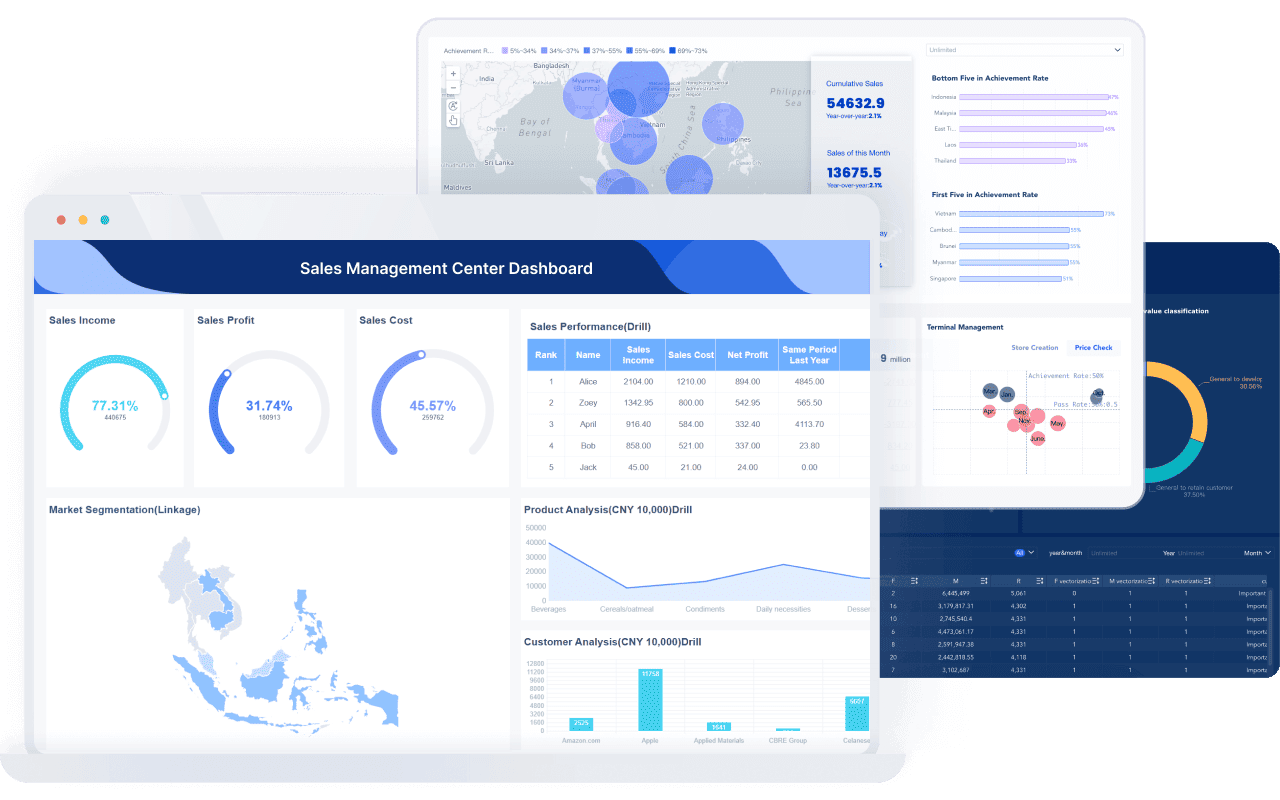
Building this manually is complex; use FineBI to utilize ready-made templates and automate this entire workflow. Instead of assembling fragmented reporting logic from scratch, teams can use FineBI to:
Connect security and operational data sources in one analytics layer
Build role-based dashboards for executives, SOC managers, analysts, and responders
Use ready-made templates to accelerate KPI and view creation
Enable drill-down analysis from summary metrics into operational detail
Automate recurring reporting for leadership and continuous improvement reviews
Standardize dashboard logic across teams to reduce inconsistency
Utilize ready-made templates and automate this entire workflow with FineBI
For enterprise decision-makers, the value is not just prettier visualization. It is faster deployment, stronger consistency, and lower operational overhead. For security teams, it means less time building dashboards and more time improving detection, triage, and response.
If your current soc dashboard depends on manual reporting work, disconnected tools, or one-off analyst effort, that is the signal to modernize. FineBI helps turn SOC data into a repeatable, scalable decision system.
A SOC dashboard gives security teams a real-time view of alerts, incidents, KPIs, and workflow status in one place. Its main purpose is to help analysts and managers detect threats faster, prioritize better, and coordinate response more efficiently.
A practical SOC dashboard should focus on metrics like alert volume, severity distribution, MTTD, MTTR, false positive rate, escalation rate, and case closure rate. These KPIs help teams measure risk, response speed, and operational efficiency without overwhelming users with noise.
A SIEM is the underlying system for collecting logs, correlating events, and supporting deep investigation, while a SOC dashboard is the visibility layer built for quick decision-making. The dashboard summarizes what matters now, whereas the SIEM usually provides more raw technical detail.
SOC analysts, incident responders, managers, and executives can all use a SOC dashboard, but each role needs a different view. Analysts need actionable alert and case context, while leaders need trend, workload, and performance summaries.
An effective SOC dashboard highlights high-priority risks, reduces manual tool switching, and shows both current threats and team performance clearly. It should be role-based, easy to interpret, and tied directly to investigation and response workflows.
Product Trial
FineReport
Pixel-perfect reports · Interactive dashboards · Easy data entry · Digital twins