
Data Governance
Stop Planning Your Data Governance Strategy (Do This Instead)
Having realigned our mental models in the previous installment, we now face the crucible of execution. A paradigm shift is merely the prologue, the inevitable question that follows is: how do we translate this newly corrected philosophy into operational reality?
This is where many people go wrong again. They either wait until everything is perfectly set up before starting, or they lead with a sweeping, multi-year transformation plan that exhausts the team before it begins.
The right path lies between those two extremes: start with a narrow wedge, grow it incrementally, and simultaneously build a governance mechanism that can sustain itself for the long haul.Here is how.
Use the project as a starting line, not a finish line
Just because data governance isn’t a project doesn’t mean you can’t start with one. You need something concrete to work with. Tell your CEO you want to build processes, capabilities, and organizational structure, and he’ll ask: where does it begin? How much does it cost? When does it pay off? “It’s ongoing and never ends” isn’t going to get you budget. So you need a project, a tangible container.
The key is how you run that project. Don’t treat it as the finish line, rather, it’s a starting line. Use the project to lay down processes, build capabilities, and stand up the organizational structure. The day the project goes live isn’t the end. The deliverables are the shell. What matters is the core that remains: the workflows, the people, the institutional muscle.
One practical tip: modern data governance platforms can accelerate this foundation-building phase. Enterprise reporting tools like FineReport allow you to embed data quality checks directly into operational dashboards, turning abstract policies into visible, actionable metrics from day one. The goal isn’t to buy your way out of governance work, it’s to give your team the visibility they need to make governance real.
Start narrow, build momentum: a real-world case
Let me tell you a story. It illustrates the method better than any framework ever could.
A chain retailer with a decade-plus history and hundreds of locations had never once had accurate inventory data. Month-end reconciliation took days every time. The numbers from district managers never matched the system. This had been the state of affairs for over ten years, and everyone had simply learned to live with it.
Then a new CIO arrived. He didn’t launch a “group-wide data governance strategy.” He didn’t mandate that every location roll out handheld scanners — he knew that would cost millions and require store-by-store training that nobody wanted. Instead, he did one thing: he asked IT to pull a report showing which product categories had the largest reconciliation gaps over the past three months. The answer sitting at number one: beer.
He picked three representative stores and told the managers: we’re running an experiment. No extra workload, no new systems. At close each day, just take a photo of the actual beer stock and post it to the group chat. No forms, no data entry. Just a photo.
Two weeks in, they spotted something. A high-volume domestic lager showed 15 cases in stock for Store A in the system. The actual count was 3. The reason was mundane: a delivery driver, noticing Store B was running low, had quietly transferred a few cases from Store A on his own initiative. He never logged the movement. That single informal transfer led headquarters to believe Store A was well-stocked, so no replenishment was sent. The timing was terrible — it was peak Euro Cup season. Store A was out of stock for three straight days.
The CIO brought the case to the CEO: look at this — we spent nothing, and we found a real, concrete leak. If we just formalize the transfer process — even just requiring drivers to send a message in the group chat — we recover real money. The CEO saw it immediately. The initiative got approved.
Generate a small proof of value first, then use that proof to earn more budget and buy-in. No executive will fund a grand vision on faith alone. But show them you’ve already made money, even a little, and they’ll back you for the next phase.
What happened next? Beer expanded into other fast-moving categories. Photo-in-a-chat evolved into a simple mobile reporting app. Three pilot stores grew into every company-owned location. Each step worked the same way: generate a small win, then cash it in for more resources and more cooperation. Three to four years later, inventory accuracy had climbed from below 70% to over 95%.
Did this CIO know data governance theory? The term probably wasn’t even fashionable yet when he started. Did he run a grand data governance program? Not in the slightest. He just never tried to do everything at once. He rolled a snowball, learning as he went — mastering the craft of governance by practicing it, not by planning it.
Legislation+Judiciary+Enforcement: making governance run
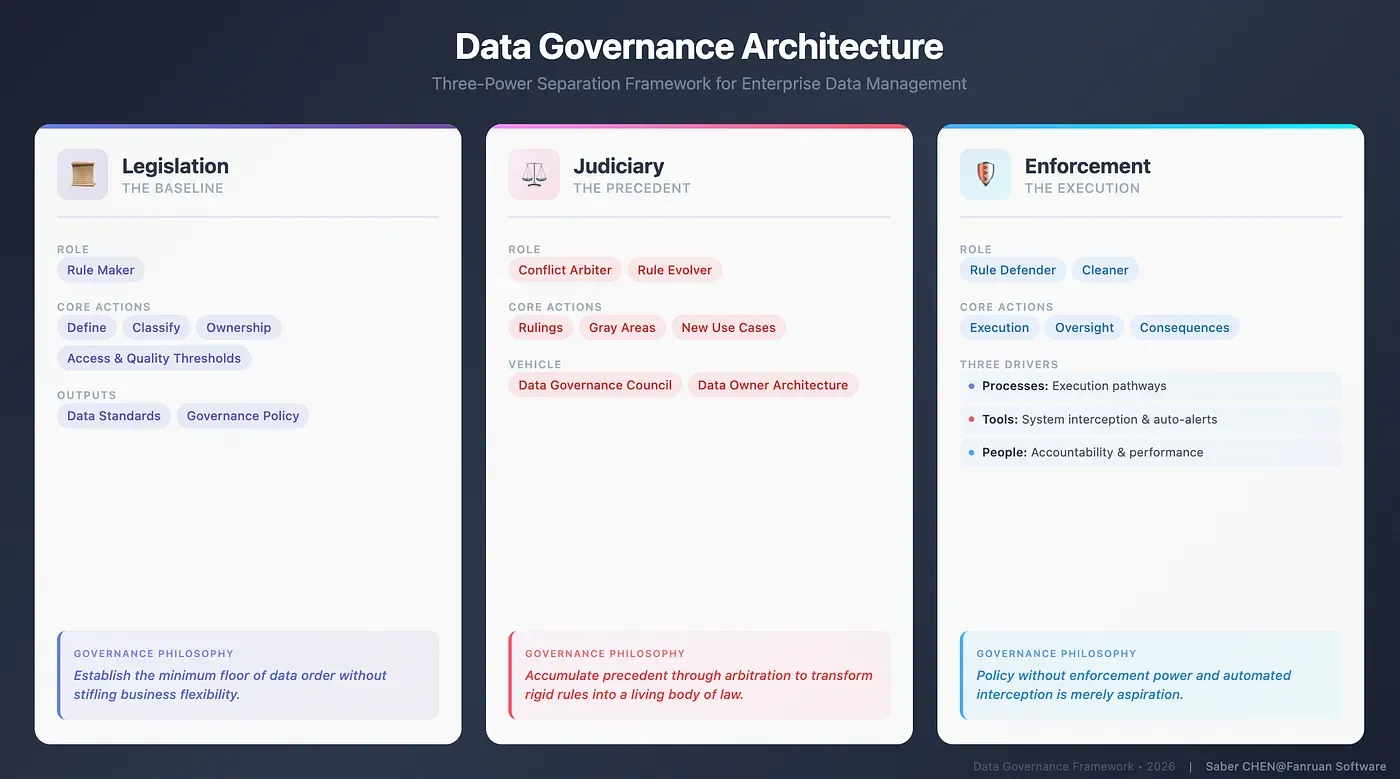
Once you’ve found your entry point and the snowball is rolling, you need an institutional mechanism to keep governance running over the long term. I find it useful to think of this as a three-branch system: legislation, judiciary, and enforcement.
Legislation means standards and policy. How is data defined, classified, and named? Who owns what? What access controls apply? What quality thresholds are acceptable? Write these down, and you have data standards and governance policy. Good legislation sets a floor without capping flexibility, it keeps data orderly without strangling business agility.
The judiciary means rulings and precedent. No policy can anticipate every situation. New use cases, new disputes, and new gray areas appear constantly. That’s where a data governance council or data ownership structure steps in to rule: should this field be shared? Can this dataset be opened up? These decisions, accumulated over time, become case law — a living body of precedent that extends and clarifies the written rules.
Enforcement means execution and oversight. Rules that aren’t enforced are just aspirations. Non-compliant entries get blocked by the system. Poor data quality triggers automatic flags. Repeat offenders see consequences in performance reviews. Processes give enforcement a pathway, tools give it efficiency, and the organization gives it someone accountable. All three wheels must turn together.
Work both horizons at once
A word on how governance initiatives actually get started: most companies don’t choose to begin — they’re forced to. An IPO is coming. A new system needs clean data to go live. The CEO finally lost patience in a meeting. The natural instinct in these moments is to focus entirely on the immediate problem: clean up the data, fix the report, satisfy the requirement, and exhale. Then the next crisis arrives and you start again from zero. This is reactive governance: always fighting fires, never getting ahead of them.
The right approach is to work both time horizons simultaneously. Handle the immediate problem, and handle it well — you need the quick wins to earn credibility and breathing room. But while you’re fighting the fire, keep one eye on the root cause. Why did this problem occur? Missing entry rules? Absent monitoring? Unclear ownership? Log that root issue, put it on the roadmap, and resolve it when the emergency is over. After every fire, do a little more fireproofing. Do this consistently, and the fires become less frequent. That’s how you get ahead of the chaos.
Final Thought
Data governance is not a destination. It’s a capability, one that compounds over time. Start small, prove value, build mechanism, and let your tooling evolve alongside your practice. The companies that win at governance aren’t the ones with the most sophisticated platforms on day one. They’re the ones that treated governance as a craft to be mastered, not a checkbox to be completed.
And when you’re ready to scale that craft? Choose partners who understand that governance is a journey, not a product shipment.
Got questions? Ping me on Linkedin.

Article by
Saber Chen
AI Product Architect & CPO
Saber has 15 years of experience in enterprise software, where he has guided 43,000+ clients and managed teams of 500+, building top-tier data intelligence solutions. When not building scalable B2B architecture, he's on the basketball court or diving into vibe coding.


Keep Learning
 Your CEO Can’t See IT Value. Here’s the Missing Lens.
A CEO’s joke that wasn’t really a joke. I hear this from executives all the time — the same bewildered frustration, the same agonizing gap between millions poured into systems and zero visible return at the altitude where decisions are made.
 Fix the Data. Clarify the Accountability. Build the Organization
Discover the 3 pillars of effective data governance: Fix the data, clarify accountability, and build the organization. Move beyond planning to real execution.
 Everything You Think You Know About Data Governance Is Wrong
Still struggling with rigid data policies? Everything you think you know about data governance is wrong. Discover how to build a modern, agile strategy.