
Data Governance
Everything You Think You Know About Data Governance Is Wrong
The term data governance gets thrown around in boardrooms until it loses all meaning. Ask a thousand people and you’ll get a thousand answers: build a platform, define standards, clean the data, stand up a data middle layer. All of them are partially right. None of them gets to the root of the matter.
After years in the data and AI trenches, falling into every pitfall imaginable, I’ve arrived at a truth that rarely gets said out loud: most companies have been thinking about data governance wrong from the very beginning. This isn’t a capability problem. It’s a framing problem. Get the frame wrong, and the direction is wrong. Get the direction wrong, and all the effort in the world won’t save you.
Mistake 1: Treating governance as a project
The most common mistake is treating data governance as a project with a finish line. Assemble a team, buy a tool stack, draft a pile of standards, grind through it for a year or two, get sign-off, declare victory, and disband. The vendors go home. The team scatters. A year later you look back: the standards nobody uses, the platform gathering dust, the data just as messy as before.
Why? Because projects end, but data quality problems don’t. Clean the data today; bad entry practices make it dirty again tomorrow. Standards hold this month; a new hire next month who was never trained quietly unravels them. Data issues are perpetual. Deploying a finite solution against an infinite problem is a losing game before the kickoff meeting even ends.
Data governance is fundamentally a process framework — like expense approval in finance or sign-off workflows in procurement. It’s a permanent part of how the organization operates, not a one-time construction project.

Mistake 2: Conflating governance with platform-building
There’s a more insidious misconception: the belief that data governance means building a data platform or “data middle layer.” This is a purely technology-first mindset, repackaging what is fundamentally an organizational and process challenge as a technical solution.
Platforms are tools. Governance is a mechanism. Tools can support a mechanism, but tools cannot replace one. A company can have no world-class data platform and still govern its data well, as long as processes are clear, ownership is assigned, and oversight is real. Conversely, the most advanced platform in the world does nothing for data quality if the processes are absent, accountability is blurry, and nobody enforces anything.
Mistake 3: Seeing only one side of an inherent tension
Practitioners tend to fall into one of two camps. The first sees data as pure asset: the new oil, digital gold, something worth going all-in on immediately. They charge ahead, buying tools and drafting grand strategies, only to find the business won’t follow. The second sees data governance as pure cost center:put out fires, keep the lights on, move on. They stay permanently reactive, perpetually exhausted, and never build lasting value.
Both perspectives are real. Both, taken alone, are wrong. Data governance is inherently paradoxical: it demands long-term vision and near-term pragmatism simultaneously. Lean too far toward idealism and you build castles in the air. Lean too far toward short-termism and you’re just patching holes forever, never achieving anything systemic.
The right frame: process, capability, and organization as one
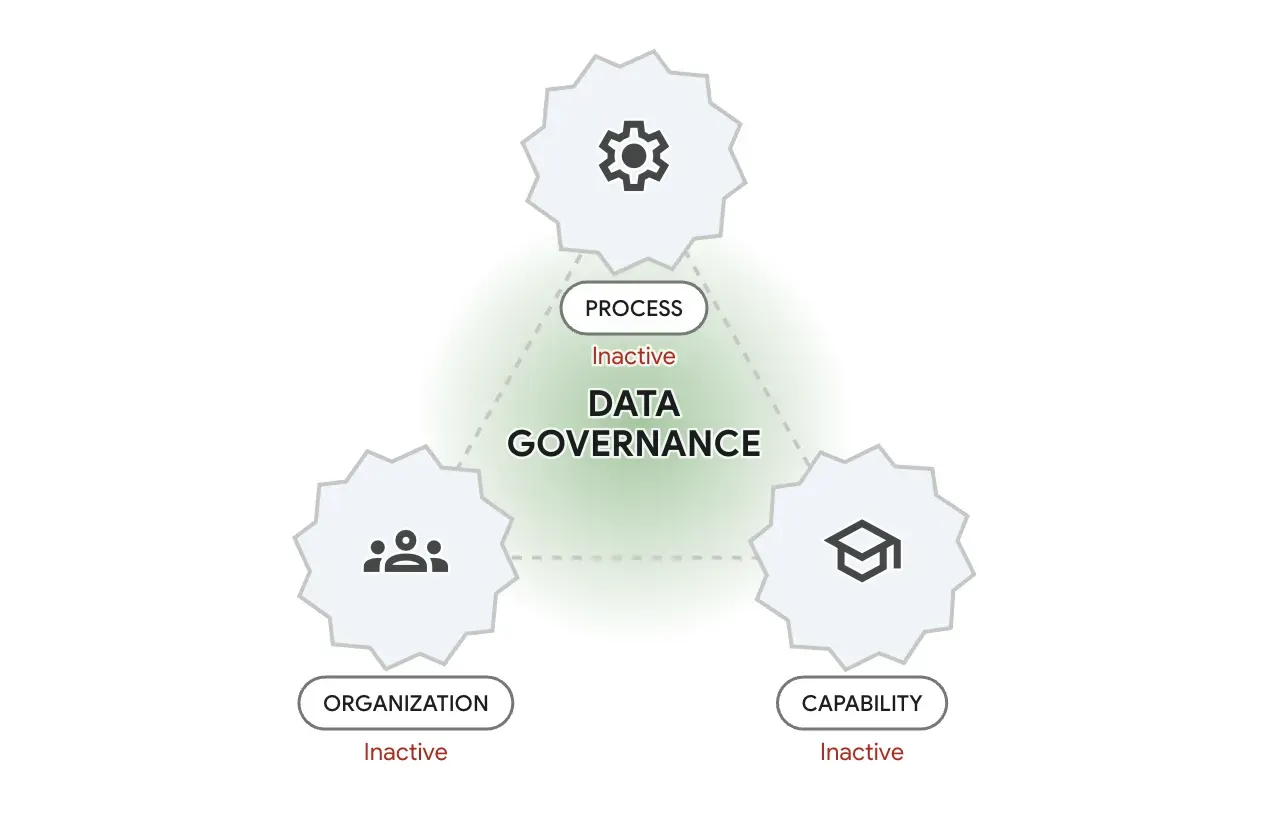
Data governance is a process framework, but processes only come alive when they’re internalized as organizational capability, and capability only holds when it’s anchored in the organization’s structure and culture.
The best-designed process is just paper if nobody executes it, nobody monitors it, nobody improves it. You need dedicated people who own it, business units who accept it, and performance systems that reinforce it. Process, capability, and organization, weave these three together, and you have real governance.
And this work has no finish line. Think of road maintenance: the road being built is not the end, as long as people drive on it, it needs upkeep. Data governance is a fitness regimen, not a construction project. The day you stop training, the condition starts to slip.
Got questions? Ping me on Linkedin.

Article by
Saber Chen
AI Product Architect & CPO
Saber has 15 years of experience in enterprise software, where he has guided 43,000+ clients and managed teams of 500+, building top-tier data intelligence solutions. When not building scalable B2B architecture, he's on the basketball court or diving into vibe coding.


Keep Learning
 Your CEO Can’t See IT Value. Here’s the Missing Lens.
A CEO’s joke that wasn’t really a joke. I hear this from executives all the time — the same bewildered frustration, the same agonizing gap between millions poured into systems and zero visible return at the altitude where decisions are made.
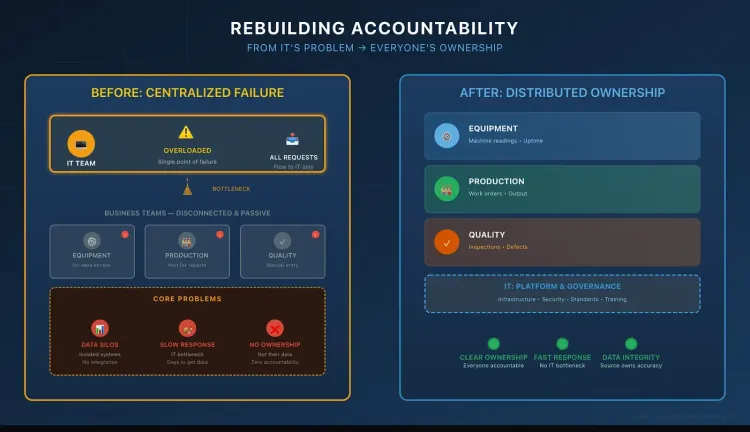 Fix the Data. Clarify the Accountability. Build the Organization
Discover the 3 pillars of effective data governance: Fix the data, clarify accountability, and build the organization. Move beyond planning to real execution.
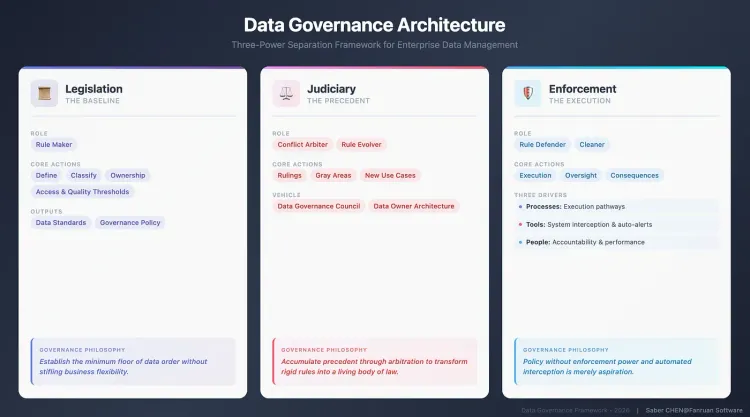 Stop Planning Your Data Governance Strategy (Do This Instead)
Stop wasting time on rigid 5-year data governance plans. Discover why traditional strategy planning fails and learn how to implement a value-driven, agile approach that delivers real results today.