
“We invest in IT every year. Where’s the ROI I can touch?”
A CEO’s joke that wasn’t really a joke. I hear this from executives all the time — the same bewildered frustration, the same agonizing gap between millions poured into systems and zero visible return at the altitude where decisions are made.
It starts with misunderstanding two fundamentally different things.
Stage 1: Business Informatization.
Your ERP, CRM, OA, WMS, MES — the operational arsenal running daily workflows. They standardize processes, cut manual work, and generate data. Call this data comes in.
These systems serve one audience: operations teams. The frontline soldiers executing daily battles. Your CFO doesn’t log into ERP to check cash flow. Your CEO doesn’t browse CRM for pipeline updates.
Stage 2: Data Informatization.
BI, analytics, big data — turning that operational data into decision support. Cross-functional visibility, trend analysis, moving from experience-driven to data-driven. Call this data goes out.
This is the altitude change. From transaction to insight. From ground-level detail to the strategic overview your leadership actually needs.
Most enterprises I work with are stuck halfway. Great at collecting data. Terrible at using it.
The architecture most companies miss.
No Stage 1, no Stage 2. That part, most people understand. What they miss: Stage 2 must feed back into Stage 1.
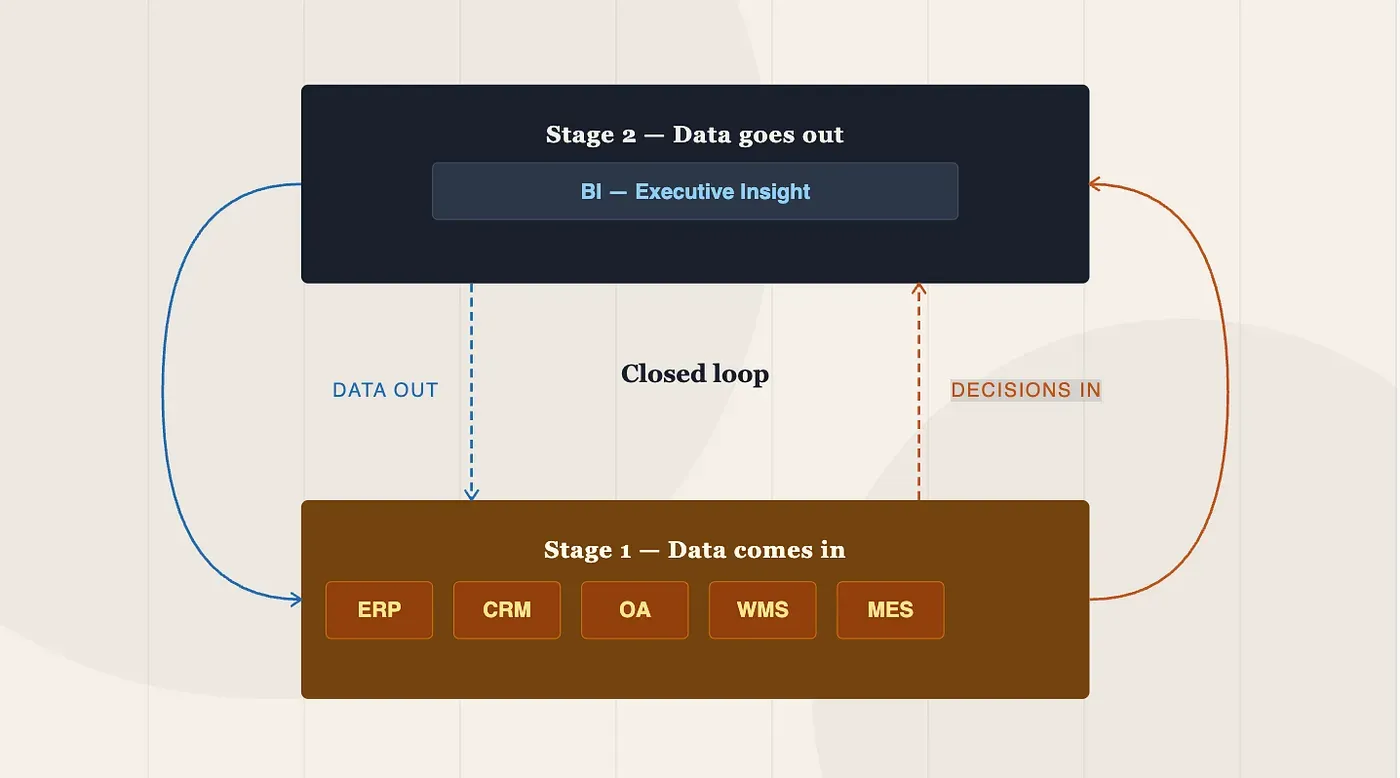
They are upstream-downstream partners, not separate purchases. The insight that flows out through BI must flow back in as decisions that reshape operational processes. This is a closed loop, not a one-way pipe.
Here’s what that looks like in practice: BI flags that pipeline in the Midwest has been trending down for two consecutive quarters. That signal flows back into CRM — territory quotas get reassigned, outreach cadence changes, sales motion adapts. The data went out as insight. It came back in as action. That’s the loop closing.
Without this return path, you have data going out but never coming back. A broken loop. Intelligence without consequence.
What leadership actually needs.
Not more data. A different lens on the same data.
Your ERP records every order. Your CRM tracks every deal. But neither tells the CEO whether this quarter’s pipeline is trending up or down across all business units. Neither flags the anomaly that deserves immediate attention. Neither shows the pattern that predicts next quarter’s risk.
BI does all three. It takes the raw operational data your systems already generate and refracts it through a strategic prism — aggregate, filter, highlight exceptions, reveal trends over time.
From 200-row Excel reports to a single pane that answers the question the CEO actually asked. Same data. Completely different altitude.
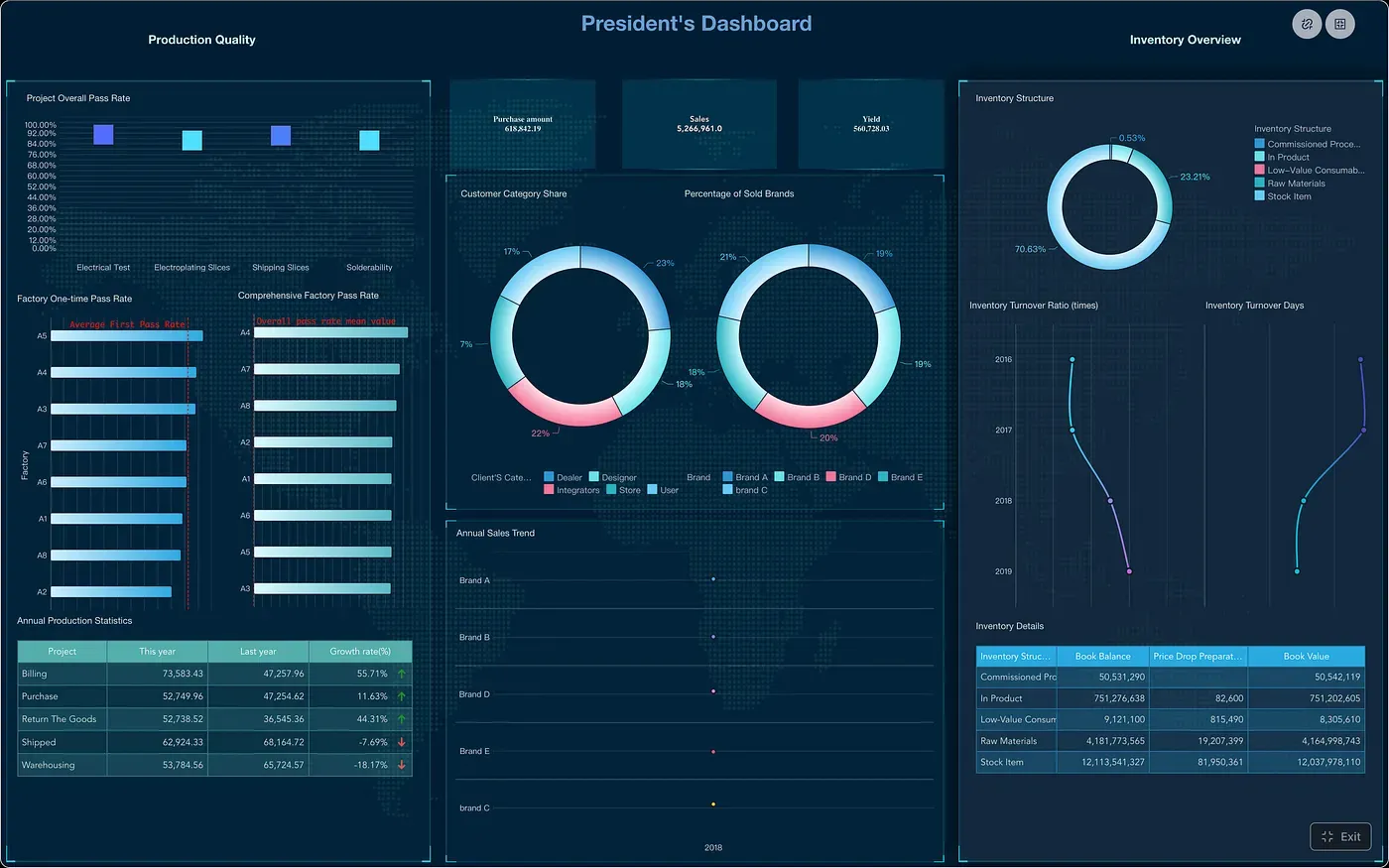 FanRuan’s C-suite dashboard
This is what Stage 2 looks like-not more data, but a different lens. Cross-functional KPIs, trend lines, and exceptions. The altitude change your leadership team has been missing. Learn more.
FanRuan’s C-suite dashboard
This is what Stage 2 looks like-not more data, but a different lens. Cross-functional KPIs, trend lines, and exceptions. The altitude change your leadership team has been missing. Learn more.
If your executive dashboard still looks like a spreadsheet, you’ve built the wrong product for the wrong audience.
The fix isn’t more data collection. It’s a different lens: aggregate across business units, filter out operational noise, highlight exceptions that demand attention, show trends instead of snapshots.
The same ERP data that records what happened can reveal why it happened — if you model it right. The same CRM data that tracks individual deals can show whether your entire pipeline is healthy or hemorrhaging —** if you aggregate it right**.
The value was always there. Buried in systems you already own. Trapped at the ground level, visible to operations, invisible to leadership.
The missing lens isn’t a new system. It’s a new perspective on data your existing systems already generate.
So here’s one concrete first step: pull your last quarter’s ERP and CRM data, and ask a single question — does your leadership team see the same trends your operations team sees? If the answer is no, you don’t have a data problem. You have a lens problem.
Got questions? Ping me on Linkedin.

Article by
Saber Chen
AI Product Architect & CPO
Saber has 15 years of experience in enterprise software, where he has guided 43,000+ clients and managed teams of 500+, building top-tier data intelligence solutions. When not building scalable B2B architecture, he's on the basketball court or diving into vibe coding.


Keep Learning
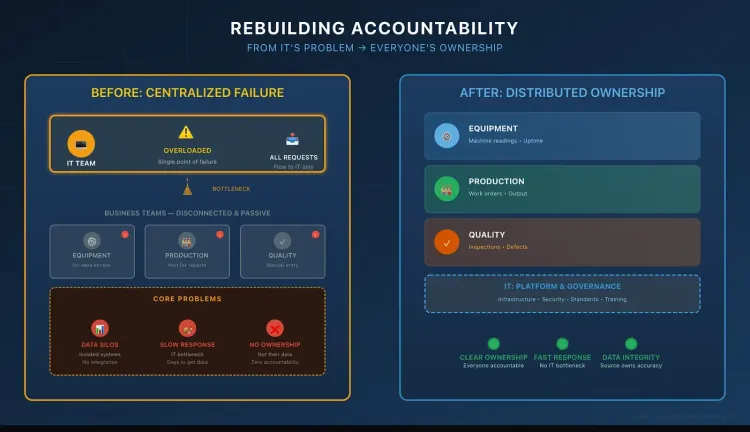 Fix the Data. Clarify the Accountability. Build the Organization
Discover the 3 pillars of effective data governance: Fix the data, clarify accountability, and build the organization. Move beyond planning to real execution.
 Everything You Think You Know About Data Governance Is Wrong
Still struggling with rigid data policies? Everything you think you know about data governance is wrong. Discover how to build a modern, agile strategy.
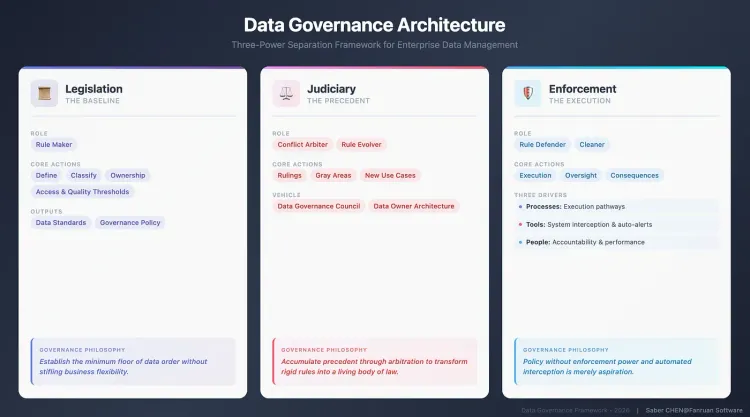 Stop Planning Your Data Governance Strategy (Do This Instead)
Stop wasting time on rigid 5-year data governance plans. Discover why traditional strategy planning fails and learn how to implement a value-driven, agile approach that delivers real results today.