
Data Governance
Fix the Data. Clarify the Accountability. Build the Organization
You may have experienced this: you understand the theory, you’ve bought the tools, you’ve drafted the standards, and data governance still won’t move. The business won’t cooperate. IT is stuck in the middle, taking fire from both sides. The same problems keep surfacing, and nobody truly owns them.
This isn’t an execution problem. It isn’t a technology problem. It’s an accountability problem. When you follow data governance to its roots, you find that what’s actually being governed was never the data itself — it was always the people, the processes, and the allocation of responsibility behind it.
The root failure of the old model: IT manages, business uses
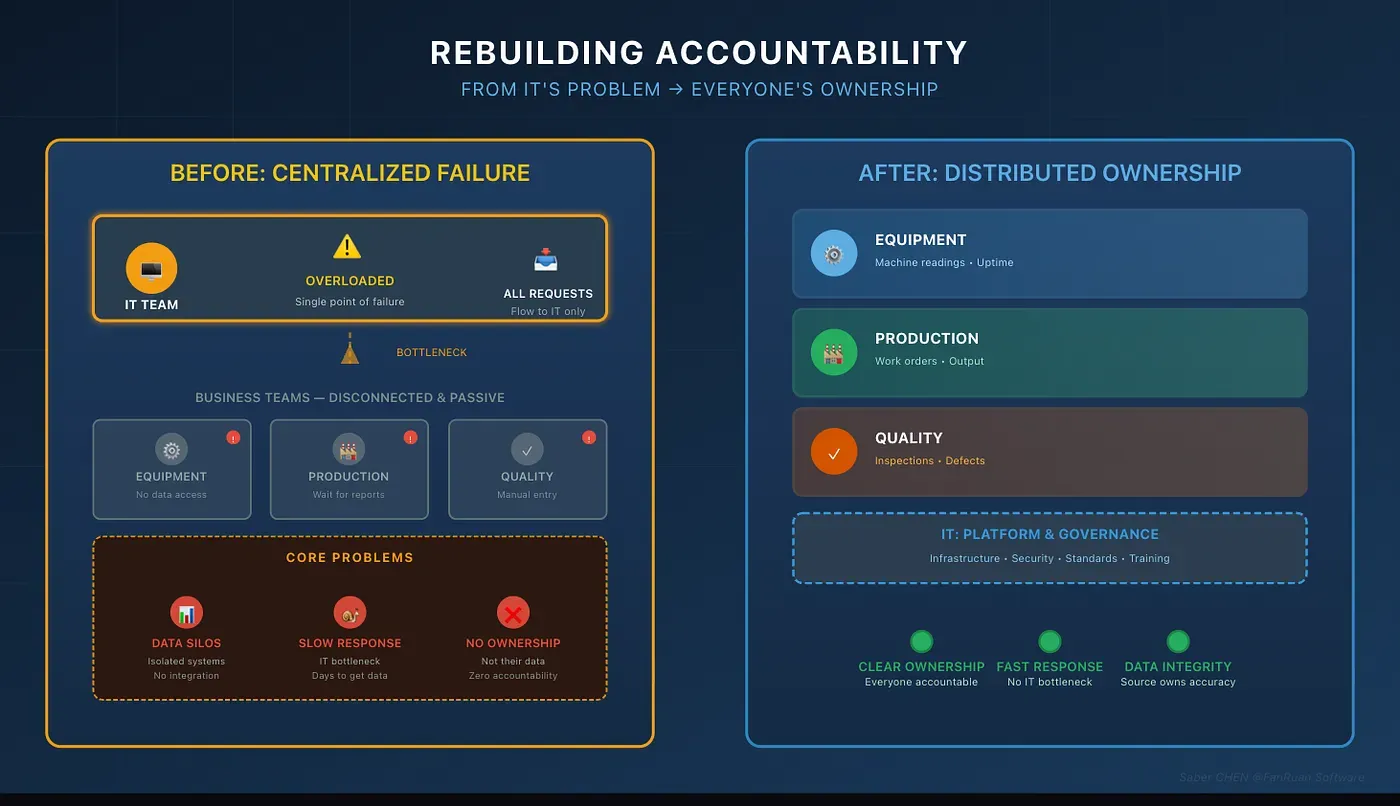
In the traditional accountability model, IT manages the data and the business uses it. The people managing it don’t understand the business context. The people using it don’t care about data quality. An invisible wall stands between them.
That wall produces a predictable pattern: when data is inaccurate, IT gets blamed; when data isn’t useful, the business says “not our problem”; data accountability becomes an unclaimed asset, passed from department to department until the issue dies without resolution. The result is a broken cycle that repeats indefinitely.
Platform after platform gets built. Standards document after standards document gets written. And yet data quality remains poor, and the business remains unengaged. The root cause, in almost every case, has never been insufficient technology. It’s been an accountability model that was never rebuilt.
Rewriting accountability: from IT’s problem to everyone’s ownership
Rebuilding accountability means tearing down that invisible wall. It means ensuring that every data field, every metric definition, has a named business owner who is accountable for its quality.
In manufacturing, for example: the production team owns the accuracy of work order data; quality assurance owns the completeness of inspection records; the equipment team owns the timeliness of machine readings. This isn’t adding burden to the business. It’s returning data to its natural home — data is generated by business operations, and business teams are best positioned to be responsible for its integrity.
When accountability lands on specific people, a new coordination mechanism takes shape organically. When something goes wrong, everyone knows who to call. When something changes, there’s someone to approve it. When a discrepancy appears, there’s someone to explain it. Data stops being cold numbers and becomes something with a human face — a business asset with a responsible owner.
This isn’t a simple reallocation of tasks. It’s a deep change in how the organization operates. When business teams start taking responsibility for data, it stops being IT’s problem and becomes everyone’s shared stake.
Coordination: data gains value in transit, not loses it
Rebuilding accountability produces a second, deeper benefit: it generates genuine cross-functional coordination. When every team and every role has clear data ownership, data stops being a series of silos and becomes a value chain running through the entire business.
The production team, when entering work order data, starts thinking about what the quality team will need downstream. The quality team, when capturing inspection records, considers how the equipment team will use that data to trace anomalies. Everyone plays their part, and every part connects. Data gains value as it moves through the organization rather than degrading with every handoff.
This coordination doesn’t emerge from top-down mandates. It emerges from accountability. Once each person understands what data they own and who depends on them, cooperation becomes natural. Data governance shifts from “something I’m required to do” to “something I want to do.” The motivation transforms entirely.
Self-correction: the power of systems, not heroes
When every step in the process has an owner, the organization develops the capacity to correct itself. This is the deepest value that accountability restructuring delivers.
When data quality deteriorates, the system flags it automatically and the responsible owner intervenes immediately — not at the monthly review when the damage is already done. When a process breaks down, the relevant roles are triggered and coordination kicks in at once, rather than languishing in email chains and meetings.
This self-correcting capacity doesn’t depend on a data hero charging in at the critical moment. It depends on the system running continuously. It doesn’t rely on individual awareness — it relies on institutional structure. It doesn’t rely on bursts of enthusiasm — it relies on ingrained habits. When an organization develops this capability, data governance stops being a project and becomes the default mode of operation.
Data DNA: what mature governance actually looks like
The deepest value of data governance isn’t measured in tables fixed or dashboards built, but in whether the organization has developed what you might call **data DNA**.
What is data DNA? It’s knowing who to call when something goes wrong. It’s experience crystallizing into institutional knowledge. It’s good decisions becoming habitual. It’s the organizational state where accountability is clear, processes flow without friction, and teams coordinate efficiently. It’s data that has stopped being a burden and become an asset — stopped being a source of problems and become a source of answers.
When people say data-driven organization, they’re not talking about how many tools are installed, but asking whether the organization has the capacity to deliver data to the right people, at the right time, with the right quality, in a way that produces the right action. That capacity is built on rebuilt accountability. On nothing else.
The Only True Endpoint
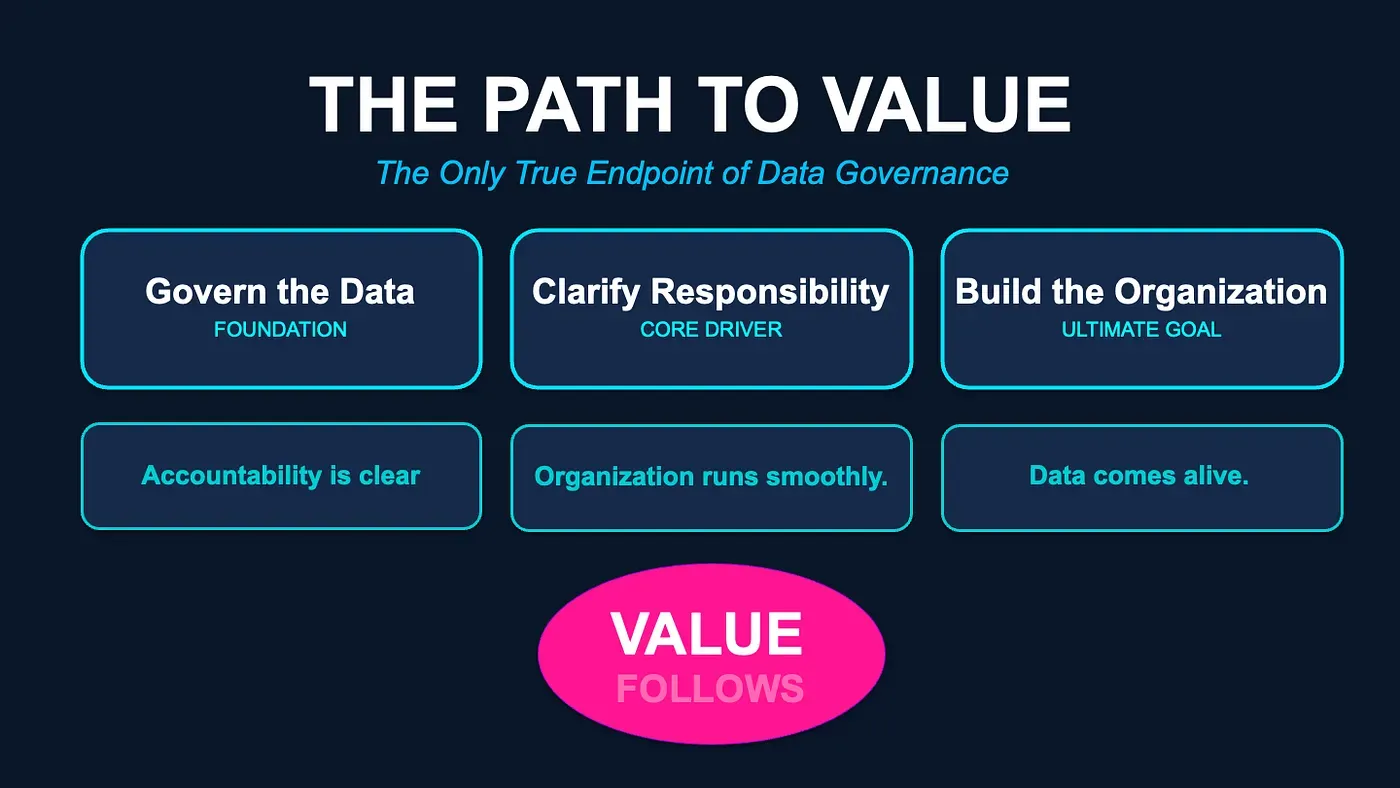
Govern the data. Clarify the responsibility. Build the organization.
When accountability is clear, the organization runs smoothly. When the organization runs smoothly, the data comes alive. When the data comes alive, the value follows.
That is the only true endpoint of data governance. And yes — it requires both the organizational will to rebuild accountability and the technical foundation to sustain it. But never forget the order: accountability first, technology second. Get the first one right, and the second one becomes a force multiplier.
Got questions? Ping me on Linkedin.

Article by
Saber Chen
AI Product Architect & CPO
Saber has 15 years of experience in enterprise software, where he has guided 43,000+ clients and managed teams of 500+, building top-tier data intelligence solutions. When not building scalable B2B architecture, he's on the basketball court or diving into vibe coding.


Keep Learning
 Your CEO Can’t See IT Value. Here’s the Missing Lens.
A CEO’s joke that wasn’t really a joke. I hear this from executives all the time — the same bewildered frustration, the same agonizing gap between millions poured into systems and zero visible return at the altitude where decisions are made.
 Everything You Think You Know About Data Governance Is Wrong
Still struggling with rigid data policies? Everything you think you know about data governance is wrong. Discover how to build a modern, agile strategy.
 Stop Planning Your Data Governance Strategy (Do This Instead)
Stop wasting time on rigid 5-year data governance plans. Discover why traditional strategy planning fails and learn how to implement a value-driven, agile approach that delivers real results today.