Finance teams are under pressure to close faster, explain variance sooner, and deliver management-ready reporting without expanding headcount. That is exactly why financial reporting AI bots are getting attention. But the real question for CFOs, controllers, finance managers, and IT leaders is not just whether AI can help. It is whether it can help without putting sensitive financial data, audit readiness, and reporting integrity at risk.
In practice, most enterprises do not need an ungoverned bot making up answers from raw uploads. They need a controlled reporting foundation plus an AI assistant layer. With financial reporting AI bots, teams can ask for a report summary in chat, generate structured narratives from trusted report assets, receive scheduled briefings, and push exceptions to the right owner.
What financial reporting AI bots actually do with sensitive data
Financial reporting AI bots can be useful, but trust starts with understanding what they actually touch, where they process it, and how much control your organization keeps.
At a basic level, these tools may:
collect financial data from uploads, spreadsheets, ERP exports, or reporting systems
process that data to classify, summarize, compare, or explain it
generate narratives for management reports, board packs, or variance commentary
store prompts, outputs, report context, or workflow records
trigger follow-up actions such as alerts, task routing, or scheduled briefings
The security conversation changes dramatically depending on the type of tool in use.
Document assistants
These tools usually work on uploaded files such as financial statements, budgets, close checklists, or commentary drafts. They are often used for one-off tasks like summarizing a file or reformatting notes.
Definition: A file-based AI helper that reads uploaded content and returns a summary or answer. Business value: Fast for ad hoc document review and drafting support. AI use: Can summarize approved finance documents, extract key themes, or rewrite commentary in a clearer format.
The downside is that document assistants may create risk if users upload raw or highly sensitive files into tools with unclear retention, training, or access policies.
Reporting copilots
These tools sit closer to approved dashboards, reports, and governed KPI logic. Instead of treating every uploaded file as a fresh source of truth, they retrieve answers from trusted reporting assets.
Definition: An AI assistant that helps users query, explain, and summarize enterprise reports. Business value: Better fit for recurring financial reporting because it works from governed metrics and approved templates. AI use: Can explain changes in gross margin, summarize a monthly finance packet, or answer chart-based questions in chat.
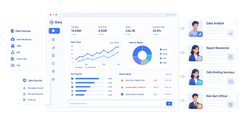
This is where FineReport + Dora is especially relevant. FineReport provides the formatted reports, management reports, and financial operational cockpits. Dora adds the enterprise Data Agent layer so users can consume those assets through natural-language queries, structured report summaries, scheduled pushes, and follow-up workflows.
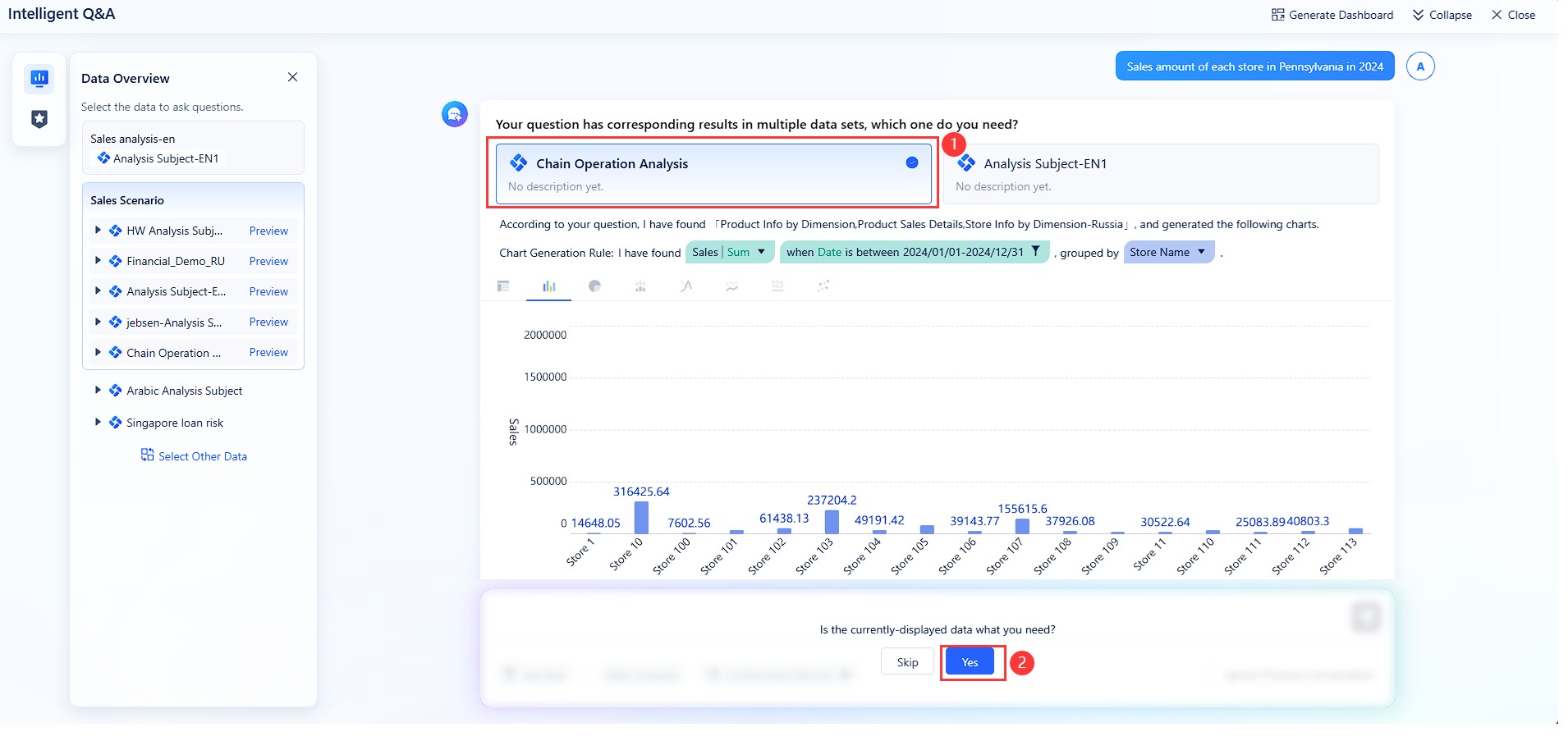
Natural-language Query
Fully integrated finance automation tools
These solutions connect into ERP, consolidation, planning, or reporting ecosystems and may automate more steps across the reporting process.
Definition: A connected finance AI tool that interacts with systems, data models, workflows, and reporting outputs. Business value: Higher automation potential for recurring finance processes. AI use: Can support recurring variance review, report preparation, exception alerts, and finance follow-up tasks.
These tools can be powerful, but they also increase the importance of governance, permissions, auditability, integration security, and human review.
Trust depends on more than model quality. It depends on technical safeguards and organizational controls working together:
encryption and secure transport
role-based access control
data residency and retention settings
approved semantic definitions for KPIs
human review before distribution
audit logs for prompts, outputs, and actions
clear policies on what can and cannot be shared
That is why many enterprises should avoid starting with raw public AI tools for sensitive reporting work. A better path is to start from a trusted reporting layer and then add governed AI on top.
The biggest security and privacy risks of financial reporting AI bots to understand first
The main risks are not theoretical. They show up in everyday finance workflows: someone uploads a draft board pack into a general AI tool, a bot retains prompts longer than expected, or an inaccurate summary gets reused in management reporting.
Data exposure during upload, processing, and storage
Sensitive finance data can be exposed at three common stages: when it is uploaded, while it is processed, and after it is stored.
Report Element: Raw financial uploads Definition: Files or data extracts containing revenue, payroll, margins, liabilities, forecasts, customer data, or internal commentary. Business value: Needed for analysis and reporting preparation. AI use: Dora should work from trusted FineReport assets or approved data pathways rather than uncontrolled copy-paste uploads whenever possible.
Report Element: Processing environment Definition: The infrastructure where the AI service interprets and responds to requests. Business value: Determines whether security controls are enterprise-grade. AI use: A governed AI workflow can restrict what data is accessed, how it is used, and what outputs are returned.
Report Element: Stored prompts and outputs Definition: Conversation history, generated summaries, logs, or retained files. Business value: Useful for auditability and review if governed correctly. AI use: Dora can support auditable reporting workflows, but retention and access rules still need to be defined by the enterprise.
Common exposure points include:
unsecured or weakly governed browser uploads
employees pasting account details into consumer AI tools
excessive retention of prompt history
broad access to generated finance summaries
data cached in third-party integration layers
copied outputs being forwarded outside approved channels
Finance leaders should assume that any uploaded content may persist somewhere unless contract terms and platform controls clearly say otherwise.
Model training, third-party access, and hidden data-sharing concerns
One of the first questions any finance team should ask is simple: Will our prompts, files, or outputs be used for model improvement?
That question matters because “AI bot” can describe very different architectures. Some vendors isolate customer data. Others may involve subprocessors, external model providers, support access, or logging pipelines that expand the risk surface.
Review these areas carefully:
whether customer data is used for training or fine-tuning
whether admins can disable model improvement usage
which subprocessors handle storage, inference, monitoring, or support
whether support staff can access prompts or report outputs
whether data crosses regions or residency boundaries
whether deletion and retention settings are configurable
For enterprise finance use cases, a stronger pattern is to use AI against trusted reporting assets rather than exposing raw finance material broadly. FineReport provides the governed report foundation, while Dora acts as a controlled AI assistant above that layer. This helps reduce the need for repeated raw uploads and improves consistency through semantic rules, KPI governance, report templates, and permissions.
Accuracy, hallucinations, and reporting integrity
Security risk is not only about leakage. In finance, wrong answers are also a control risk.
If a bot:
misreads a chart
applies the wrong filter period
invents a variance explanation
summarizes an outdated draft
ignores consolidation logic
confuses actuals with forecast
then the result can affect compliance, management decisions, board communication, and audit readiness.
Report Element: KPI definition integrity Definition: Whether terms like EBITDA, operating expense, cash conversion cycle, or overdue receivables follow approved business logic. Business value: Prevents finance teams from debating numbers instead of acting on them. AI use: Dora relies on the trusted semantic foundation behind FineReport to explain governed KPIs rather than improvising definitions.
Report Element: Reporting narrative accuracy Definition: Whether the written summary reflects the actual report content. Business value: Critical for leadership communication and audit defensibility. AI use: Dora can generate a structured report summary, but finance should retain human review before formal release.
AI should support financial reporting, not bypass finance controls. The safest enterprise pattern is: governed data, governed reports, governed AI workflow, human sign-off.
How corporations can evaluate the use of financial reporting AI bots
A good evaluation process should balance opportunity and control. The question is not “Does this bot have AI features?” It is “Can this tool operate safely inside our finance governance model?”
Questions to ask vendors before sharing financial information
Before exposing any finance data, ask for clear answers in these areas:
Security controls
Is data encrypted in transit and at rest?
How are secrets, credentials, and API tokens protected?
Are role-based permissions supported?
Can access be restricted by user, department, report, or data scope?
Are audit logs available for user activity, prompts, outputs, and workflow actions?
Privacy and retention
Is customer data used for model training or product improvement?
Can retention be configured or disabled for sensitive workflows?
How is deleted data handled?
What data is stored in chat history, logs, or monitoring tools?
Which subprocessors handle customer data?
Compliance and operating model
Where is data processed and stored?
Are data residency options available?
What is the incident response process?
How are vulnerabilities disclosed and remediated?
Can the tool operate on top of existing approved reporting assets instead of requiring raw uploads?
Reporting integrity
How does the bot know KPI definitions and business terms?
Can the workflow be constrained to approved reports and semantic rules?
Are generated summaries traceable back to source reports?
Can human approval be required before output distribution?
For finance and IT leaders, the strongest answer is rarely “our model is smart.” It is “our workflow is governed.”
Governance policies finance leaders should put in place
Vendor controls matter, but they are not enough. Internal governance is what turns AI from a risky experiment into a manageable reporting capability.
At minimum, finance leaders should define:
approved use cases
prohibited data types
review and approval steps
responsibility by role
documentation and audit standards
escalation paths for exceptions or suspected misuse
Recommended policy areas include:
Role-based permissions
Not every user should be allowed to query every report or generate every summary. AI outputs should respect the same access boundaries as the underlying reporting system.
With FineReport + Dora, the reporting foundation and AI assistant layer should align with enterprise permission governance, so users only retrieve what they are authorized to see.
Human review
AI-generated report narratives should not go straight to executives, auditors, or external stakeholders without review.
A practical model:
AI prepares a structured summary.
Finance owner reviews and edits.
Controller or manager approves when needed.
Final version is distributed through approved channels.
Documentation standards
Teams should document:
which reports are AI-enabled
approved KPI definitions
prompt templates for recurring reporting tasks
alert thresholds and responsibility rules
review checkpoints
retention requirements
This is especially important for recurring tasks like board packs, monthly management reports, budget variance commentary, and risk alerts.
Browser-based automation and integration risks
Some teams try to automate finance reporting through browser bots, extensions, or lightweight automation layers. Others connect AI directly into ERP, consolidation, or reporting platforms.
Both approaches can work, but both need review.
Browser-based automation risks
Review:
where browser session data is stored
whether credentials are exposed in scripts or extensions
how downloaded files are handled
whether the automation captures or stores output locally
who can modify automation steps
whether the automation bypasses approved reporting workflows
Browser automation may be useful for low-risk repetitive tasks, but it can become a control problem if teams quietly create shadow finance workflows outside IT and finance governance.
Integration risks with ERP and reporting systems
Review:
API permission scope
service account governance
token lifecycle management
field-level access controls
environment separation between test and production
logging and traceability for data pulls and output pushes
The safer enterprise pattern is to avoid exposing raw ERP complexity directly to every user prompt. Instead, standardize trusted reporting and semantic layers first. FineReport helps create that reporting foundation, and Dora then interacts through governed query and Skills-based execution for more controllable and auditable AI workflows.
Should you share your financial info with AI bots?
The right answer is not always yes or no. It depends on the type of data, the use case, the tool architecture, and the strength of your governance.
When the answer may be yes
There are finance scenarios where AI can add value with lower risk, especially when teams work from already approved or less sensitive reporting outputs.
Examples include:
drafting commentary for already approved monthly reports
formatting management narratives from finalized KPI tables
summarizing approved variance reports
answering questions from trusted FineReport dashboards
generating meeting prep notes from published internal management reports
sending scheduled finance briefings to authorized users
In these cases, FineReport + Dora is a practical fit because FineReport provides the trusted report, cockpit, and template foundation, while Dora turns those assets into an enterprise Data Agent experience.
For executives, this means concrete ROI:
Dora is not an AI experiment. It is a landed digital employee for recurring reporting work such as monthly management reports, operation summaries, finance risk reports, quality anomaly alerts, and owner follow-up.
For business users, the benefit is lower friction:
Dora helps business teams get timely report summaries, chat-based answers, scheduled briefings, and exception pushes without waiting for analysts or searching through reports.
When the answer should be no or not yet
Finance teams should pause or avoid AI sharing when:
the vendor cannot clearly explain retention, training, or subprocessors
the use case involves highly regulated or restricted data
access controls are weak or undefined
internal approval workflows do not exist
KPI definitions are inconsistent across teams
report templates are not standardized
users plan to paste raw account numbers, personal data, tax IDs, or credentials into prompts
the AI output would be used in formal reporting without human review
If governance is unresolved, the answer is not “trust the bot more.” The answer is “tighten the system first.”
Does the data include regulated, personal, payroll, banking, or account-level information?
Is the content draft-only or already approved for internal distribution?
2. Necessity
Does AI provide real workflow value here?
Could the same result be achieved without sharing raw sensitive content?
3. Safeguards
Are encryption, permissions, audit logs, retention controls, and residency rules in place?
Is data protected from model training or unnecessary third-party exposure?
4. Governance
Are there approval workflows, prompt standards, and human review steps?
Are access boundaries aligned with reporting permissions?
5. Oversight
Can outputs be traced back to source reports?
Is there accountability for validating AI-generated summaries?
If the answer is weak on any of these, the use case is not ready.
Benefits, future trends of financial reporting AI bots, and what to expect in 2026
The market interest is real because the benefits are real. But the winners in 2026 will not be the loudest bots. They will be the tools that combine productivity with security, privacy, and auditability.
faster summarization of monthly and weekly reports
easier variance explanation and chart interpretation
reduced manual effort in preparing management commentary
quicker access to report answers through natural language
scheduled distribution of approved report briefings
exception monitoring and owner follow-up
Report Element: Variance commentary Definition: Explanation of why actuals differ from budget, prior period, or forecast. Business value: Helps management act on issues instead of just viewing numbers. AI use: Dora can generate a structured report summary, explain chart movements, and include abnormal changes in scheduled briefings.
Report Element: Management briefing Definition: A concise summary of performance, risks, and action items for leaders. Business value: Improves decision speed and meeting readiness. AI use: Dora’s Daily Briefing Secretary can prepare periodic report summaries and push them to the right users.
Report Element: Exception list Definition: Overdue items, threshold breaches, unusual swings, or missing submissions. Business value: Makes reporting operational, not just descriptive. AI use: Dora’s Risk Alert Officer can detect issues, push alerts, and support follow-up.
Future trends shaping finance AI tools
By 2026, enterprise finance buyers should expect more maturity in four areas:
Secure enterprise deployments
More organizations will prefer private or controlled deployments, stronger tenant isolation, and clearer data handling terms.
Policy-aware assistants
Instead of generic AI behavior, finance teams will want assistants that understand approved business rules, KPI definitions, access policies, and reporting boundaries.
Stronger auditability
AI activity will need to be explainable and reviewable. That includes source linkage, prompt records, output history, and workflow logs.
Agentic BI with governed execution
This is where Dora’s positioning matters. Dora should be understood as fourth-generation Agentic BI:
natural-language request
trusted semantic layer
governed query or Skill execution
report summary, answer, exception push, action, and follow-up
This is more practical for enterprise finance than a prompt-only tool that lacks reporting context and governance.
How to compare the best finance chatbots in 2026
When reviewing finance AI tools and market roundups, use criteria like these:
Can it work from governed reporting assets?
Does it support role-based permissions and access boundaries?
Are KPI definitions and semantic rules controllable?
Can it generate structured report summaries instead of generic prose?
Are alerts, pushes, and follow-up workflows supported?
Is the AI workflow auditable?
Can it operate as a repeatable digital employee for reporting scenarios?
Does it reduce operational friction without increasing compliance risk?
Is it designed for enterprise landing, not just demo conversations?
For IT teams, this is also a role shift:
IT moves from manually building every report to optimizing enterprise data connections, semantic layers, data quality, permission governance, report templates, and reusable agent Skills.
How an AI Data Agent Automates Report Consumption
Most finance teams do not need AI to invent a report. They need AI to help people consume trusted reports faster and more consistently.
With FineReport + Dora, FineReport serves as the trusted reporting and semantic foundation. It contains the approved management reports, formatted financial reports, cockpits, and KPI logic. Dora sits on top as the AI assistant layer, helping users query those assets in natural language, retrieve the right report sections, generate structured summaries, explain chart changes, push scheduled briefings, and follow up on exceptions.
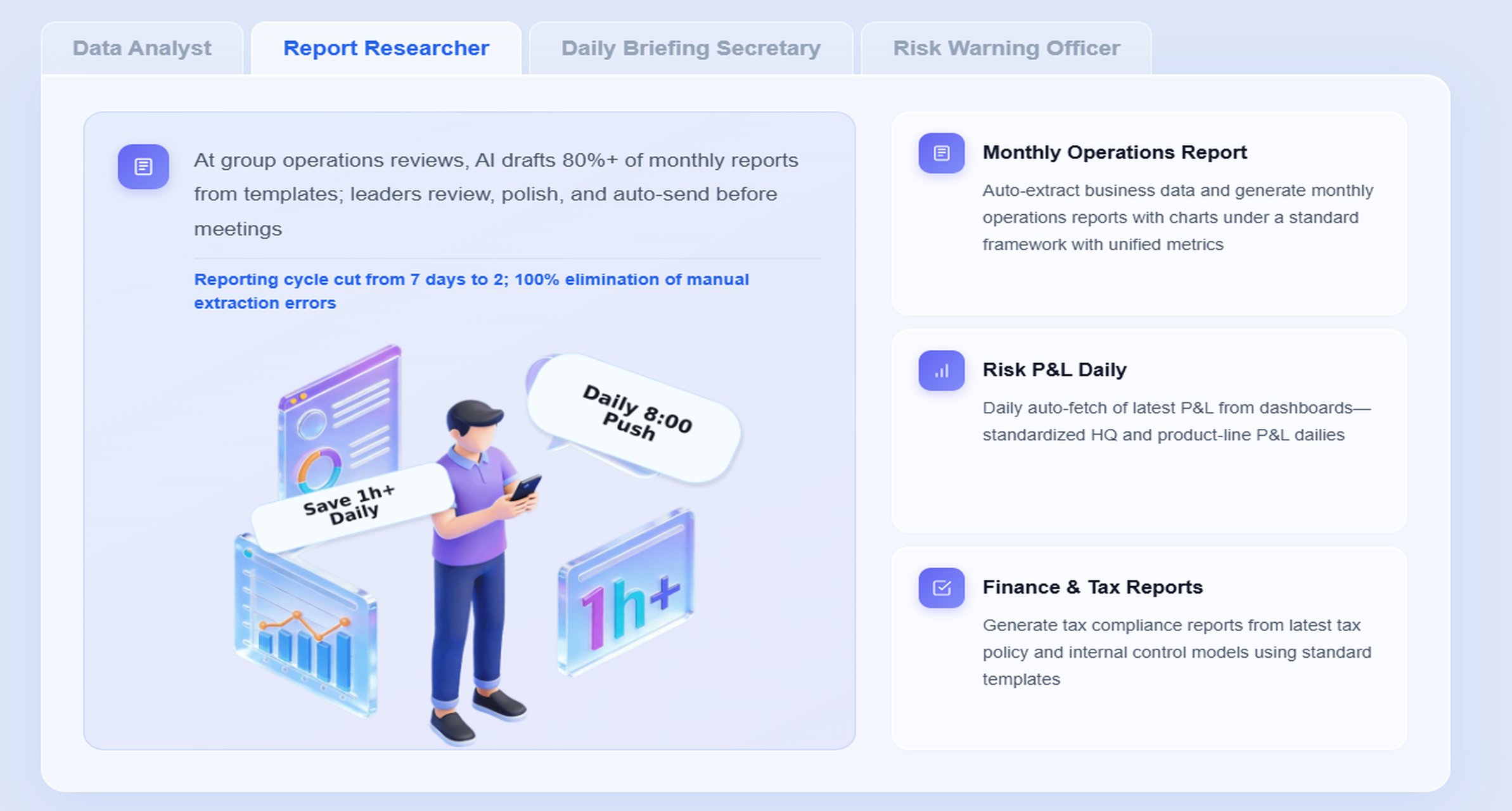
The most relevant Dora digital employee here is the Report Researcher, often combined with the Daily Briefing Secretary or Risk Alert Officer for recurring finance scenarios.
“Summarize this month’s finance management report, highlight abnormal operating expense changes above threshold, explain the main receivables risk areas, and list the departments that need follow-up.”
That is a much better enterprise pattern than asking a generic bot to interpret ungoverned spreadsheets from scratch.
Dora as a report researcher
Dora workflow for financial reporting AI bots
Retrieve trusted FineReport report or financial cockpit data
Dora pulls from the approved FineReport asset rather than relying on an unverified manual upload.
Understand KPI definitions, report templates, filters, and business terms
Dora uses the trusted semantic layer so terms like operating margin, overdue receivables, or budget variance are interpreted correctly.
Generate a structured report summary through chat
Dora returns a management-ready narrative, chart explanation, or section-by-section summary linked to the source report.
Detect exceptions or threshold breaches
Dora identifies abnormal changes, overdue items, risk concentrations, or unresolved issues when rules are configured.
Push summaries, alerts, or actions to responsible users
The AI assistant can send scheduled briefings or exception notifications to authorized stakeholders.
Produce follow-up records for review
Dora supports governance by helping teams track what was flagged, who owns it, and what needs review next.
Why this approach is safer and more practical
This model works because it separates responsibilities clearly:
FineReport builds the trusted reporting foundation with templates, permissions, formatted reports, operational cockpits, and governance.
Dora turns that foundation into a scenario-specific AI assistant or AI digital employee for report consumption and follow-up.
That improves enterprise landing capability because the AI is not operating blindly. It is constrained by report assets, permissions, KPI definitions, and reusable Skills. Compared with raw prompt-only agents, this approach is better aligned to lower token waste, improve response speed, and increase workflow stability in real business use.
Actionable best practices
To use financial reporting AI bots responsibly, start with a small number of high-value workflows and design for control from day one.
1. Standardize report templates, KPI definitions, and business terms first
If finance teams use different definitions for the same metric, AI will amplify confusion.
Create standard definitions for:
revenue and margin views
budget vs. actual logic
variance thresholds
overdue categories
entity and department mappings
approved report layouts
This is exactly where FineReport creates long-term value as the reporting foundation.
2. Start with recurring high-value reports, not every finance document
A better first step is a controlled use case like:
These are repeatable, high-friction tasks where Dora can act as a digital employee with clear boundaries.
3. Build a semantic layer inside the reporting workflow
This is AI-specific and essential.
Do not let the AI guess what your KPIs mean. Define the semantic rules behind your reports so the assistant can retrieve and explain trusted metrics consistently. FineReport provides the report and metric foundation, while Dora consumes that semantic structure for governed AI workflows.
4. Treat data quality as part of the AI implementation
AI cannot fix poor source data or inconsistent report logic. Finance and IT should jointly validate:
5. Preserve permission governance and human review
This is the second must-have AI-specific practice.
AI outputs should respect FineReport access boundaries. And for formal reporting, human review should remain in control. Start with assisted summaries and controlled alerts. Expand Dora Skills gradually as the workflow proves stable and auditable.
A governance-first approach to building trust
The trust question around financial reporting AI bots is really a governance question.
If a team uses a generic bot with raw uploads, weak permissions, and no review process, the answer is simple: trust should be limited.
If an enterprise standardizes trusted reporting assets, controls permissions, defines KPI logic, applies human review, and uses AI in governed workflows, then AI can support finance safely and productively.
Building this manually is complex. FineReport helps teams standardize trusted reports, operational cockpits, templates, and reporting workflows. Dora turns those assets into an AI assistant that can answer report questions in chat, generate structured summaries, push scheduled briefings, monitor exceptions, and follow up with responsible owners.
FineReport + Dora is not only a reporting upgrade; it is a practical fourth-generation Agentic BI path. FineReport provides governed reports and operational cockpits. Dora provides the AI assistant layer for scenario execution, with more controlled Skills, lower token waste, faster execution paths, and more stable workflows than prompt-only agents.
The strongest Dora pitch is scenario + product + service: FineReport provides the trusted reporting foundation, Dora provides the AI digital employee, and implementation service connects data, governance, semantic setup, Skills, report templates, permissions, and rollout.
The bottom line for CFOs and finance teams is straightforward: yes, financial reporting AI bots can be used responsibly—but only when security, privacy, reporting governance, and human judgment remain in control.
They can be trusted only when they operate on a governed reporting foundation with strong access controls, encryption, audit logs, and clear retention policies. Public or unmanaged tools are much riskier for sensitive financial reporting work.
The main risks are data exposure during upload, processing, or storage, unauthorized access, unclear prompt retention, and inaccurate outputs being reused in official reporting. Risk also rises when employees paste raw financial files into general AI tools.
A safer approach is to let AI work from approved reports, governed dashboards, and trusted KPI definitions instead of raw file uploads. Teams should also enforce role-based permissions, human review, and clear policies on what data can be shared.
They should require encryption, secure integrations, role-based access, data residency and retention settings, prompt and action audit trails, and human approval for report distribution. Governance over metric definitions and workflow actions is just as important as model quality.
FineReport plus Dora is positioned around trusted report assets rather than uncontrolled uploads, which helps preserve reporting consistency and governance. It also supports structured summaries, scheduled briefings, and follow-up workflows within a more controlled enterprise reporting environment.
Product Trial
FineReport
Pixel-perfect reports · Interactive dashboards · Easy data entry · Digital twins


 Natural-language Query
 Dora as a report researcher