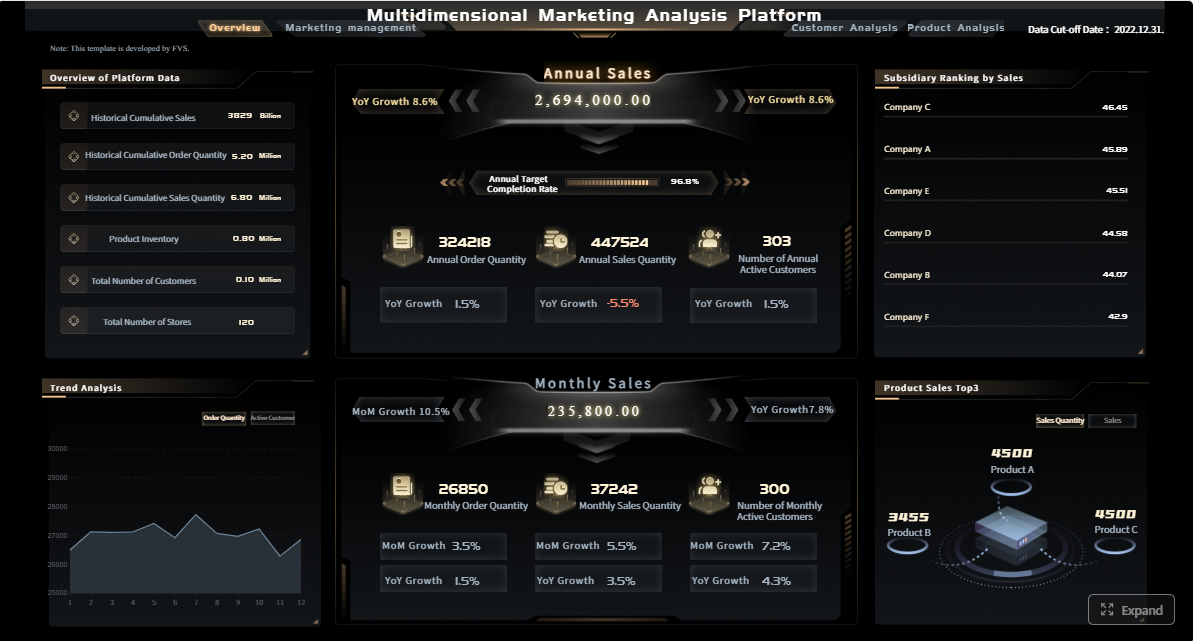
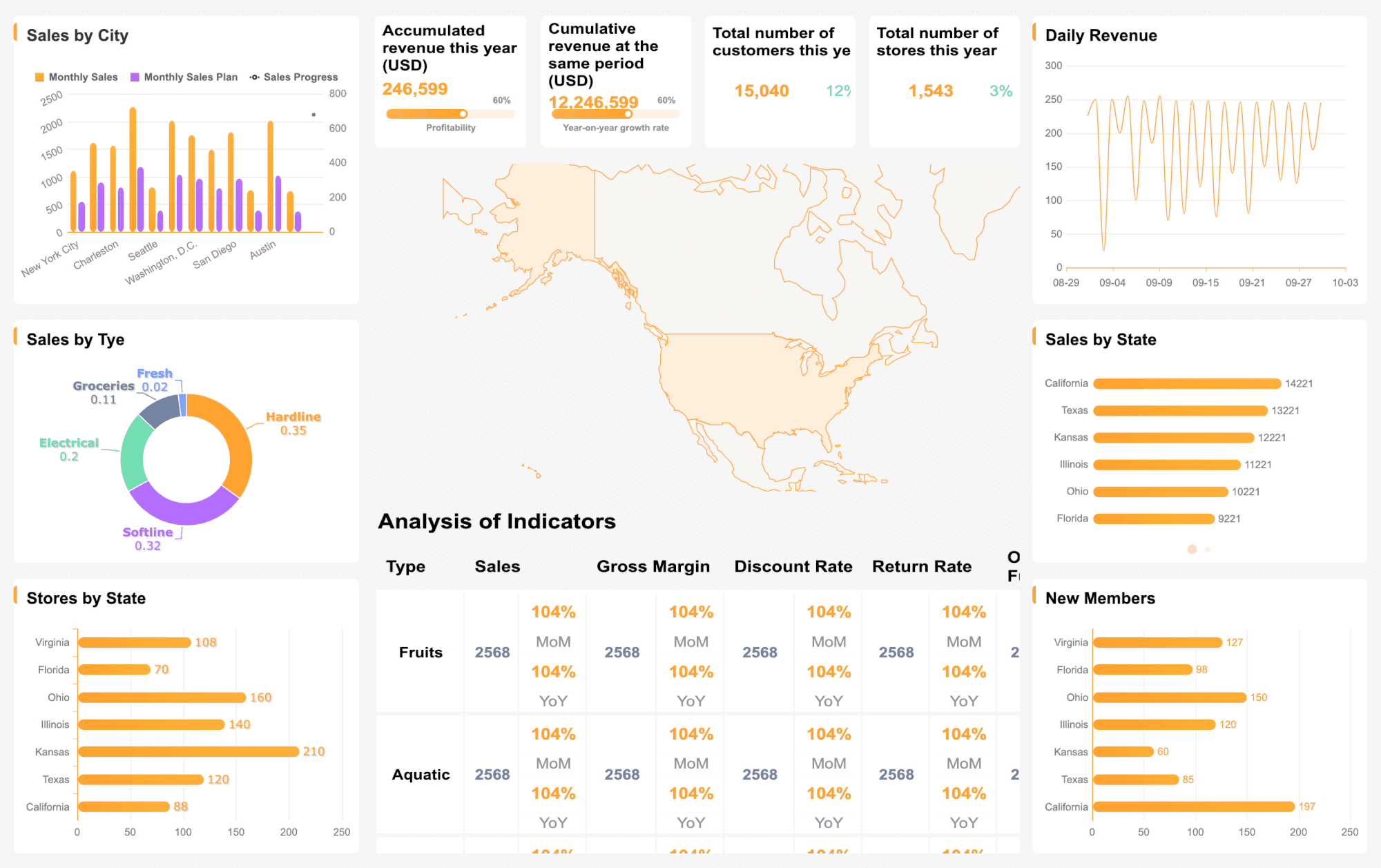
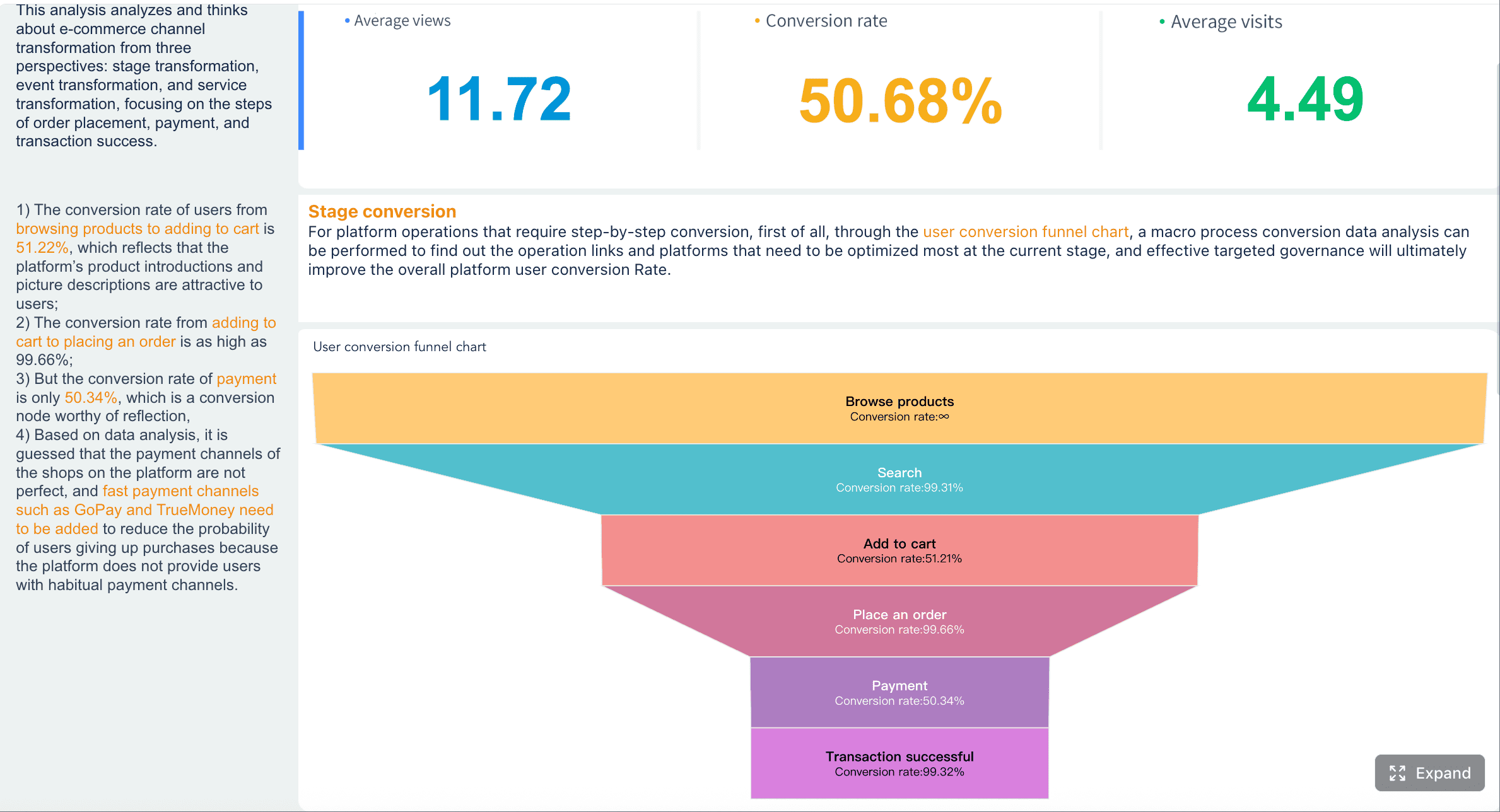
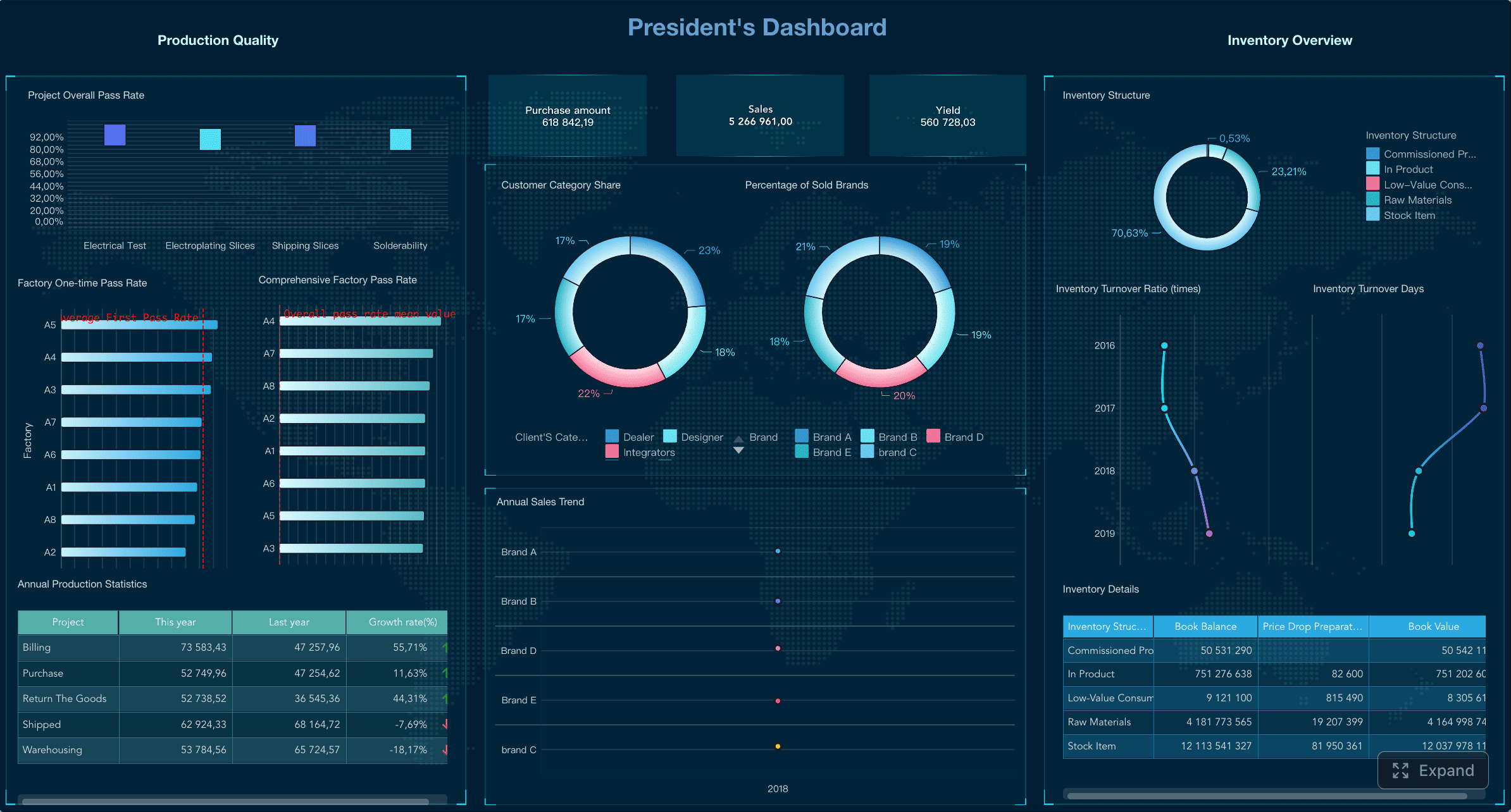
A strong marketing report template is not just a formatting tool. It is a decision-making system that helps marketing managers, CMOs, performance teams, and operations leaders turn scattered channel data into clear business action. When reporting is inconsistent, stakeholders lose trust, teams chase vanity metrics, and budget decisions get delayed. A well-built template fixes that by standardizing what gets reported, how results are interpreted, and what actions come next.
All reports in this article are built with FineReport.
What a marketing report template should accomplish
A useful marketing report template should make reporting faster, more consistent, and more actionable. It should help teams answer three questions quickly: What happened, why did it happen, and what should we do next?
For enterprise teams, this matters because reporting often serves multiple audiences at once. Channel specialists want tactical detail. Marketing leadership wants business impact. Finance and executives want efficiency, trend direction, and forecast confidence. A good template keeps all of that aligned without becoming bloated.
Core elements every marketing report template should include
Purpose definition: States whether the report is for monthly review, campaign analysis, executive updates, or board-level presentation.
Audience alignment: Tailors the level of detail to leadership, channel owners, or cross-functional stakeholders.
Time-period consistency: Uses standardized date ranges so month-over-month and quarter-over-quarter comparisons remain valid.
Goal-to-KPI mapping: Connects each reported metric to a business objective, not just platform availability.
Cross-channel comparability: Makes it easy to compare SEO, paid media, email, social, and content using common logic.
Insight layer: Explains performance drivers instead of dumping raw numbers.
Action framework: Ends with next steps, owners, and expected impact.
Key Metrics (KPIs)
Below are the most important KPI categories to structure into a high-performing marketing report template:
Traffic: Total visits, sessions, or users generated across channels.
Lead volume: Number of qualified or unqualified leads captured in the reporting period.
Conversion rate: Percentage of traffic or leads that completed a desired action.
Revenue: Attributed revenue generated by campaigns, channels, or segments.
Customer acquisition cost (CAC): Total spend required to acquire a customer.
Return on ad spend (ROAS): Revenue generated for every dollar spent on paid campaigns.
Cost per lead (CPL): Average spend to acquire a lead.
Click-through rate (CTR): Percentage of impressions that generated clicks.
Cost per click (CPC): Average cost incurred per ad click.
Engagement rate: Interaction level with content, emails, or social posts.
Pipeline contribution: Marketing’s impact on opportunities or sales pipeline value.
Forecast pacing: Progress toward monthly, quarterly, or campaign goals.
Core sections to include in a marketing report template
A complete marketing report template should follow a predictable structure. This makes it easier for stakeholders to scan reports quickly and compare performance across reporting periods.
Executive summary
The executive summary is the first section decision-makers read, and often the only section some executives will read in detail. It should present the reporting period, scope, top outcomes, and biggest changes in clear business language.
This section should answer:
What was the reporting period?
What were the top wins and losses?
Which result mattered most to leadership?
What changed materially from the last period?
Keep it concise, but specific. Avoid generic language like “campaigns performed well.” Say instead: “Paid search conversions increased 18% month over month, while email revenue declined 9% due to lower click-through rates from promotional sends.”
Goals, KPIs, and benchmarks
This section defines what success means. Every campaign objective should be mapped to a measurable KPI, and every KPI should be shown with target, actual, and comparison context.
Include:
Current-period actuals
Target values
Prior-period comparisons
Year-over-year context where useful
Industry or internal benchmarks
This is also the right place to separate vanity metrics from metrics that actually support decisions. Impressions and reach may matter for awareness, but they should not crowd out indicators like conversion rate, CAC, pipeline contribution, or attributed revenue.
Best-practice KPI structure
Goal
KPI
Target
Actual
Prior Period
Benchmark
Status
Generate leads
Qualified leads
800
760
710
750
Slightly below target
Improve paid efficiency
ROAS
4.0x
4.6x
3.9x
4.2x
Exceeded
Grow organic traffic
Organic sessions
120,000
126,500
118,300
121,000
Exceeded
Increase conversion
Landing page CVR
3.5%
3.1%
3.4%
3.2%
Needs improvement
Channel performance overview
This is where the report becomes operationally useful. Break down results by major channel such as SEO, paid media, email, social, and content marketing. For each channel, show both efficiency and business outcomes.
A solid channel performance section typically includes:
Traffic or reach
Conversions or leads
Cost or spend
Engagement metrics
Revenue or return
Notes on what drove change
Consistency matters here. If one channel is measured by clicks and another by sessions without explanation, stakeholders will struggle to compare performance.
Email: Sends, open rate, click rate, unsubscribe rate, conversions, revenue
Social media: Reach, engagement rate, follower growth, clicks, assisted conversions
Content marketing: Pageviews, average engagement time, downloads, leads, influenced pipeline
Insights, actions, and next steps
The best reports do not stop at performance summaries. They explain what changed and what should happen next.
For example, instead of reporting that paid social CPL rose by 22%, explain the likely drivers: audience saturation, weaker creative performance, or increased competition in the auction. Then recommend the next move: refresh creatives, tighten audience segmentation, or reallocate spend to a stronger campaign set.
This section should include:
Root-cause insights
Recommended optimizations
Budget shift suggestions
Follow-up analysis requests
Owners and due dates
KPIs that matter most in different marketing report template types
Not every marketing report template should look the same. The KPI mix should match the report’s purpose and audience.
Monthly reporting KPIs
Monthly marketing reporting should balance operational detail with strategic pacing. It is the right cadence for spotting trends before they become expensive problems.
Focus on:
Leads
Conversions
Revenue
CAC
ROAS
Traffic trends
Engagement trends
Progress toward quarterly goals
The key is to show movement over time, not isolated snapshots. Month-over-month direction often matters more than a single-period total.
Digital marketing campaign KPIs
Campaign-level reporting should be more granular. It needs to reveal where performance is strong, where leakage exists, and which assets or audiences deserve more investment.
Critical campaign KPIs include:
Impressions
Clicks
CTR
CPC
Conversion rate
CPL
Attributed revenue
Landing page performance
Audience or segment performance
When relevant, include creative-level or audience-level insights. A campaign may look healthy at the top line while underperforming in a key audience segment.
Stakeholder and leadership KPIs
Leadership reporting should emphasize business impact over platform detail. Executives usually need to understand whether marketing is efficient, predictable, and aligned with growth targets.
Prioritize:
Revenue contribution
Pipeline influence
CAC
ROAS
Budget utilization
Forecast accuracy
Resource efficiency
Risk areas and opportunities
Keep technical detail concise. The report should connect performance to strategic implications such as growth pacing, channel mix quality, and budget reallocation needs.
Slide-by-slide structure for presenting a marketing report
A presentation-ready marketing report template should work as both a document and a slide deck. That means each section should translate cleanly into a story stakeholders can follow in 10 slides or fewer.
Slide 1–3: Context and headline results
The first three slides should establish the reporting scope and top-line outcomes immediately.
Slide 1: Title slide
Reporting period
Team or business unit
Scope of channels or campaigns covered
Slide 2: Executive summary
Top findings
Biggest wins and risks
One-line takeaway for leadership
Slide 3: Goals and KPI snapshot
Target vs actual
Variance to plan
Status indicators
Slide 4–7: Channel and campaign analysis
This is the analytical core of the presentation. Use one slide per major channel or campaign group. Keep the layout consistent so comparisons are intuitive.
Each slide should include:
Trend line or period comparison
Top contributors
Underperformers
Notable anomalies
Short interpretation notes
Consistency in chart type, color logic, and KPI placement reduces cognitive load for the audience.
Slide 8–10: Insights, recommendations, and action plan
End with decisions, not just observations. This is where the report becomes a management tool instead of a status update.
Slide 8: Key lessons
What the team learned this period
Which assumptions were validated or disproven
Slide 9: Recommended optimizations
Tests to run
Budget shifts
Messaging or audience changes
Slide 10: Action plan
Owners
Timelines
Expected business impact
How to choose and customize the right marketing report template
The best marketing report template depends on your reporting cadence, audience, data maturity, and decision environment. A template that works for a channel manager may not work for a VP of Marketing.
Spreadsheet, dashboard, and slide deck options
Each reporting format serves a different purpose.
Spreadsheets are best for flexible analysis, recurring monthly tracking, and manual data review.
Dashboards are best for live monitoring, faster access, and ongoing visibility across teams.
Slide decks are best for storytelling, stakeholder communication, and formal review meetings.
In practice, mature marketing organizations use all three. The spreadsheet supports analysis, the dashboard supports monitoring, and the slide deck supports executive communication.
Templates, samples, and editable versions to look for
When evaluating a template, focus less on visual style and more on reporting logic.
Look for templates that offer:
Clear executive summary space
KPI targets and benchmark fields
Channel-by-channel modular sections
Editable commentary boxes for insights
Action plan fields with owners and deadlines
Reusable layouts for monthly and quarterly reporting
A template should be easy to update, print, present, and share without needing a redesign every reporting cycle.
Common mistakes to avoid
Many reports fail because they confuse activity with insight. The most common problems are avoidable.
Avoid these reporting mistakes
Too many metrics, not enough interpretation
If every platform metric is included, the signal gets buried.
Inconsistent date ranges
Comparing channels with different reporting windows creates false conclusions.
Mixed attribution logic
Using different attribution models in the same report undermines trust.
No benchmark context
A metric without target or baseline is hard to interpret.
No recommendations section
A report should end with a decision or next action, not just a summary.
Actionable best practices for building a high-performing marketing report template
If you want your marketing report template to drive action across teams and leadership, build it with discipline. These are the same practices experienced consultants use when standardizing reporting for scaling marketing organizations.
1. Start with business questions, not data exports
Define the decisions the report should support before choosing metrics. For example:
Should we increase budget in paid search?
Is organic growth pacing toward quarterly pipeline goals?
Which campaign should be paused, optimized, or scaled?
This prevents reports from becoming dumps of whatever the platforms happen to provide.
2. Build one KPI hierarchy for every report
Create a reporting hierarchy with three levels:
Top-line business outcomes: revenue, pipeline, CAC, ROAS
Ensure every KPI ties to a goal or business question
Check benchmark and prior-period comparisons
Make sure visuals are readable and labels are clear
Validate attribution model consistency
Remove low-value metrics that do not support decisions
Confirm insights explain why performance changed
End with actions, owners, and the main takeaway
Build a marketing report template that scales with FineReport
Building this manually is complex; use FineReport to utilize ready-made templates and automate this entire workflow.
For growing marketing teams, the challenge is rarely a lack of data. The challenge is structuring that data into a reporting system that is accurate, repeatable, stakeholder-friendly, and presentation-ready. FineReport helps solve that by combining dashboarding, report design, cross-source integration, and executive-ready visualization in one environment.
A strong marketing report template should include an executive summary, goal-to-KPI mapping, benchmark comparisons, channel performance, key insights, and clear next steps. The goal is to show what happened, why it happened, and what actions should follow.
The most important KPIs depend on your goals, but common core metrics include traffic, leads, conversion rate, revenue, CAC, ROAS, CPL, and pipeline contribution. Focus on metrics that connect marketing activity to business outcomes rather than vanity numbers alone.
A monthly marketing report usually starts with an executive summary, then moves into KPI performance versus targets, channel-by-channel analysis, insights on performance drivers, and an action plan. This structure makes it easier for stakeholders to scan results quickly and compare trends over time.
Keep the report concise, emphasize business impact, and highlight major wins, losses, and shifts from the previous period. Executives usually want clear trends, efficiency metrics, and recommended actions more than detailed platform-level data.
Standardization improves consistency, saves reporting time, and makes results easier to compare across campaigns and periods. It also helps teams build trust with stakeholders by using the same logic, definitions, and decision framework every time.
Product Trial
FineReport
Pixel-perfect reports · Interactive dashboards · Easy data entry · Digital twins