
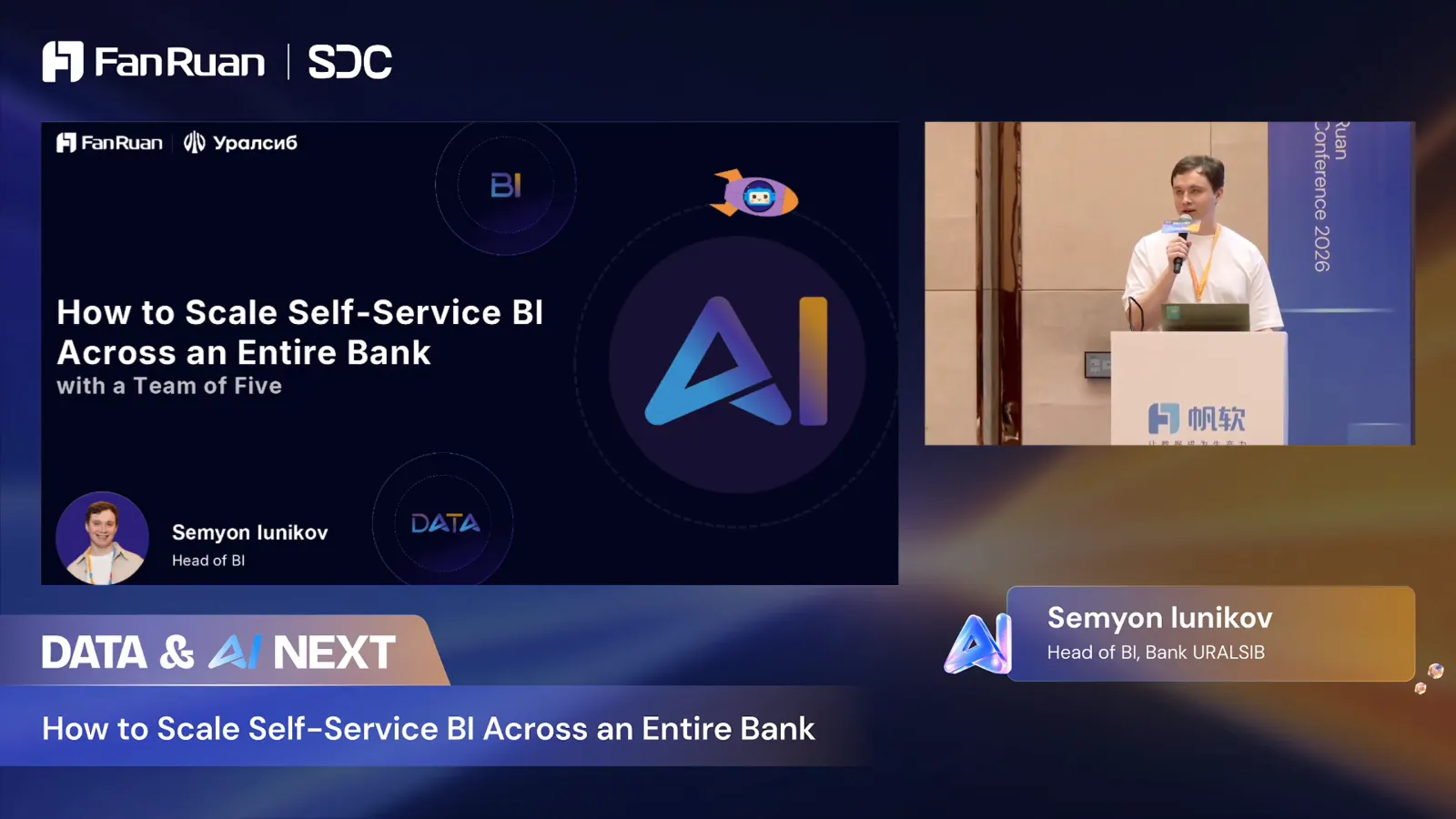


When Business Teams Build Their Own Dashboards: Governance Challenges for a 5-Person BI Team
Semyon Yunikov is Head of BI at Uralsib Bank. His team consists of just five people, yet they are responsible for supporting the bank-wide self-service BI platform.Each team member has a clearly defined role: Semyon oversees overall strategy and complex analytics development; Ksyusha and Andrey handle technical and user support; Vadim serves as the BI trainer; and Julianna develops complex analytics to meet business and internal needs.
The team is responsible for platform support, user support, BI development, and establishing unified standards. Business teams, in turn, are responsible for dashboard development, data ownership, and accountability for dashboard content and usage.
This division of responsibilities enables business teams to independently meet their own analytical needs, but it also creates challenges for governance at scale. Dashboard numbers fluctuate from month to month, and some dashboards are no longer needed once their tasks are completed. Duplicate content, refresh failures, and changes to internal dashboard links are recurring issues, while support requests continue to grow.How can a five-person team keep the platform stable, enable self-service for users, and maintain dashboard quality? This is the key question the Uralsib Bank BI team must answer.
FineBI at the Core: Building a Self-Service Analytics Platform with Controlled Resources
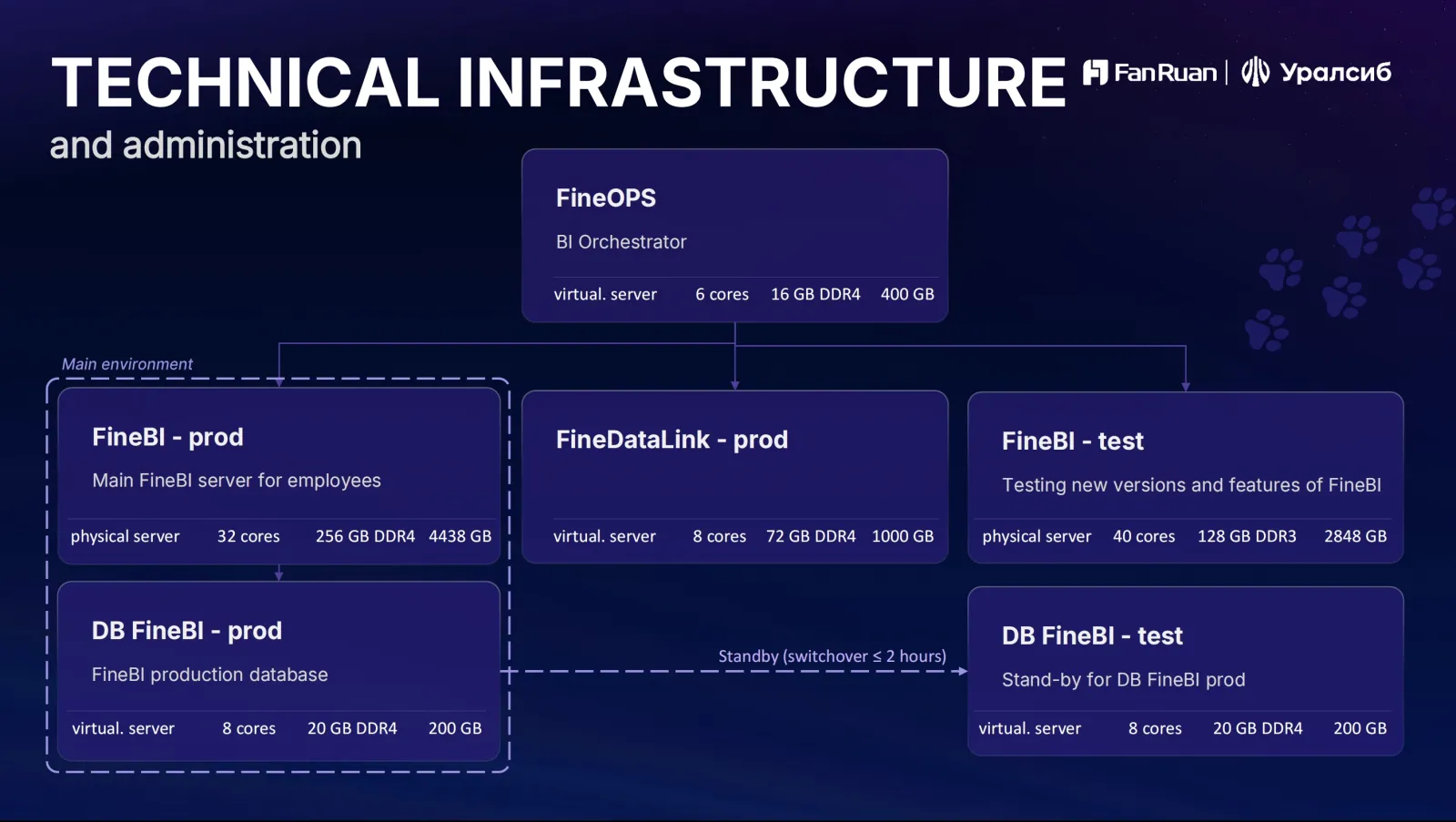
To enable a five-person team to support self-service analytics across the bank, Uralsib Bank built its platform architecture around FineBI, complemented by FineDataLink, FineDB, and FineOPS.FineOPS serves as the BI orchestrator, overseeing overall scheduling. The production environment includes FineBI-prod, FineDataLink-prod, and DB FineBI-prod, while the test environment consists of FineBI-test and DB FineBI-test. A standby mechanism is also in place, with a switchover time of no more than two hours.
This architecture enables the BI team to support extensive analytical demands while keeping resource usage under control.
Connectors, datasets, tasks, and dashboards across the platform are managed centrally. The system automatically monitors duplicate objects, newly added objects, unused objects, and resource consumption.When a developer’s dashboard encounters an issue, the system sends notifications via email, the FineBI homepage, and enterprise communication tools, enabling developers to troubleshoot and resolve issues themselves.
The platform also performs load analysis and optimization. AI analyzes SQL queries with high resource consumption and generates improved versions, which are automatically delivered to developers for review. Developers can then decide whether to adopt the suggested optimizations.
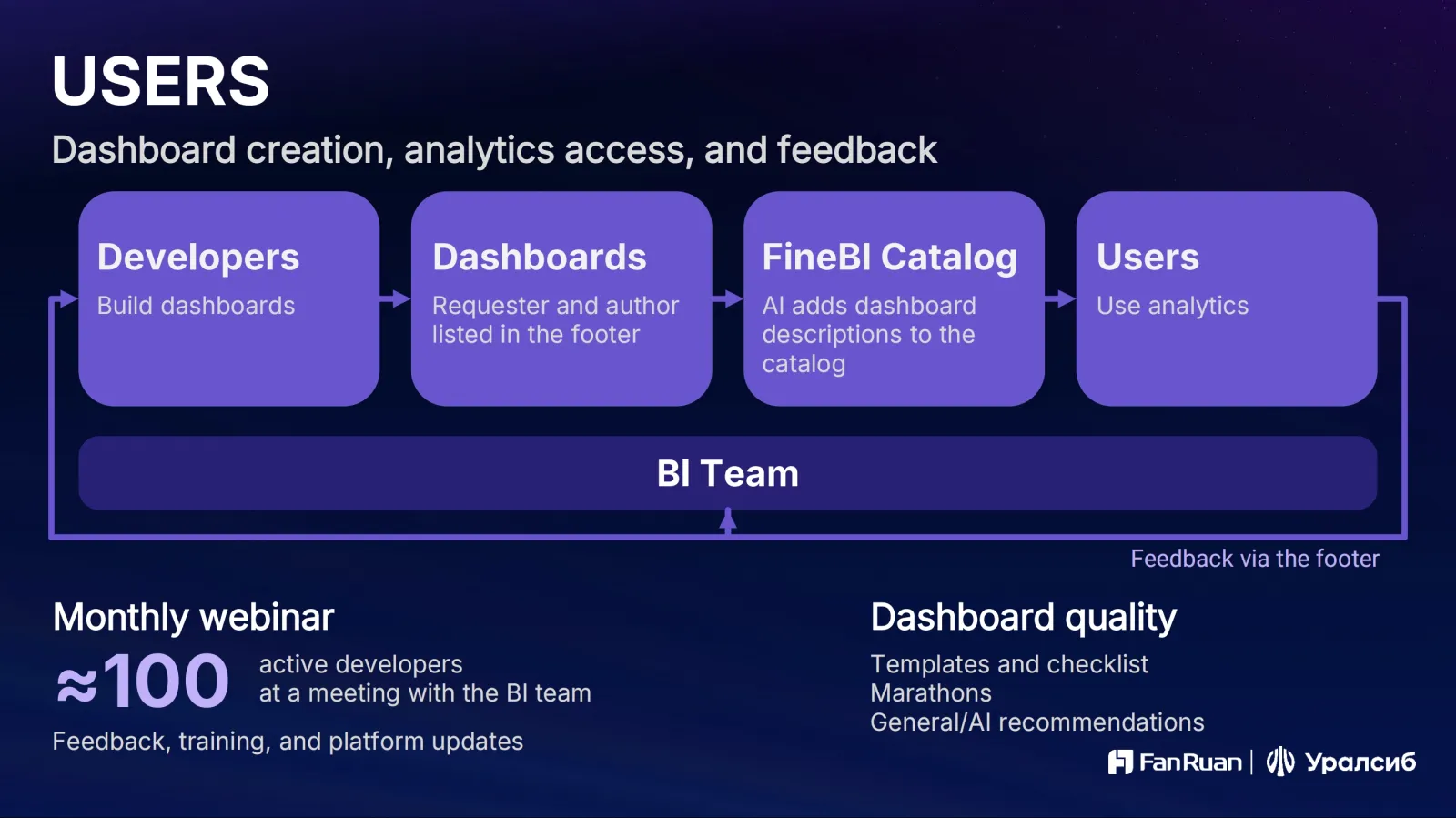
Developers are responsible for building dashboards, with the requester and author listed in each dashboard’s footer to ensure traceability. FineBI Catalog uses AI to automatically generate dashboard descriptions, eliminating the need for developers to write them manually.
Users can browse the catalog to find relevant analytics and use the dashboards. Meanwhile, the BI team collects feedback, provides training, and announces platform updates through dashboard footers, monthly webinars, and meetings with approximately 100 active developers.Dashboard quality is continuously improved through templates, checklists, marathons, and AI-generated recommendations.
AI and Automation: 1,500 Support Requests and a 98% Dashboard Load Success Rate
As the platform scales, AI and automation become central to its operations. For dashboard descriptions, the system collects text from dashboards, including component names, axes, calculations, and tooltip text, and sends it to ClickHouse. AI then generates descriptions, which are added to FineBI Catalog.This enables every dashboard to “describe itself,” significantly reducing the effort developers spend writing descriptions manually.
The support system also runs on automation. Over eight months, Uralsib Bank handled 1,500 support requests, with the number of requests closed increasing by 60% year over year and an average support rating of 4.98 out of 5.Support requests are routed to the appropriate teams: dashboard-related issues are handled by dashboard developers, while platform-related issues are managed by the support team. Team members also provide backup for one another when needed.
The platform also automates authorization, logging, and alerting workflows, while an AI support assistant called BI Guru is currently being tested. BI Guru draws on FanRuan documentation, the AI catalog, internal training materials, and the knowledge base, supplemented with ready-made answers and scripts. It helps the support team find information and prepare responses more quickly, while enabling users to resolve issues independently without submitting support tickets.
To monitor server load, Uralsib Bank focuses on dashboard loading times and table refresh delays. Performance is analyzed daily, hourly, weekly, and monthly, comparing loading and viewing rates during business hours against predefined thresholds.The results show that 98% of dashboards load within 3 seconds during business hours, and 99% of table loads begin within a 60-minute delay window.
From Onboarding to Advanced Skills: Empowering 1,000 Users and 44 Developers
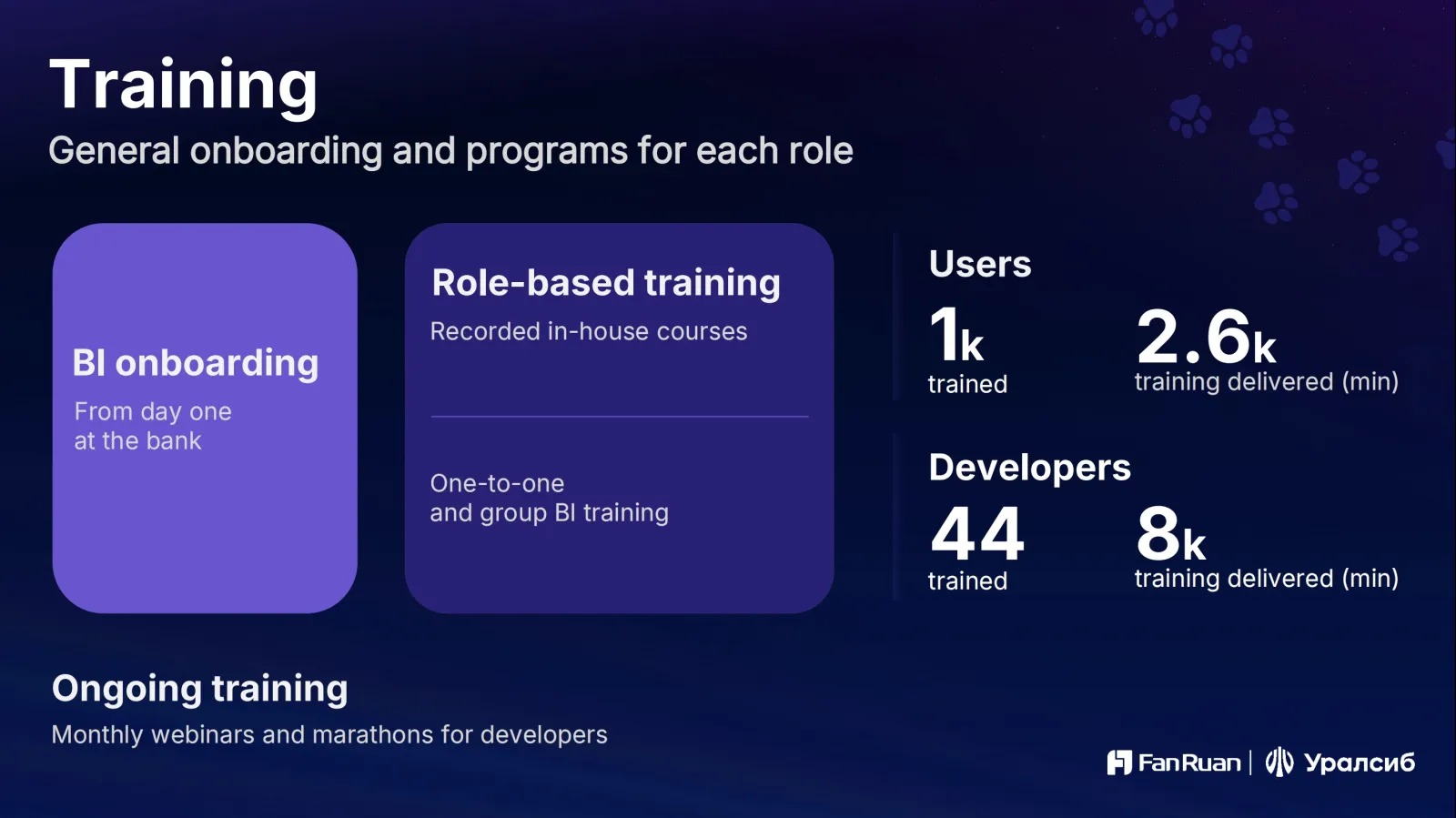
For self-service BI to succeed, user adoption must be supported by effective training. At Uralsib Bank, the training journey begins on the first day of employment with BI onboarding, followed by role-specific courses.Role-based training primarily consists of internally recorded courses, complemented by one-on-one and small-group BI training sessions. Ongoing learning is delivered through monthly webinars and marathons.
Over the past year, Uralsib Bank trained 1,000 users, totaling 2,600 minutes of training, and 44 developers, totaling 8,000 minutes.Behind these figures is the BI team’s commitment to treating training as a pillar of equal importance to the platform and support. This ensures that both users and developers can find their own paths to growth within the platform.
Turning Dashboard Governance into a Game: 80 Developers Tackling Challenges Together
Beyond training and automation, Uralsib Bank has also incorporated gamification into governance. The team designed a pixel-art game called “BI Challenge,” where participants have their own characters and progress through levels by completing tasks. Each task comes with a list of resources and requirements to help developers improve their dashboards and learn more about the platform’s features.
The challenge featured seven levels and attracted 80 developers, covering more than 1,500 datasets and 800 dashboards, and reaching 2,000 users. Results were tracked automatically by the system, with a trip to China as the grand prize.
The challenge delivered significant governance improvements: dashboard errors decreased from over 100 to 40; dashboard footer coverage increased from 48 to 244; the number of users adopting incremental updates grew from 6 to 17; and business requester labels on dashboards increased from 0 to 182.
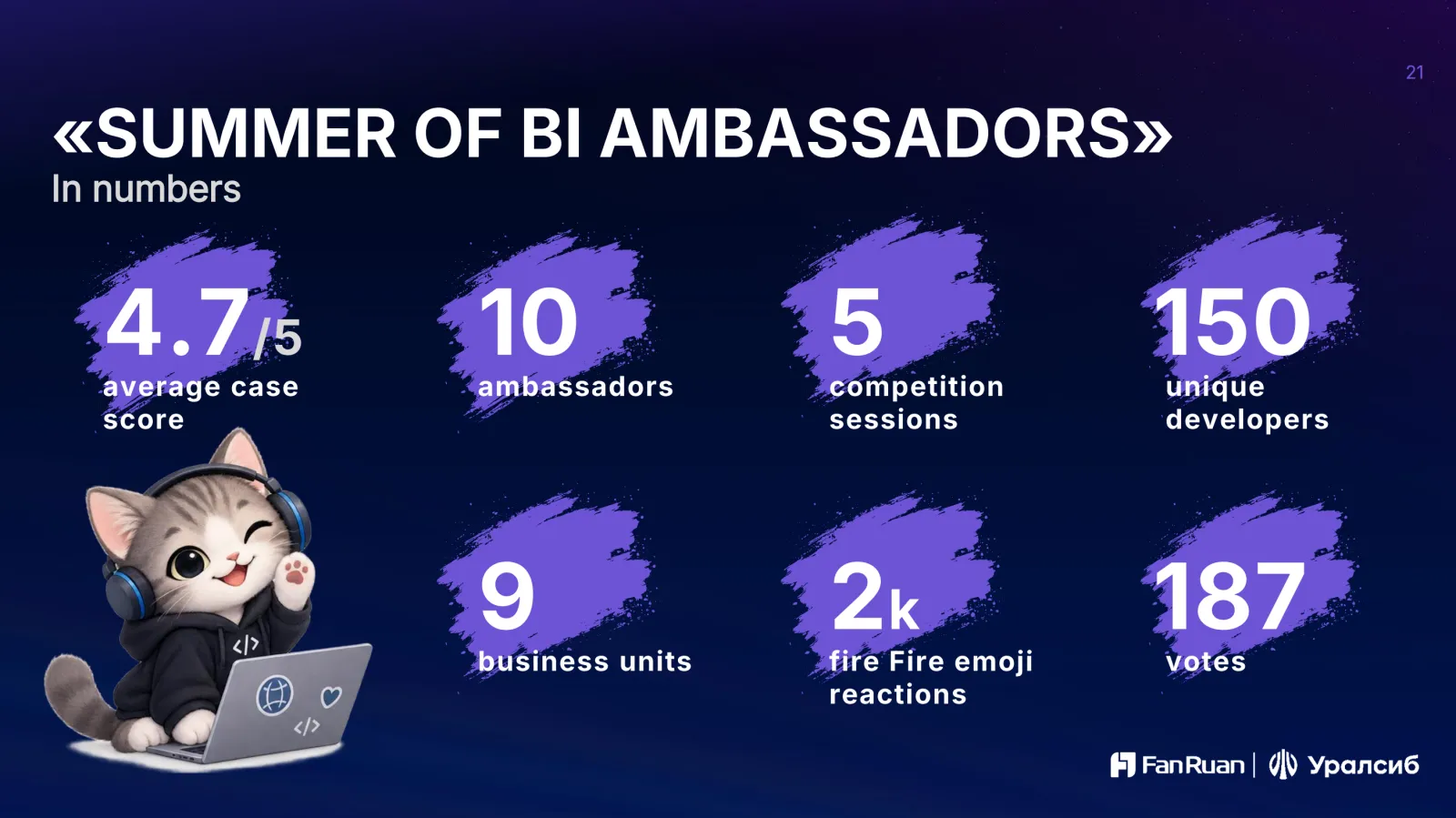
Another initiative, “Summer of BI Ambassadors,” invited developers to share their work, demonstrate how they use BI, and become BI ambassadors.The initiative brought together 10 ambassadors across five rounds of competition, with 150 unique developers participating and nine business units represented. It generated 2,000 Fire emoji reactions and 187 votes, with an average case study rating of 4.7 out of 5.The initiative emphasized reproducibility, practicality, and clarity.
Ambassadors could also choose cat images that matched their moods, adding a touch of fun to developers’ daily work.Uralsib Bank has also fostered a warm and approachable brand identity through cat imagery, informal communication, and a friendly tone, encouraging users and developers to engage more actively in the BI community.
Proving Scalability with a Five-Person Team: Self-Service BI Doesn’t Require a Large Team
These efforts are reflected in a set of impressive figures. The platform currently supports 12,000 analytical datasets, 1,600 published dashboards, and approximately 1,000 data flows per day. It serves 2,600 unique users each month, with 300 developers contributing to the platform.All of this is supported by a BI team of just five people.
Semyon Yunikov states: “Our experience shows that a five-person team can support and improve a large-scale system.”Through system governance, AI and automation, tiered training, and gamified operations, Uralsib Bank has demonstrated that scaling self-service BI does not require a large team. Instead, platform capabilities, automation, and a strong community culture can make data an integral part of everyday operations across the bank.