
AI & Data
How AI Agents will fix broken workflows, and 3-steps roadmap enterprise leaders must follow today.
The Dawn of Agentic AI
Where exactly do we stand right now? Absolutely no one can say for sure anymore. In the blink of an eye, the chatbots have stopped talking and started frantically clicking the mouse on your behalf. Have we entered the age of agentic AI? Or is this an infrastructure supercycle?
The release of new models simply will not stop. Claude Sonnet 4.6 crashed the party in mid-February, taking complete control of your desktop. Gemini 3.1 Pro debuted around the exact same time, effortlessly crushing the ARC-AGI-2 benchmark with a 77.1% score and doubling logical reasoning metrics overnight. OpenAI locked Codex inside a pure whiteboard environment for 25 hours; when it emerged, it brought out 30,000 lines of code and a standalone, independently developed design tool. In late February, the academic world threw FDM-1 to the public, granting everyone free access to a computer action model. The pure software era has turned the page. Digital laborers are officially in position. They are scrolling your mouse, and they will never, ever clock out.
Executives running traditional IT companies are breaking into a cold sweat; they watched helplessly as IBM’s market cap evaporated by 13% in a matter of hours, simply because Wall Street suddenly woke up to the reality that an algorithm could rewrite decades of legacy COBOL code before breakfast. SaaS middlemen are watching their business models turn to ash. Meanwhile, the companies training foundational large models are vacuuming up capital at a scale that defies gravity. OpenAI just casually swept up a $110 billion mega-round at a staggering $730 billion valuation, dragging SoftBank, Nvidia, and AWS into the fray merely to keep their server racks from melting down. AMD just snatched a massive order away from Meta. Nvidia remains the unshakeable god.
Every morning, we scroll through this panic-inducing tech news on our daily commute. Then, we walk into the office, sit down at our desks, and the business line leader walks over to ask you: why hasn’t the sales team updated the customer relationship management system for three straight weeks?
The cognitive dissonance is absolutely deafening. We seem to be only weeks away from an omniscient, omnipotent AI, yet internal enterprise workflows are still firmly stuck in the Stone Age. This is the stark, unvarnished dilemma facing the vast majority of enterprises today.
The Enterprise Workflow Dilemma
Recently, I received a consultation request from a mid-to-large enterprise with highly complex operations. Their chief executive officer had incidentally stumbled upon a customer power map, covertly mapped out by a regional sales pod desperately trying to land a massive account.
As defined by Harvard Business School, a power map is a visual framework used to identify who holds influence and authority in a given situation, helping strategists navigate complex organizational dynamics.
The chief executive officer was absolutely thrilled with the tool. He immediately issued a top-down mandate to roll this methodology out across the entire group, attempting to break down silos and integrate data across the sales operations center, the service operations center, and various independent business units to form a single, unified global view.
From the perspective of decision intelligence, this vision is practically bulletproof. Modern enterprise clients frequently purchase products across multiple business units simultaneously; they require intense upfront sales engagement and rely heavily on post-sales technical support. If information fractures anywhere along the line, the organization’s understanding of the customer becomes severely distorted. Yet, when this company actually attempted to build out this workflow, they slammed violently into two insurmountable walls.
The agonizing friction of internal alignment: Simply to standardize the data fields for this map, communication costs exploded exponentially. The massive cross-functional span resulted in a chaotic tangle of information and completely irreconcilable demands. Teams spent weeks arguing endlessly in conference rooms, only to repeatedly report back up the chain for approval.
The maintenance death spiral: Even after deployment, the subsequent daily data upkeep became an absolute operational disaster. You simply cannot expect exhausted frontline sales representatives to enthusiastically log into a clunky system late at night just to manually update subtle shifts in a client’s organizational hierarchy. The moment data entry slacked, the accuracy of the entire database collapsed.
So, caught in the middle of this tech hurricane, how are we actually supposed to tackle these two very real bottlenecks?
The Paradigm Shift to Machine-Readable Data
A recent insight shared by Brian Flynn offers exactly the perspective we need to break this deadlock. He astutely points out that the entire history of sales has essentially been about capturing human attention. But Flynn is absolutely right: AI agents don’t browse; they query.
The traditional marketing playbook — relying on brand storytelling and emotional triggers — is completely useless on an AI. Its decision function is ruthlessly simple: Can you solve the problem? How fast? For how much? How reliable? When an agent can discover a service, compare prices, and execute a call all within a single HTTP request, historically high transaction costs rapidly plummet to zero.
Based on this, he arrives at a critical conclusion: we need to provide machine-readable APIs instead of merely trying to capture human attention.
If we internalize this logic, the internal workflows we are engineering today should absolutely no longer be designed just to generate pretty dashboards for executive review. Instead, they must be fundamentally built to silently accumulate high-quality, agent-readable data during daily operations.
Following this train of thought, AI agents execute a dimensional strike against the two aforementioned pain points:
Unstructured data ingestion obliterates alignment nightmares: In the future, frontline sales reps will simply throw raw data (meeting recordings, chat logs, web scrapes) straight into the internal AI knowledge base. The agent will automatically "pan for gold," dynamically piecing together relationships without the need for rigid forms.
On-demand retrieval solves the maintenance spiral: Digital agents will act like invisible assistants, automatically parsing emails and notes to update backend data in real-time. When needed, users can simply ask the AI for precise answers, exactly as they would a veteran colleague.
A Pragmatic 3-Step Roadmap
In this disorienting transition period, the pragmatic actions of management must focus intensely on three levels:
Inject AI awareness into the daily routine: Avoid "boiling the ocean." Force teams to get accustomed to lightweight tools for basic insight transport. For instance, mandate that the sales team use transcription and summarization tools to process customer meeting notes before logging takeaways.
Build a forward-deployed team that genuinely understands the business: Do not just hire external prompt engineers. Handpick internal experts who grasp your decision intelligence logic and pair them directly with the business lines. Their job is to surgically eradicate specific pain points using existing AI plugins.
Use low-cost tools to validate logic: Do not spend fortunes on heavy, customized software development yet. Use zero-code or low-code tools to run core workflow logic for a week or two. The objective is to definitively answer: what specific information do we actually need to capture?
Embracing True Decision Intelligence
When the inevitable day arrives that a mature AI agent completely rewrites the rules of enterprise software, those pragmatic companies will be entirely ready. Having already meticulously figured out their core business logic and successfully accumulated vast reserves of agent-readable data, they will be able to seamlessly leap into the true AI era with near-zero organizational friction.
We must soberly recognize that the shelf life of technological tools is shrinking. However, profound insights into commercial essence, a rigorously mapped internal decision chain, and high-quality business data assets will forever remain an enterprise’s most impregnable moat.
Meanwhile, those who are currently paralyzed by tech vertigo, who choose to do nothing but wait for the perfect system, will ultimately become the digital relics of this era. True decision intelligence will always belong to the pragmatists who keep laying down the tracks, even in the thickest of fogs.
Got questions? Ping me on Linkedin.

Article by
Saber Chen
AI Product Architect & CPO
Saber has 15 years of experience in enterprise software, where he has guided 43,000+ clients and managed teams of 500+, building top-tier data intelligence solutions. When not building scalable B2B architecture, he's on the basketball court or diving into vibe coding.


Keep Learning
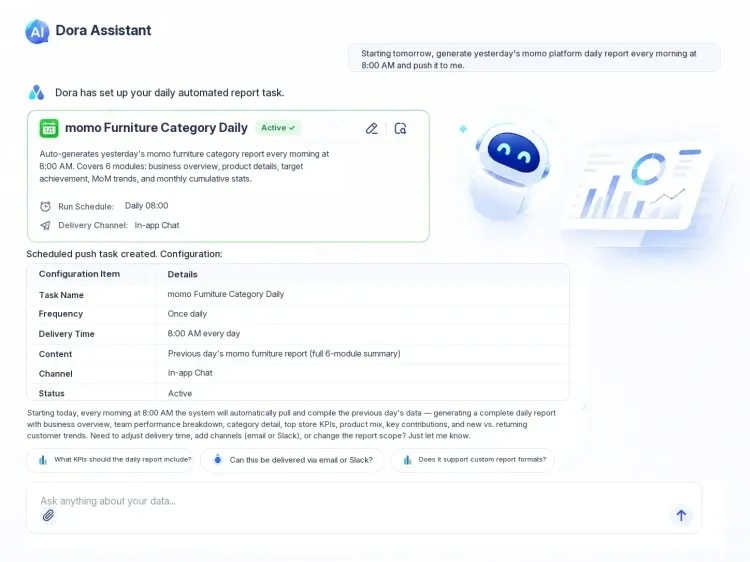 Fast Answers Are Not Enough: Why Data Agents Need AI-Ready Data
See why enterprise Data Agents need AI-ready data—and how trusted metrics, traceable sources, secure access, timely updates, and business context build trust.
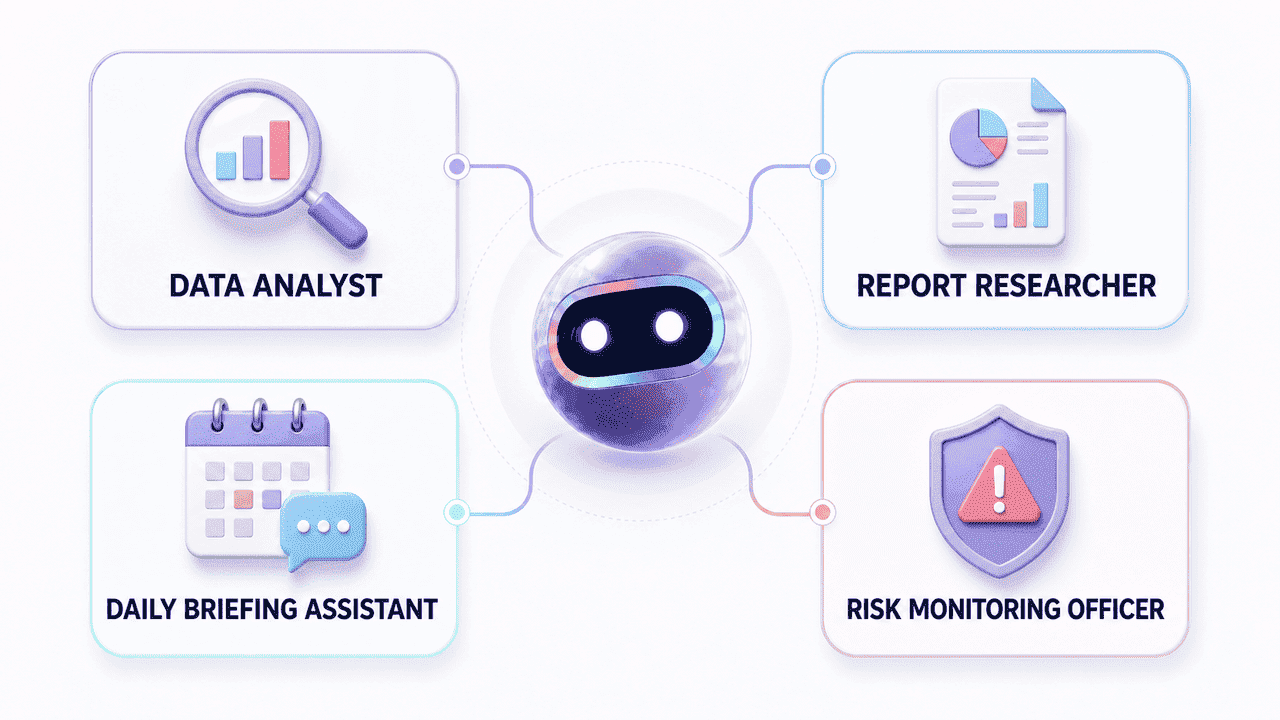 The Next Step for Enterprise AI: From Productivity Tools to Data Agents That Get Work Done
See how enterprise AI is evolving from productivity tools to Data Agents like Dora, which turn trusted BI into analysis, reports, alerts, and action.
 Stop Calling BI “Dashboards.” The Real Work Is Underwater.
The visualization is the visible 10%. The real work happens underwater, in the crushing depths where no one looks and no one credits.