
AI & Data
The Next Step for Enterprise AI: From Productivity Tools to Data Agents That Get Work Done
At nine o’clock on Monday morning, the COO walks into the weekly operations meeting. The dashboard shows that manufacturing yield in South China has fallen two percentage points since the previous week.
“Which production line is responsible?” she asks. “When did the decline begin, and is it linked to a particular batch of materials?”
The room goes quiet. An analyst opens the BI dashboard. The manufacturing lead calls the plant. Someone else starts searching through last week’s spreadsheets. The numbers already exist across the MES, ERP system, and management reports, but a useful answer is still hours away.
This scene exposes a persistent gap in enterprise data operations. Most companies can see a problem. Far fewer can complete the research, root-cause analysis, reporting, and follow-up quickly enough to act on it.
Generative AI has moved rapidly into everyday office work. Employees use it to summarize meetings, draft emails, and edit copy. These tools save time for individuals, but operational decisions demand far more context. AI must understand the company’s metrics, data permissions, and business processes. General-purpose models lack that context. They can produce a plausible explanation, but rarely one that a manager can use with confidence.
The next phase of enterprise AI will be measured less by how many employees have tried it and more by how much real work it can take on. Data Agents are emerging at precisely this turning point.
BI Shows You the Problem. A Data Agent Takes On What Comes Next.
Over the past decade, enterprises have invested heavily in business intelligence platforms and management dashboards. Data from ERP, MES, and CRM systems has been organized into metrics and visualizations, giving managers a faster view of revenue, inventory, production yield, and customer behavior.
BI solved the visibility problem. When a dashboard turns red, however, the work has only begun.
An analyst must confirm the metric definition, drill into the relevant dimensions, compare data across systems, and turn the findings into charts and slides. Once management reviews the report, another team may need to monitor the issue or notify the people responsible. Between detection and action lies a chain of data work that still depends heavily on manual effort.
A Data Agent takes on that chain of work. It understands the company’s own metrics and access rules, calls trusted data, and carries out analysis, reporting, distribution, and alerting tasks. A user’s question no longer ends with a paragraph of generated text. It starts a workflow that the business can run, track, and improve.
Dora: An Enterprise Data Workforce Built on Trusted BI
Dora builds on the BI assets a company already has. It uses established data models, metric definitions, permissions, and analytical logic. With official Data Skills, it turns common data-intensive activities into executable tasks.
That architectural choice matters. A company does not need to expose raw data to a model without boundaries or build an AI system disconnected from its existing BI environment. Dora works within a governed, traceable data perimeter. The BI assets the company has spent years developing can now power a digital workforce alongside the people who already use them.
Dora organizes high-frequency data work across a team of specialized digital employees:
- The Data Analyst handles data queries, drill-down analysis, and root-cause investigation.
- The Report Researcher turns findings into structured reports, charts, and presentations.
- The Daily Briefing Assistant prepares scheduled summaries and delivers them to the right people.
- The Risk Monitoring Officer watches for anomalies, flags early warning signs, and recommends next steps.
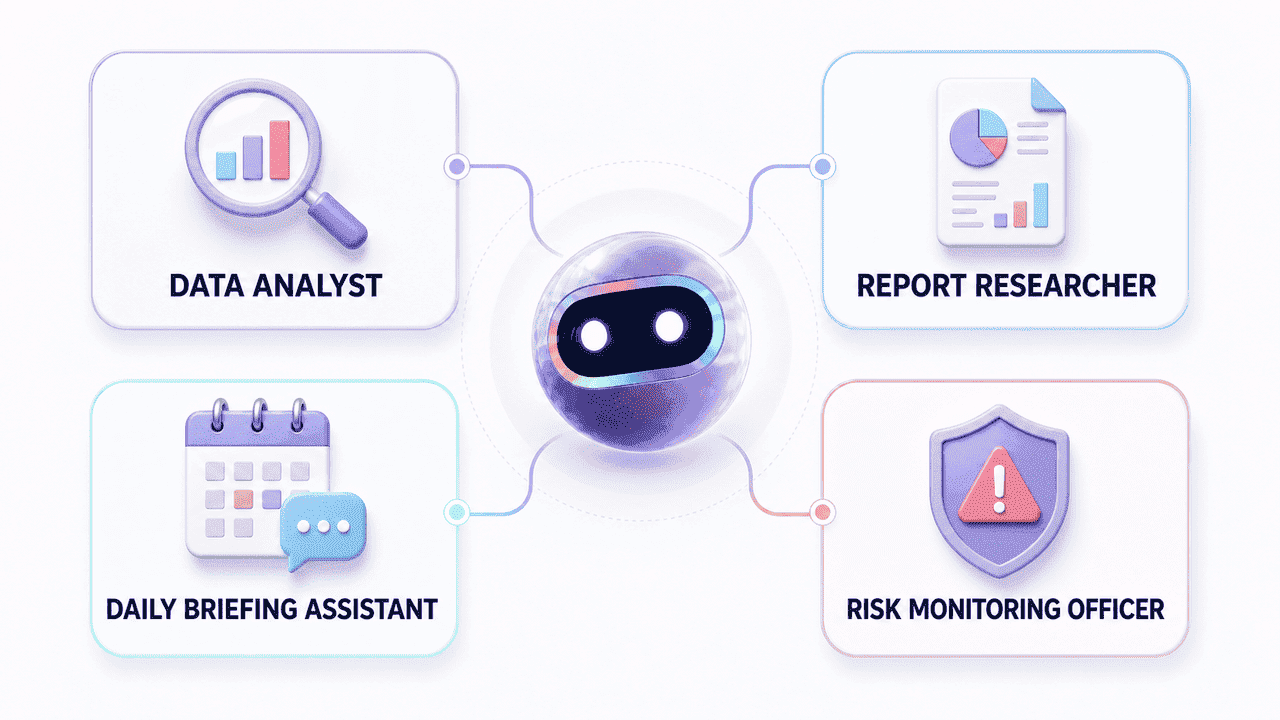
These are not four isolated features. Together, they cover the full path from retrieving data and interpreting change to prompting action.
How a Data Agent Changes a Production Meeting
Return to the manufacturing example.
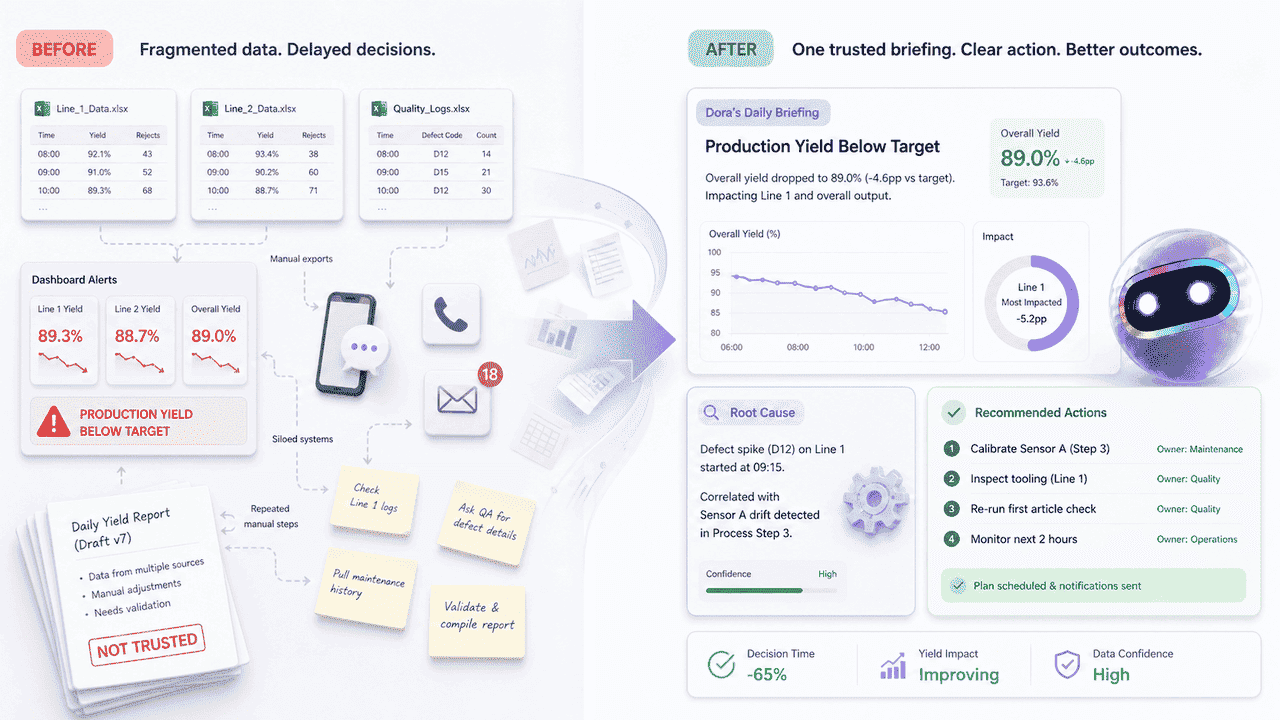
In the conventional process, a production manager compiles the previous day’s OEE, yield, and inventory reports every morning. If yield drops, an analyst runs another round of queries across production lines, batches, materials, and equipment. By the time management receives the analysis, the problem may have persisted for half a day.
With Dora, the Risk Monitoring Officer tracks yield continuously. When a production line in South China moves outside the agreed range, it raises an alert and asks the Data Analyst to investigate the line, batch, and material dimensions. The Report Researcher prepares a concise briefing, and the Daily Briefing Assistant sends it to plant and operations leaders before the morning meeting.
Management sees more than a two-point decline. The briefing shows when the deviation began, which material batch is most closely associated with it, which equipment settings changed at the same time, and who should investigate next.
The meeting no longer starts with reconciling numbers and hunting for data. The team can move straight to causes and corrective action. That is the operational value enterprise AI should deliver.
Start by Putting One Digital Employee to Work
Companies do not need to transform every dataset and process at once. A practical starting point is one frequent, time-consuming task with a well-defined data boundary: a daily operations briefing, an inventory alert, a sales query, or a management report.
The team identifies the data needed for that task, agrees on metric definitions, update schedules, access rights, and validation standards, then lets Dora take on the work within those boundaries. Once the first use case is running, the company has a reusable set of data assets, rules, and operating practices. The next digital employee becomes faster to deploy.
Enterprises already hold vast amounts of data. The next step is to put that data to work. Data Agents such as Dora extend BI from a system that people consult into an operational capability that completes data tasks for the business.
At the upcoming Dora Spotlight Event, we will show how Dora builds on trusted BI and how its Data Analyst, Report Researcher, Daily Briefing Assistant, and Risk Monitoring Officer work together across querying, analysis, reporting, distribution, and alerting.
See Dora in Action
Join the Dora Spotlight Event to see how FanRuan turns trusted analytics into business action. Watch Dora’s Data Analyst, Report Researcher, Daily Briefing Assistant, and Risk Monitoring Officer work together across a complete data workflow.

Article by
Saber Chen
AI Product Architect & CPO
Saber has 15 years of experience in enterprise software, where he has guided 43,000+ clients and managed teams of 500+, building top-tier data intelligence solutions. When not building scalable B2B architecture, he's on the basketball court or diving into vibe coding.


Keep Learning
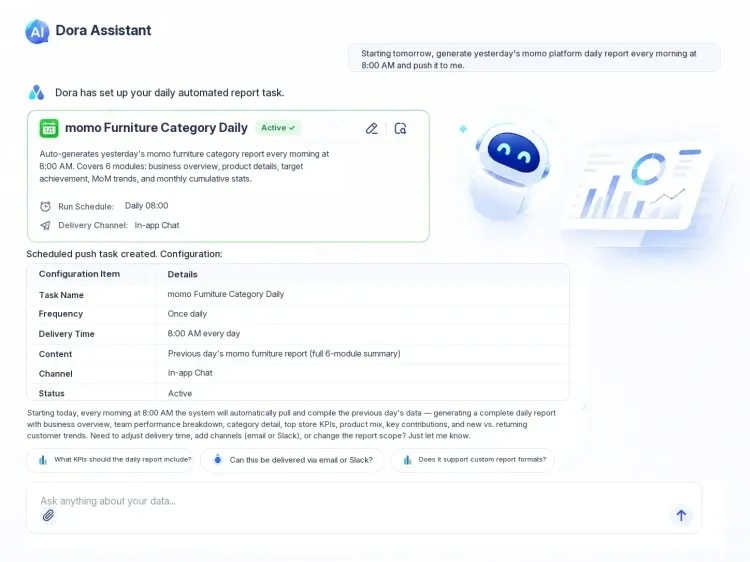 Fast Answers Are Not Enough: Why Data Agents Need AI-Ready Data
See why enterprise Data Agents need AI-ready data—and how trusted metrics, traceable sources, secure access, timely updates, and business context build trust.
 Stop Calling BI “Dashboards.” The Real Work Is Underwater.
The visualization is the visible 10%. The real work happens underwater, in the crushing depths where no one looks and no one credits.
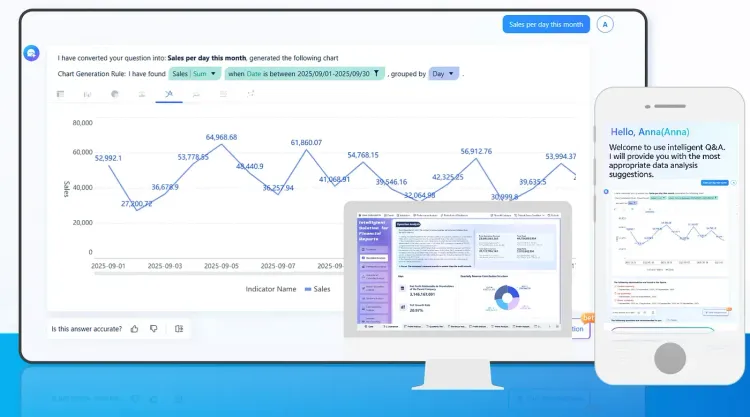 Uncovering the Truth Behind AI Delivery: Why Seemingly Perfect Strategies Fail in Enterprise Deployments
Struggling to move AI from prototype to production? Uncover the hidden truths behind AI product delivery and learn to deploy solutions that actually work.