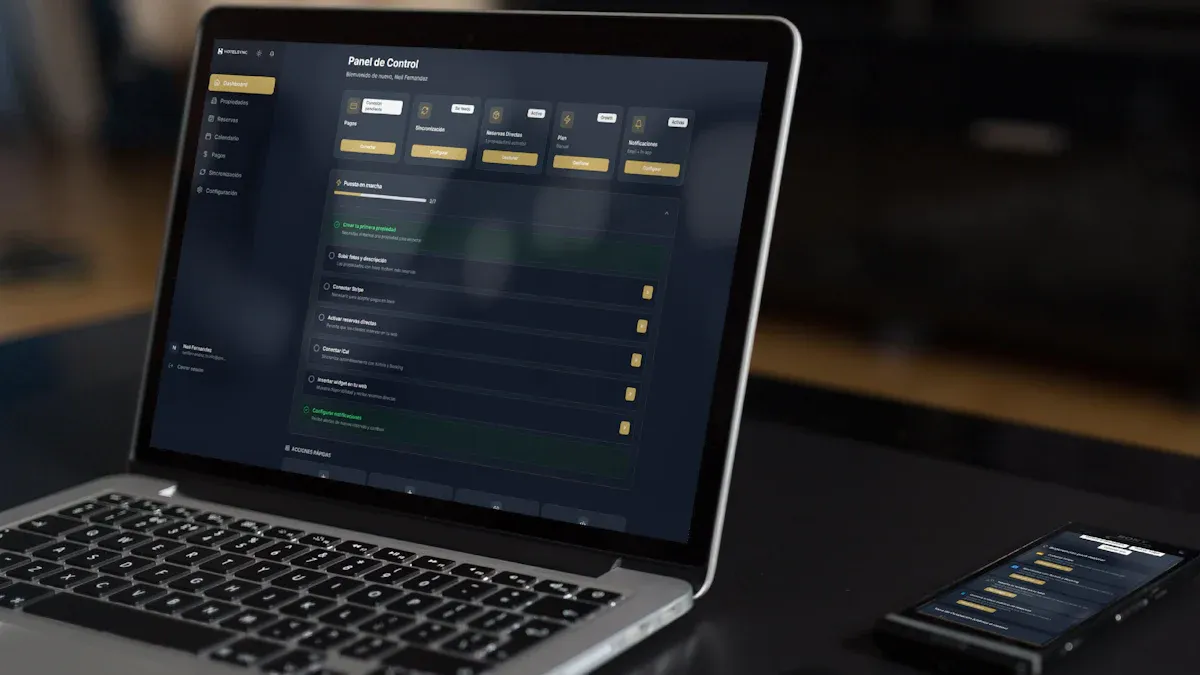

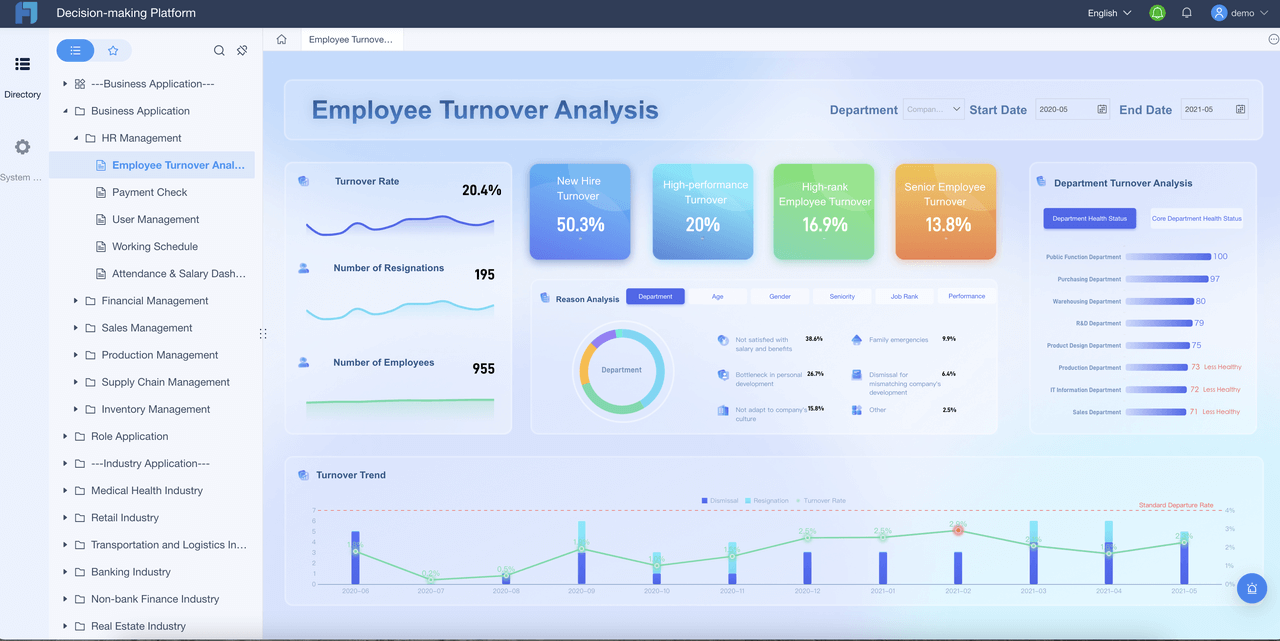
FineReport is an enterprise reporting and dashboard platform that helps manufacturers turn ERP, MES, WMS, and supply chain data into operational analytics and decision-ready reports.
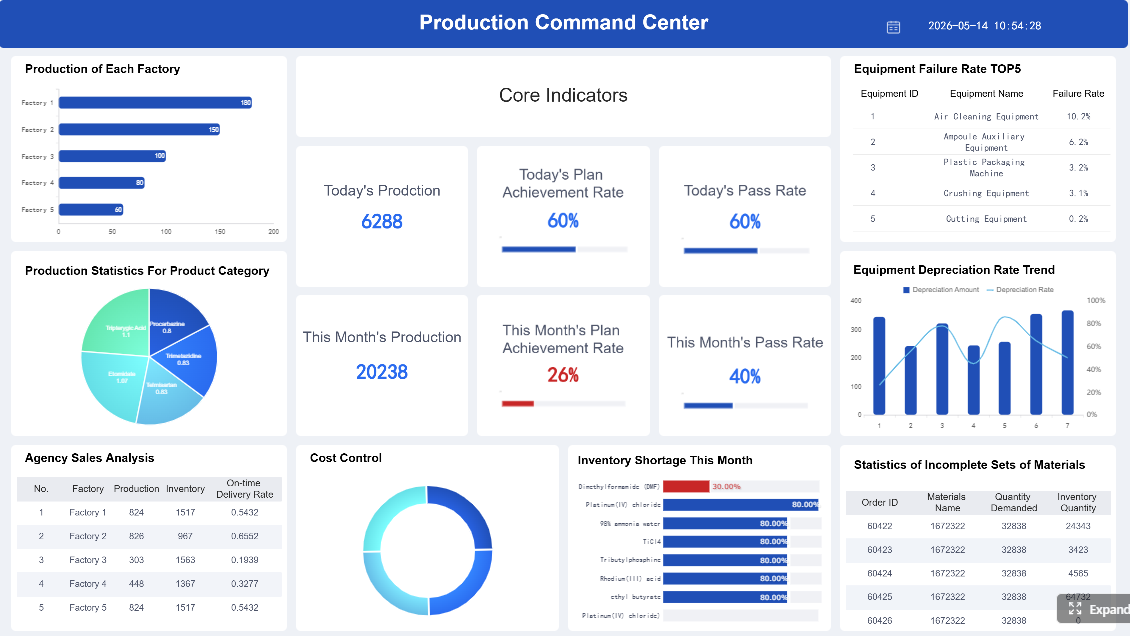 Click To Try The Dashboard
Best manufacturing supply chain management software in 2026: how to compare the right fit
Before comparing vendors, define what success looks like for each stakeholder group. For planners, success usually means better forecast accuracy, faster exception handling, and the ability to balance demand, supply, and capacity without relying on spreadsheets. For operations leaders, it means fewer stockouts, more reliable production flow, better supplier coordination, and faster response to disruptions. For IT buyers, it means manageable implementation effort, strong integration options, secure architecture, and a platform that will not create long-term maintenance problems.
When building a shortlist for manufacturing supply chain management software, focus on the workflows that matter most in production environments:
- Demand planning and forecasting
- Inventory visibility across plants and warehouses
- Production coordination and finite scheduling alignment
- Supplier collaboration and procurement workflows
- ERP integration and data consistency
- Reporting, alerting, and cross-functional analytics
A useful way to compare tools is to score every platform against the same criteria:
- Deployment model: cloud, on-premise, or hybrid
- Implementation effort: fast rollout vs. longer transformation project
- Scalability: single site, regional, or global multi-site support
- Reporting and analytics: built-in dashboards, scenario planning, KPI tracking
- Total cost of ownership: licensing, services, support, and admin burden
This structured approach prevents a common mistake: choosing the platform with the longest feature list instead of the one that fits your manufacturing processes, data maturity, and internal team capacity.
The 10 tools compared at a glance
Below is a practical comparison of 10 widely considered tools for manufacturing supply chain management in 2026. The list includes broad enterprise suites, mid-market options, and specialized platforms that solve specific planning, visibility, or analytics gaps.
| Tool | Best-Fit Company Size | Standout Strengths | Limitations | Deployment Approach | Pricing Posture |
|---|---|---|---|---|---|
| SAP Integrated Business Planning + SAP Supply Chain solutions | Large enterprise | Deep planning, strong SAP ecosystem fit, global scale | Complex implementation, premium cost | Cloud with broad SAP landscape integration | Enterprise / quote-based |
| Oracle Fusion Cloud SCM | Mid-size to enterprise | End-to-end suite, strong ERP connectivity, manufacturing depth | Broad suite can be heavy for focused needs | Cloud | Enterprise / quote-based |
| Kinaxis Maestro (RapidResponse) | Upper mid-market to enterprise | Concurrent planning, scenario modeling, fast response planning | Less ideal if execution depth is the top need | Cloud | Enterprise / quote-based |
| Blue Yonder | Enterprise | Advanced planning, warehouse and logistics capabilities | Can require significant transformation effort | Cloud | Enterprise / quote-based |
| Infor Supply Chain Management | Mid-market to enterprise | Good fit for manufacturers using Infor ERP, industry workflows | Some modules vary in depth by use case | Cloud | Quote-based |
| Epicor SCM / Epicor ecosystem | Mid-market manufacturers | Strong fit for discrete manufacturing and ERP-connected operations | Less broad than top-tier global suites | Cloud / hybrid | Mid-to-upper market |
| E2open | Enterprise and global networks | Supplier collaboration, multi-enterprise visibility, logistics network | Best value appears in complex external partner networks | Cloud | Enterprise / quote-based |
| Plex by Rockwell Automation | SMB to mid-market manufacturing | Manufacturing-centric cloud platform, plant-floor alignment | Less suited for highly complex global planning | Cloud | Quote-based |
| Acumatica + connected supply chain apps | SMB to mid-market | Flexible ERP-centric growth path, manageable complexity | Advanced planning may require add-ons | Cloud | Mid-market |
| FineReport | Any size as analytics layer | Strong manufacturing dashboards, ERP/MES/WMS reporting, lower-friction analytics rollout | Not a transactional SCM suite by itself | On-premise / cloud deployment options | Custom / typically cost-effective for reporting use cases |
What each tool is best for
- Best option for complex global manufacturers: SAP Integrated Business Planning and Blue Yonder
- Best choice for mid-market companies upgrading from spreadsheets: Epicor, Plex, and Acumatica-based environments
- Best fit for businesses that need strong ERP connectivity: Oracle Fusion Cloud SCM, SAP, Infor, and Epicor
- Best option for teams prioritizing supplier and inventory visibility: E2open, Infor, and FineReport as an analytics layer
A key takeaway: not every manufacturer needs a single monolithic platform. Some need a broad suite. Others get better results from combining an ERP-centric system with a specialized planning tool or a reporting platform like FineReport to unify visibility across systems.
Evaluation criteria for manufacturing teams
The right manufacturing supply chain management software should support both planning and execution. Manufacturing organizations usually evaluate software across six core areas.
Planning and forecasting capabilities
Planning depth matters when lead times are volatile, product mix changes often, or capacity is constrained. Look for support for:
- Demand forecasting
- Statistical planning
- Collaborative planning
- Scenario analysis
- Supply and capacity balancing
- Exception alerts
Inventory, warehouse, and replenishment controls
Manufacturers need inventory visibility beyond basic stock counts. The strongest systems help teams answer:
- What is available by site, warehouse, and stage?
- Which materials are at risk based on supplier lead times?
- Where are excess and obsolete risks building up?
- How should replenishment policies change by SKU or plant?
Production scheduling and manufacturing coordination
A generic supply chain system may support purchasing and logistics but still fall short in manufacturing coordination. Strong tools should connect planning assumptions with:
- BOM and routing context
- Capacity constraints
- Work order timing
- Material availability
- Plant-level execution signals
Supplier management, procurement, and order collaboration
Supplier performance often determines manufacturing stability. Evaluate whether the platform can support:
- Supplier portals or collaboration workflows
- Purchase order visibility
- ASN or shipment tracking
- Lead-time monitoring
- Risk alerts and order change collaboration
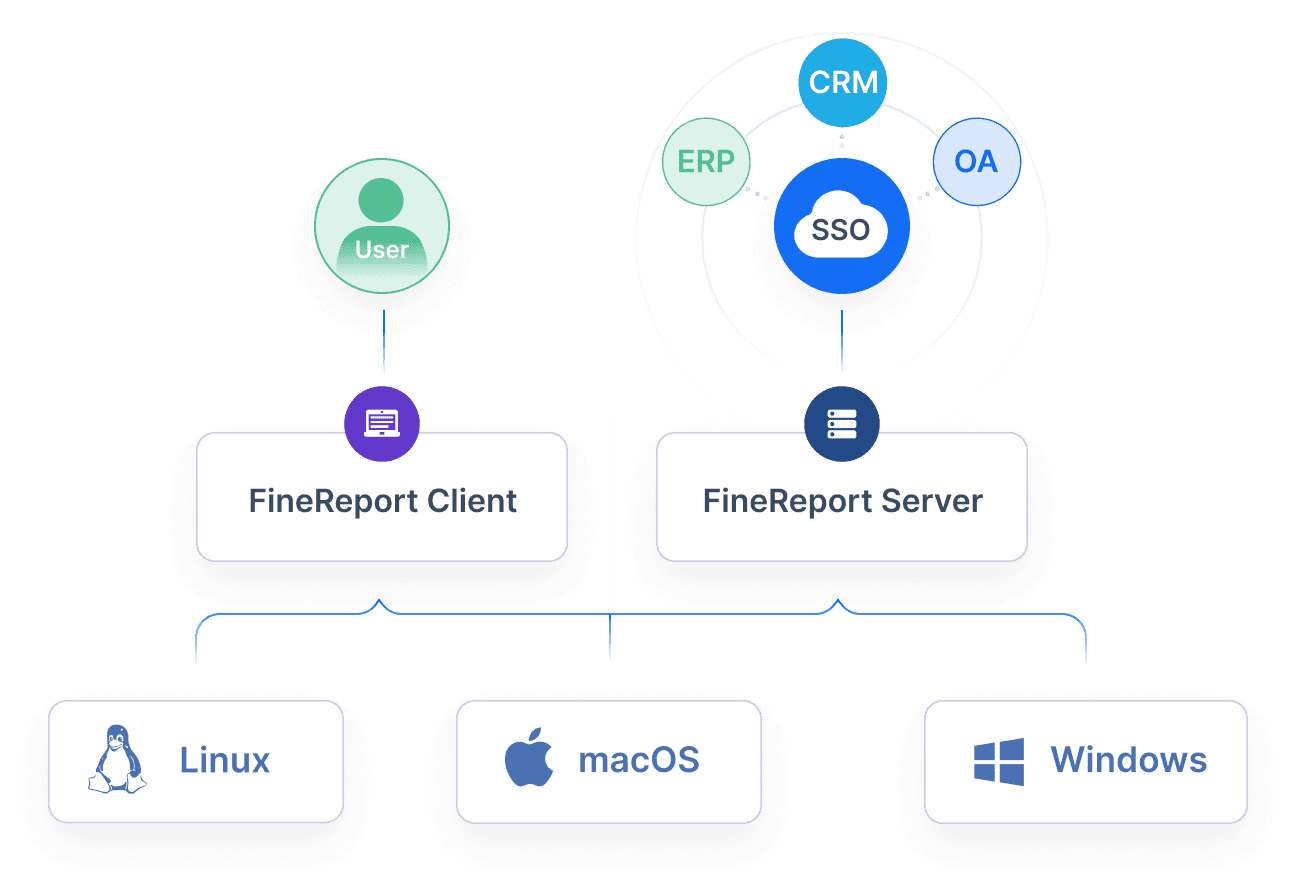
Integration with ERP, MES, WMS, CRM, and data platforms
Integration quality has a direct impact on time to value. Look for:
- Prebuilt ERP connectors
- API availability
- Event-driven integration support
- Master data synchronization
- Ease of connecting shop-floor, warehouse, and reporting systems
Dashboards, alerts, AI assistance, and scenario planning
Teams increasingly want systems that do more than record transactions. High-value platforms now provide:
- Real-time dashboards
- Alerts for supply risk and inventory exceptions
- Root-cause visibility
- AI-assisted forecasting or recommendations
- What-if modeling
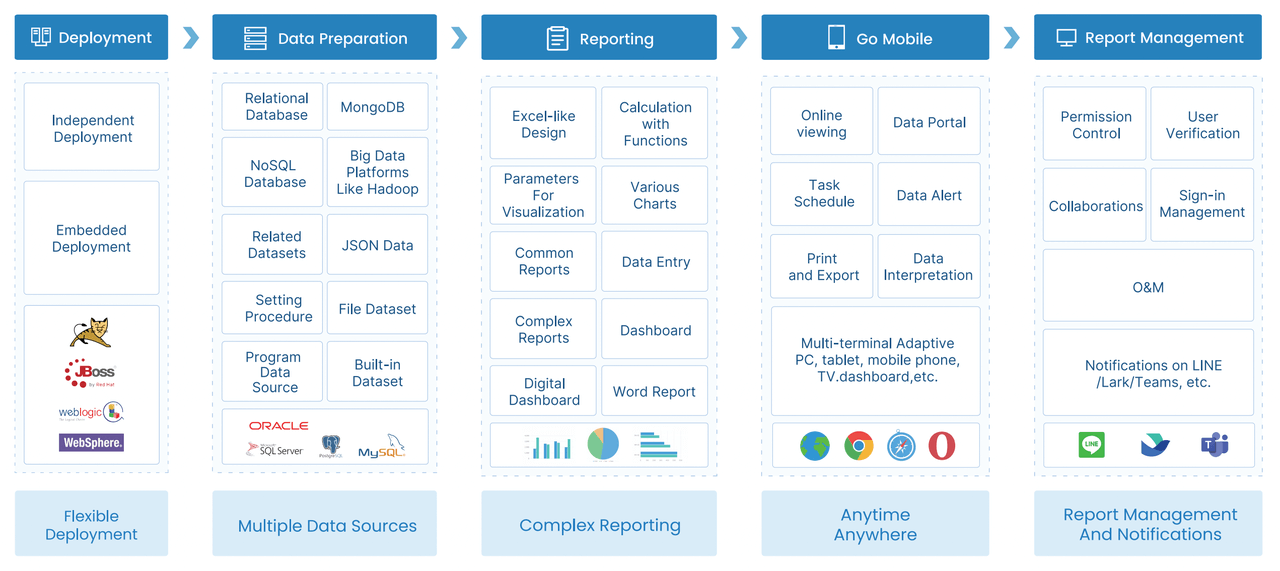
For manufacturers that already operate multiple transactional systems, FineReport can add value here by delivering cross-system dashboards, mobile reports, KPI monitoring, and drill-down analysis without requiring a full SCM replacement.
Criteria planners care about most
Planners usually prioritize:
- Forecast accuracy
- Exception management
- Scenario modeling
- Allocation support
- Multi-site balancing
- Clear visibility into demand, capacity, and material constraints
The best platforms help planners move from reactive spreadsheet firefighting to structured decision-making.
Criteria ops teams care about most
Operations teams care most about:
- Real-time visibility
- Faster execution workflows
- Reliable replenishment signals
- Coordination between procurement, production, warehousing, and fulfillment
- Shorter response time when disruptions occur
A tool that looks impressive in a demo but does not support day-to-day response speed will struggle in production environments.
Criteria IT buyers care about most
IT buyers usually focus on:
- Security and access control
- API maturity
- Implementation complexity
- Data governance
- Architecture fit
- Long-term maintainability
- Vendor ecosystem and support model
For this group, lower admin overhead and clean integration patterns can matter more than flashy front-end features.
Detailed reviews of the top 10 supply chain management systems for 2026
Each tool below follows the same evaluation structure so buyers can compare them more easily.
Enterprise platforms
1. FineReport
- One-sentence overview: FineReport is a reporting and analytics platform that helps manufacturers unify supply chain data from ERP, MES, WMS, and spreadsheets into dashboards, alerts, and operational reports.
- Key Features:
- Production, inventory, procurement, and supplier dashboards
- ERP, MES, WMS, CRM, and database connectivity
- Custom KPI reporting for planners and operations teams
- Drill-down analysis and mobile reporting
- Role-based dashboards and scheduled distribution
- Pros & Cons:
- Pros: Strong cross-system visibility, practical for replacing spreadsheet reporting, flexible dashboard design, useful for IT-led analytics standardization
- Cons: Not a transactional supply chain suite, works best as a visibility and analytics layer alongside core operational systems
- Best For (Target user/scenario): Manufacturers that already have operational systems but need better reporting, visibility, and decision support across functions
FineReport deserves consideration because many manufacturers do not fail due to lack of transactions; they fail due to fragmented visibility. If demand, inventory, purchasing, production, and fulfillment data sit in different tools, teams often revert to spreadsheets and manually merged reports. FineReport can reduce that friction by creating a unified reporting layer for planners, operations leaders, and executives.
It is particularly useful in these scenarios:
- Replacing spreadsheet-based supply chain reporting
- Building daily production and inventory dashboards
- Monitoring supplier performance and material shortages
- Giving managers one view across ERP, MES, and warehouse data
- Supporting IT teams that need governed self-service reporting for operations
For manufacturers that are not ready to replace their entire system landscape, FineReport can be a lower-risk way to improve supply chain visibility and decision speed.
2. SAP Integrated Business Planning + SAP Supply Chain solutions
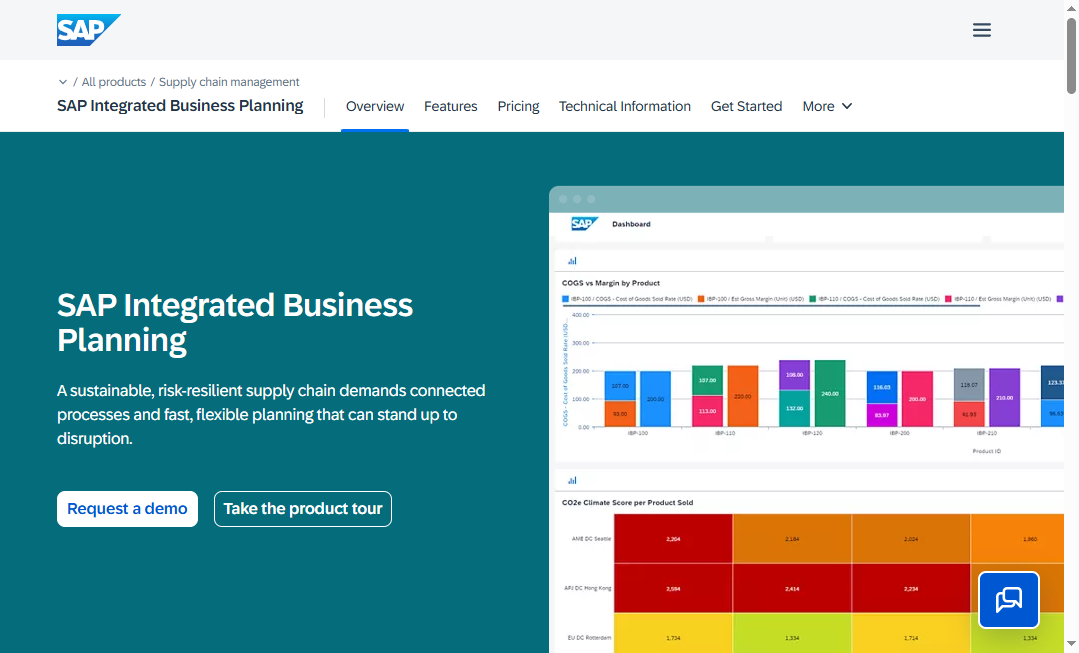
- One-sentence overview: SAP offers a broad supply chain stack for manufacturers that need advanced planning, inventory optimization, and strong alignment with SAP ERP environments.
- Key Features:
- Demand planning and S&OP support
- Inventory optimization
- Response and supply planning
- Multi-site planning for global operations
- Tight integration with SAP ERP and related SAP applications
- Pros & Cons:
- Pros: Strong enterprise scalability, deep planning capabilities, good fit for complex global manufacturing, robust ecosystem
- Cons: Implementation can be lengthy, cost is high, requires mature processes and strong internal ownership
- Best For (Target user/scenario): Complex global manufacturers already invested in SAP and looking for enterprise-grade planning and orchestration
SAP is usually a shortlist candidate when a manufacturer needs scale, governance, and broad process coverage. It is especially relevant for companies with multi-region operations, layered planning processes, and existing SAP data models. The trade-off is complexity: SAP can be powerful, but it is rarely the fastest route to value for leaner teams.
3. Oracle Fusion Cloud SCM
- One-sentence overview: Oracle Fusion Cloud SCM is a comprehensive cloud suite for manufacturers seeking strong ERP connectivity and broad supply chain process coverage in a single environment.
- Key Features:
- Supply planning and demand management
- Procurement and order management
- Inventory and manufacturing support
- Product lifecycle and logistics-related modules
- Embedded analytics within Oracle ecosystem
- Pros & Cons:
- Pros: Broad end-to-end scope, strong Oracle ERP integration, good cloud architecture, suitable for mixed business models
- Cons: Can be heavier than needed for focused use cases, licensing and implementation can be substantial
- Best For (Target user/scenario): Manufacturers that want a broad cloud suite and prioritize Oracle-centric integration
Oracle is attractive when supply chain modernization is tied to a broader ERP transformation. It is particularly useful for buyers who want fewer platform handoffs across procurement, inventory, manufacturing, and finance. The main trade-off is breadth versus simplicity: companies with one urgent planning problem may find the suite larger than necessary.
4. Kinaxis Maestro (RapidResponse)
- One-sentence overview: Kinaxis is a planning-first platform known for concurrent planning, scenario modeling, and fast decision support in volatile manufacturing environments.
- Key Features:
- Demand, supply, and inventory planning
- Scenario simulation and what-if analysis
- Rapid exception response
- Concurrent planning across functions
- Collaboration across supply chain stakeholders
- Pros & Cons:
- Pros: Excellent responsiveness, strong planner experience, useful for fast-changing environments, powerful simulations
- Cons: Less execution-centric than some broader suites, may require complementary systems for deeper transactional workflows
- Best For (Target user/scenario): Manufacturers that need decision agility, fast replanning, and visibility across changing supply-demand conditions
Kinaxis stands out when planning speed is more important than owning every execution process in one suite. It is commonly favored by companies dealing with frequent demand shifts, constrained materials, and high-value planning decisions. It is less ideal as a standalone answer if procurement, logistics execution, or warehouse workflows are the main pain points.
5. Blue Yonder

- One-sentence overview: Blue Yonder delivers advanced planning, fulfillment, warehouse, and logistics capabilities for enterprises managing complex, high-volume supply chains.
- Key Features:
- Demand forecasting and replenishment
- Supply planning and inventory optimization
- Warehouse management
- Transportation and fulfillment tools
- Control tower-style visibility
- Pros & Cons:
- Pros: Deep functional breadth, strong for large-scale planning and logistics, suitable for complex network optimization
- Cons: Transformation effort can be significant, not always the simplest fit for mid-market manufacturers
- Best For (Target user/scenario): Enterprises needing advanced planning plus logistics and warehouse depth
Blue Yonder is particularly strong where planning and execution need to connect across large distribution and manufacturing networks. For manufacturers with sophisticated fulfillment or distribution complexity, it can be a strong fit. The trade-off is that adoption, implementation, and data alignment can demand significant organizational readiness.
6. E2open
- One-sentence overview: E2open is a cloud platform focused on connected supply chains, making it strong for supplier collaboration, logistics visibility, and multi-enterprise coordination.
- Key Features:
- Supplier and partner network collaboration
- Procurement and supply visibility
- Logistics tracking and execution visibility
- Demand and supply planning support
- Global trade and partner network workflows
- Pros & Cons:
- Pros: Strong external collaboration capabilities, wide partner network value, useful for globally distributed supply chains
- Cons: Most compelling for companies with complex external networks, less manufacturing-specific on the plant side than some alternatives
- Best For (Target user/scenario): Manufacturers with complex supplier ecosystems and a high need for external collaboration and visibility
E2open is not always the first choice for plant-level manufacturing control, but it is highly relevant when the biggest challenge is outside the factory walls. If supplier coordination, partner network visibility, and logistics events drive performance, E2open can fill an important gap.
Mid-market and SMB options
7. Infor Supply Chain Management
- One-sentence overview: Infor provides supply chain capabilities that pair well with manufacturing-centric ERP workflows, especially for companies already using Infor solutions.
- Key Features:
- Supply planning and procurement support
- Inventory visibility
- Supplier collaboration options
- Industry-focused workflows
- Integration with Infor ERP environments
- Pros & Cons:
- Pros: Good manufacturing alignment, solid ERP ecosystem fit, practical for mid-market and larger manufacturers
- Cons: Depth can vary by module and deployment context, evaluation should be use-case specific
- Best For (Target user/scenario): Manufacturers using Infor ERP or seeking industry-oriented workflows without moving to the largest enterprise suites
Infor can be a strong middle ground between very large enterprise stacks and lighter mid-market tools. It often appeals to manufacturers that want process fit and ERP alignment without committing to the heaviest transformation model.
8. Epicor SCM / Epicor ecosystem
- One-sentence overview: Epicor is a practical option for discrete and mixed-mode manufacturers that want stronger supply chain coordination tightly linked to ERP operations.
- Key Features:
- Inventory and procurement management
- Supplier tracking and replenishment support
- Manufacturing and order coordination
- ERP-connected reporting and workflows
- Support for mid-market manufacturing environments
- Pros & Cons:
- Pros: Good fit for manufacturing operations, approachable for mid-market teams, strong ERP linkage
- Cons: Less expansive than top-tier global suites, advanced planning depth may require careful scoping
- Best For (Target user/scenario): Mid-sized manufacturers replacing spreadsheets and disconnected tools with a more structured operating model
Epicor is often a sensible choice for companies that need better discipline and visibility but do not need a global planning tower on day one. It is especially useful when manufacturing, inventory, and purchasing coordination need to improve together.
9. Plex by Rockwell Automation
- One-sentence overview: Plex is a manufacturing-focused cloud platform that connects production, quality, inventory, and supply chain processes for plants that want operational alignment.
- Key Features:
- Cloud-native manufacturing workflows
- Inventory and materials tracking
- Production and quality linkage
- Plant-level visibility
- Native manufacturing orientation
- Pros & Cons:
- Pros: Strong plant-floor relevance, practical for manufacturers wanting manufacturing-first software, good fit for standardization across sites
- Cons: Not the deepest option for highly complex global planning, may need complementary tools for advanced supply chain scenarios
- Best For (Target user/scenario): Small to mid-sized manufacturers that want better operational control and alignment between production and supply processes
Plex is especially useful when the real need is tighter coordination between supply chain data and manufacturing execution. It is less suited to companies whose top priority is sophisticated global planning or multi-tier network optimization.
10. Acumatica + connected supply chain apps
- One-sentence overview: Acumatica offers a flexible ERP-centered path for growing manufacturers that need inventory, purchasing, and operational visibility without excessive complexity.
- Key Features:
- Inventory and order management
- Purchasing and replenishment workflows
- Manufacturing support through ERP modules
- Open integration approach for add-ons
- Cloud deployment for growth-stage teams
- Pros & Cons:
- Pros: Flexible for SMB and lower mid-market growth, manageable complexity, good ecosystem adaptability
- Cons: Advanced planning often requires partner tools, less specialized than enterprise SCM leaders
- Best For (Target user/scenario): Growing manufacturers that need a solid operational foundation and the ability to add specialized capabilities over time
Acumatica works well for companies that are still maturing their processes. It provides structure without forcing the scale and cost profile of a large enterprise platform. For many SMB teams, that balance matters more than having every advanced feature upfront.
How to choose the best supply chain software for your manufacturing business
The best manufacturing supply chain management software depends on business maturity, process complexity, and internal resources. A large multi-site manufacturer with constrained planning and global suppliers has different needs than a growing regional producer trying to get off spreadsheets.
Start with these decisions:
- Do you need a broad platform or a focused tool?
- Are your biggest issues in planning, procurement, production coordination, inventory visibility, supplier collaboration, or analytics?
- Does your team have the bandwidth for a major implementation, or do you need faster time to value?
Then compare each option across:
- Implementation timeline
- Process change required
- Integration needs
- Internal admin effort
- User adoption risk
- ROI over the next 12 to 36 months
A practical shortlist usually includes one or two broad suites, one manufacturing-oriented mid-market option, and one analytics or visibility layer such as FineReport if reporting fragmentation is a major issue.
Questions to ask vendors before buying
Use vendor demos to validate manufacturing fit, not just generic functionality. Ask:
- How does the platform handle manufacturing constraints, finite capacity, and material shortages?
- Can it support multi-site planning and site-level execution differences?
- Which integrations are prebuilt for ERP, MES, WMS, and CRM?
- What typically requires custom work?
- How are alerts, dashboards, and scenario planning handled out of the box?
- What level of supplier collaboration is included?
- What implementation resources are required from our internal team?
- How is reporting customized for planners, operations leaders, and executives?
For analytics platforms like FineReport, also ask:
- How quickly can dashboards be deployed using our current systems?
- Can we combine ERP, MES, and spreadsheet data in one governed view?
- How are permissions, scheduling, and mobile access managed?
Common mistakes to avoid
Avoid these common software selection errors:
- Choosing based on feature volume instead of operational fit
- Underestimating data cleanup and process standardization
- Ignoring adoption needs across planning, procurement, operations, and IT
- Assuming ERP integration will be easy without validation
- Overbuying enterprise complexity when a focused solution would solve the problem faster
Many failed projects come from buying a system that is theoretically powerful but practically too difficult to implement or sustain.
Final recommendations by buyer type
Here is a direct summary of the best-fit options by buyer profile.
-
Best overall pick for enterprise manufacturers: SAP Integrated Business Planning + SAP Supply Chain solutions
Best for global scale, planning depth, and enterprise process control. -
Best value for mid-sized operations: Epicor SCM / Epicor ecosystem
Best for manufacturers that need strong operational structure without the overhead of the largest suites. -
Best supply chain software for small manufacturing teams: Acumatica + connected supply chain apps
Best for growing companies that need flexibility, manageable complexity, and room to expand. -
Best option when ERP integration is the top priority: Oracle Fusion Cloud SCM
Best for companies looking for broad process coverage in a tightly connected cloud suite. -
Best choice for companies replacing spreadsheets with structured planning: Kinaxis for planning-heavy environments, or FineReport for reporting-heavy environments
Kinaxis is stronger when replanning and scenario analysis are the main need. FineReport is stronger when the main problem is fragmented reporting, low visibility, and manual KPI consolidation.
If your organization already has core systems in place but lacks clear, timely decision support, FineReport is a strong addition to the shortlist. It is not a replacement for every transactional workflow, but it is highly effective at turning disconnected manufacturing and supply chain data into dashboards that planners, ops teams, and IT buyers can actually use.
FAQs
It helps manufacturers plan demand, manage inventory, coordinate production, track suppliers, and improve visibility across operations. The main goal is to reduce stockouts, delays, and manual spreadsheet work.