
Choosing the right supply chain risk management tools is no longer just a procurement technology decision. It is a reporting, governance, and response decision. Enterprises need more than a platform that detects supplier issues. They need a system that can turn fragmented risk signals into clear operational cockpits, structured management reporting, faster escalation, and accountable follow-up.
With FineReport + Dora, teams can ask for a report summary in chat, generate structured narratives from trusted report assets, receive scheduled briefings, and push exceptions to the right owner. That matters in supply chain risk management because delays in understanding risk often become delays in action.
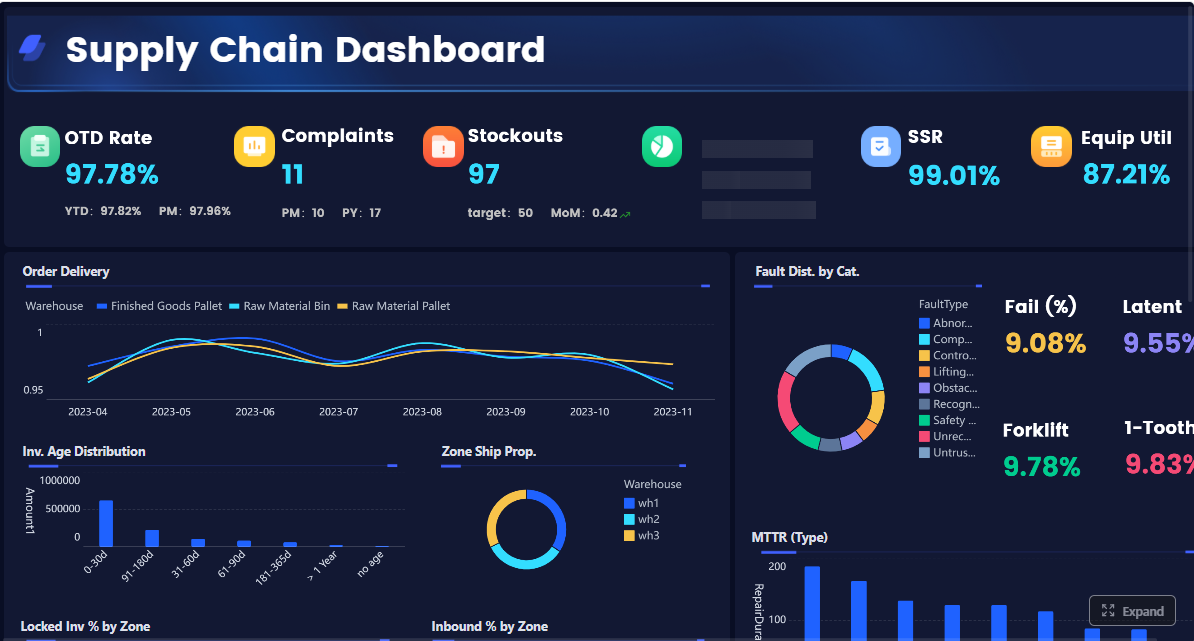 Click To Try The Dashboard
All reports in this article are built with FineReport
What to look for in supply chain risk management tools
The evaluation process should start with business outcomes, not feature lists. Many enterprises buy platforms that look strong in demos but fail in day-to-day reporting and escalation because the tool does not fit real operating workflows.
The first question is simple: what should the platform help the business do better? In most organizations, the answer includes four outcomes:
- clearer enterprise reporting
- faster risk escalation
- better cross-functional decision-making
- more consistent follow-up on supplier issues
A useful evaluation framework should also define which risks the platform must surface. In supply chains, that often includes:
- supplier disruption
- geopolitical exposure
- logistics delays
- compliance gaps
- supplier financial instability
- cyber and operational risk signals
- concentration risk across sites, categories, or regions
At this stage, separate must-have capabilities from nice-to-have features. A polished map or attractive dashboard is not enough if the system cannot support routine management reviews, weekly risk briefings, and frontline action.
Finally, confirm whether the tool supports both executive visibility and operational action. Leadership needs concise summaries and impact views. Procurement, operations, compliance, and category owners need drill-down details, documentation, and workflows.
Core capabilities that matter most
Below are the capabilities that usually matter most when evaluating supply chain risk management tools for enterprise use.
Multi-tier supplier visibility and dependency mapping
Report Element: Visibility into Tier 1, Tier 2, and critical dependency relationships across suppliers, sites, materials, and regions.
Business value: This helps teams identify hidden concentration points and single-source dependencies before a disruption spreads.
AI use: Dora can summarize dependency exposure by region, supplier group, or product line and highlight where upstream concentration may require mitigation.
Real-time alerts, configurable thresholds, and workflow triggers
Report Element: Alerts for threshold breaches such as financial deterioration, compliance incidents, shipment delays, or geopolitical events.
Business value: Timely escalation reduces the lag between risk detection and response.
AI use: Dora can explain why an alert was triggered, summarize the business context, and push the exception to the relevant owner for follow-up.
Reporting dashboards that connect risk signals to business impact
Report Element: Dashboards that link supplier risk events to revenue exposure, production delays, service risk, or contract impact.
Business value: Risk becomes actionable when teams can see operational and financial consequences, not just abstract scores.
AI use: Dora can generate a structured report summary that translates risk indicators into management language for weekly reviews or executive meetings.
Audit trails, documentation, and collaboration features for cross-functional teams
Report Element: Records of alerts, investigations, mitigation actions, approvals, and status updates.
Business value: This supports governance, compliance reviews, and accountability across procurement, operations, finance, and legal teams.
AI use: Dora can compile follow-up notes, summarize unresolved issues, and prepare status briefings based on trusted workflow records.
How enterprise reporting requirements should shape evaluation
Too many software evaluations focus on risk detection while underestimating reporting needs. In practice, a supply chain risk platform only becomes useful when it supports the reporting habits of the enterprise.
Start by identifying who needs reporting and how often. In most organizations, the list includes:
- procurement teams tracking supplier exposure and mitigation
- operations teams monitoring production and logistics impact
- finance teams assessing cost and revenue risk
- compliance teams reviewing documentation and due diligence
- leadership teams needing concise, high-level visibility
A strong platform should support both summary dashboards and drill-down reporting. Executives should see a clean risk overview, trend lines, top exceptions, and exposure by business unit or region. Analysts and managers should be able to drill into suppliers, incidents, thresholds, source evidence, and action logs.
Data quality and scoring transparency are equally important. If users cannot understand where a score came from, how often data refreshes, or how source validation works, trust will decline quickly. In enterprise settings, a trusted report often matters more than a sophisticated model.
Customization also matters. Board reporting, internal reviews, incident response calls, and audit preparation all require different report layouts and levels of detail. FineReport is especially valuable here because it gives teams the reporting foundation to standardize these outputs instead of forcing every user into one dashboard view.
Metrics and views that improve actionability
When comparing supply chain risk management tools, look for systems that can report these metrics clearly and consistently.
Supplier criticality, concentration risk, and geographic exposure
Report Element: Supplier criticality by spend, production dependency, sole-source status, and country or region exposure.
Business value: These views help prioritize mitigation on the suppliers that matter most to continuity.
AI use: Dora can summarize which high-criticality suppliers also carry elevated geographic or concentration risk and package that into a scheduled leadership briefing.
Incident trends, response times, and mitigation status
Report Element: Number of incidents over time, average response time, overdue actions, and closure rates.
Business value: This shows whether the organization is improving its risk response process, not just detecting more issues.
AI use: Dora can compare this week versus last week, identify delayed responses, and generate a chart-based answer for operations reviews.
Revenue, production, or service impact tied to supplier risk events
Report Element: Business impact estimates linked to suppliers, categories, plants, customers, or service commitments.
Business value: This connects risk reporting directly to enterprise priorities and decision-making.
AI use: Dora can explain which incidents have the highest business impact and produce a structured management narrative from FineReport dashboards.
Leading indicators that help teams act before disruption escalates
Report Element: Early warning indicators such as rising lead-time variability, worsening supplier performance, sanctions exposure, negative event clusters, or repeated compliance exceptions.
Business value: Leading indicators support proactive action instead of reactive reporting.
AI use: Dora can flag emerging patterns, summarize why they matter, and send periodic exception pushes to responsible managers.
How to compare Supply Chain Risk Management platforms side by side
A side-by-side comparison works best when it uses a consistent scorecard. Without one, vendor demos tend to overemphasize polished interfaces and understate implementation complexity.
A practical scorecard should cover:
- visibility and supply chain mapping depth
- analytics and risk scoring explainability
- integrations with ERP, procurement, logistics, and compliance systems
- usability for both analysts and executives
- governance, permissions, and auditability
- onboarding and supplier segmentation support
- alert quality and relevance
- reporting flexibility
- implementation effort
- long-term support and service model
- total cost of ownership
Use realistic scenarios during evaluation. Ask vendors to show how the platform handles a logistics disruption affecting a critical supplier, a compliance breach in a high-risk region, or a financial-risk alert on a sole-source supplier. Then test whether the system can turn that event into a usable report, a role-based alert, and an accountable action flow.
It is also important to test alert relevance. Many risk teams are buried in noise. If the platform floods users with low-confidence or low-priority alerts, adoption will suffer. Better tools help users prioritize, not just monitor.
Licensing and implementation effort should also be evaluated early. Some platforms are effective but require significant internal support for integration, data stewardship, workflow configuration, and reporting customization. Enterprises should understand this before selection, not after contract signing.
Questions to ask during demos and trials
Use these questions to compare vendors in a more operational way:
- How does the platform validate external risk data and refresh it over time?
- Can users trace a risk alert back to the source and understand the confidence level?
- What actions can teams trigger directly from a risk event?
- How quickly can the system be configured for different business units or regions?
- Can reports be tailored for executive review, operational follow-up, and audit documentation?
- How are thresholds, risk rules, and escalation paths managed?
- How does the platform handle role-based access and sensitive supplier information?
- Can the system integrate with existing reporting assets instead of forcing a full replacement?
That last question matters more than many teams realize. In many enterprises, the best answer is not to replace all existing reporting. It is to build a trusted reporting layer and then add an AI assistant for faster consumption and follow-up.
How an AI Data Agent Automates Report Consumption
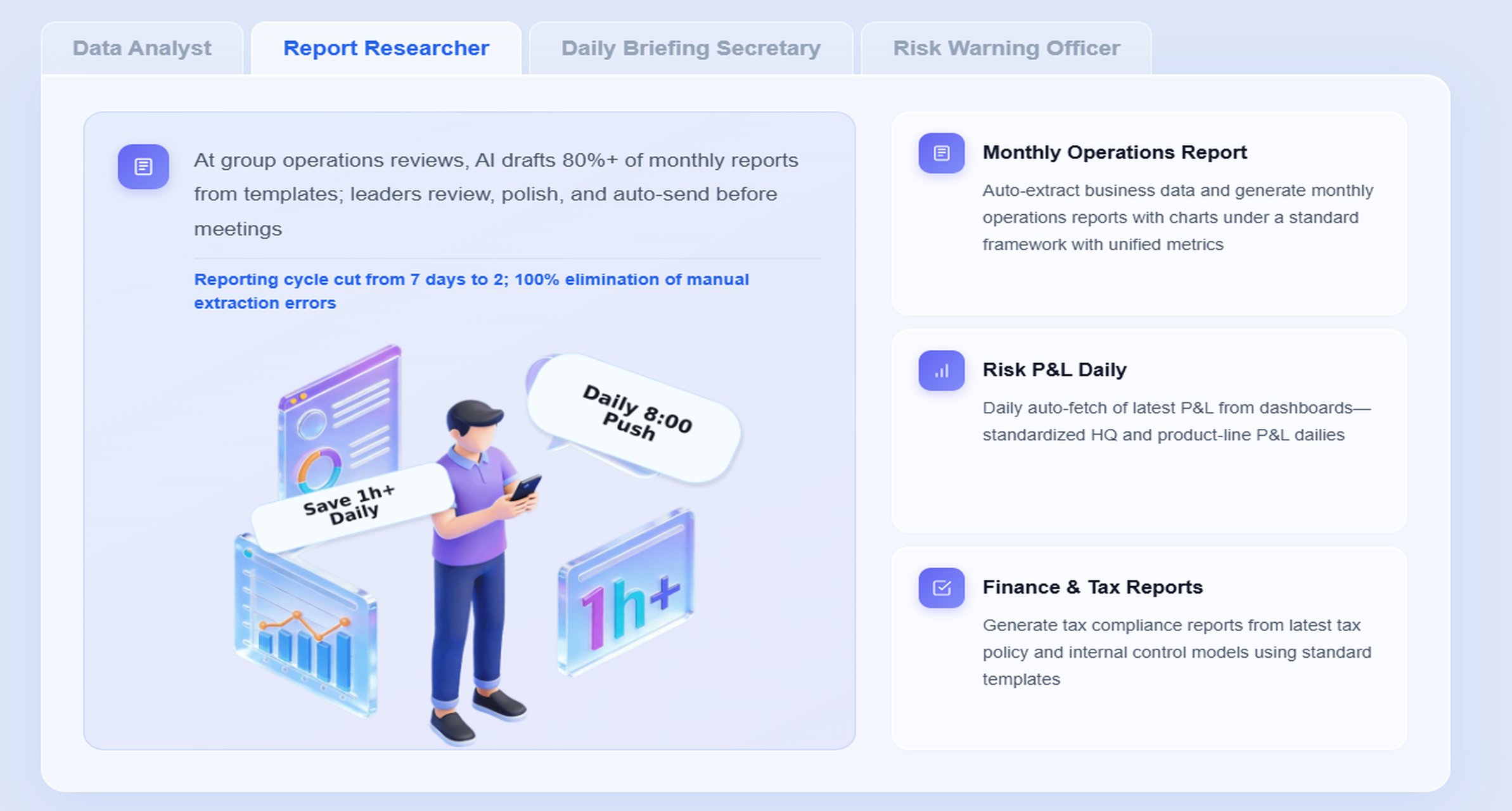
Once a company has risk data, dashboards, and reporting logic in place, the next bottleneck is often report consumption. People still spend too much time opening dashboards, reading multiple tabs, interpreting changes, writing summaries, and forwarding issues to owners.
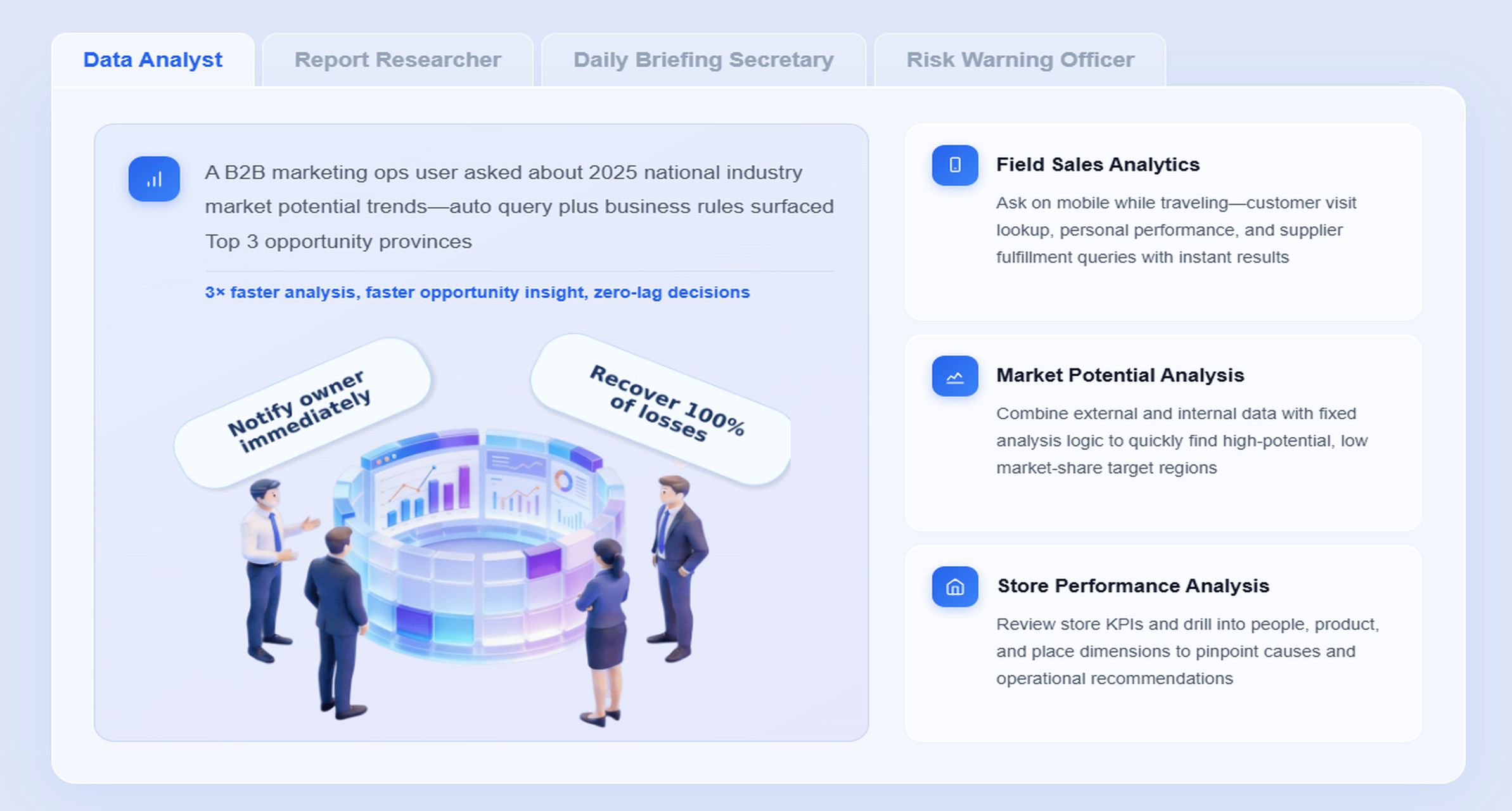
This is where Dora, FanRuan’s enterprise Data Agent platform, creates practical value. Dora is not a generic chatbot. It is an AI assistant layer that sits on top of trusted enterprise report assets and governed semantics. In the supply chain risk scenario, Dora can act as a Risk Alert Officer, Report Researcher, or Daily Briefing Secretary depending on the workflow.
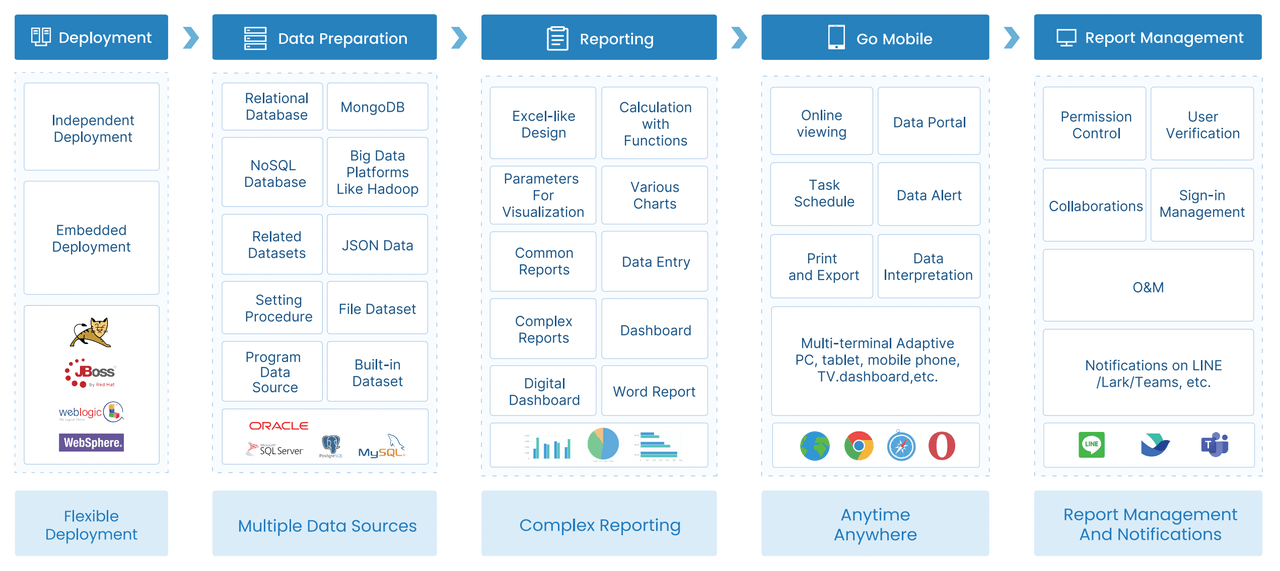
FineReport provides the trusted foundation: formatted reports, operational cockpits, supplier risk dashboards, exception lists, templates, KPI definitions, and permission control. Dora then turns those assets into a governed AI workflow for chat-based query, structured report summary, exception push, and follow-up.
A scenario-specific example:
“Summarize this week’s supply chain risk report, highlight suppliers with rising financial or logistics risk, show which plants may be affected, and list the owners who need follow-up.”
In a real enterprise workflow, Dora can automate report consumption in five steps:
-
Retrieve trusted FineReport data assets
Dora accesses the relevant FineReport risk dashboard, supplier exception list, and operational cockpit rather than relying on ungoverned raw prompts. -
Understand KPI definitions and business rules
It uses trusted semantic definitions for supplier criticality, concentration thresholds, incident severity, plant exposure, and escalation logic. -
Generate a structured report summary
Dora produces a management-ready summary explaining what changed, which suppliers are high risk, what business units are exposed, and which trends deserve attention. -
Detect exceptions and overdue actions
It identifies threshold breaches, unresolved incidents, delayed mitigation actions, and repeated supplier exceptions where follow-up is required. -
Push the right information to the right people
Dora sends scheduled briefings, exception alerts, or action prompts to procurement leads, plant managers, compliance teams, or executives based on permissions and workflow rules. -
Create follow-up records for review
It supports repeatable reporting workflows by compiling pending items, generating daily or weekly summaries, and helping teams track whether owners responded.
This is where the AI value becomes concrete. Instead of asking analysts to manually prepare recurring supply chain risk summaries, Dora acts as an AI digital employee that helps users query, summarize, alert, and follow up using trusted enterprise assets.
The practical advantages are significant:
- natural-language query over trusted reporting assets
- chat-based AI assistant for faster report consumption
- structured summaries from FineReport dashboards and reports
- scheduled daily or weekly briefings for leadership and operations
- exception alerts with owner-based pushes
- more controllable execution through Skills-based workflows
- better enterprise fit through permissions, semantic rules, KPI governance, and report templates
For IT teams, this changes the role of the reporting stack. IT no longer has to manually produce every recurring summary. Instead, IT strengthens data connections, governance, semantic setup, and reusable agent Skills. For business users, Dora reduces friction. They get timely answers and report summaries without hunting through multiple systems. For executives, the value is direct: Dora is not an AI experiment. It is a landed digital employee for recurring risk reporting, weekly operation summaries, supplier exception briefings, and owner follow-up.
Key integration and workflow checks before selection
A supply chain risk platform may look strong on its own but fail to land if it cannot fit enterprise systems and workflows.
First, verify integration with the systems that actually hold operational truth:
- ERP
- procurement systems
- supplier management platforms
- logistics and transport systems
- compliance and due diligence tools
- incident management systems
- internal reporting and BI assets
Second, confirm how the tool fits existing escalation workflows. If a high-risk supplier event is detected, who is notified, who owns action, how is progress recorded, and how is status reported upward? If the platform cannot support that flow, the organization will fall back to spreadsheets and email.
Third, review governance controls carefully. Role-based access, data permissions, audit trails, and security are especially important when supplier financial, compliance, and sourcing data are involved.
Fourth, check collaboration support. During active disruptions, cross-functional coordination matters as much as analytics. Procurement, operations, finance, legal, and compliance may all need access to the same event context but with different reporting views.
Signs a solution will drive adoption
The following signs usually indicate stronger adoption potential:
Clear user experience for both analysts and executive stakeholders
Report Element: Role-specific dashboards and reporting views.
Business value: Adoption improves when leaders get clarity and analysts get depth.
AI use: Dora can provide chat-based summaries for executives and more detailed metric explanations for analysts from the same FineReport foundation.
Low manual effort to maintain supplier records and reporting outputs
Report Element: Automated data refreshes, reusable templates, and consistent workflows.
Business value: Lower maintenance means stronger sustainability of the program.
AI use: Dora can reduce manual reporting effort by generating recurring summaries, exception recaps, and briefing notes automatically.
Flexible workflow design that matches real operating processes
Report Element: Configurable thresholds, escalation rules, action statuses, and approval steps.
Business value: Tools are adopted more easily when they match existing operating reality.
AI use: Dora can operate within governed AI workflows instead of relying on free-form prompting that is harder to control and audit.
Training, customer support, and change management resources
Report Element: Vendor enablement, onboarding support, and rollout guidance.
Business value: Even good software can stall without operational adoption support.
AI use: Dora works best when organizations also invest in KPI definitions, semantic setup, report templates, and user training.
Common mistakes to avoid when choosing a solution
Many failed tool selections come from predictable mistakes.
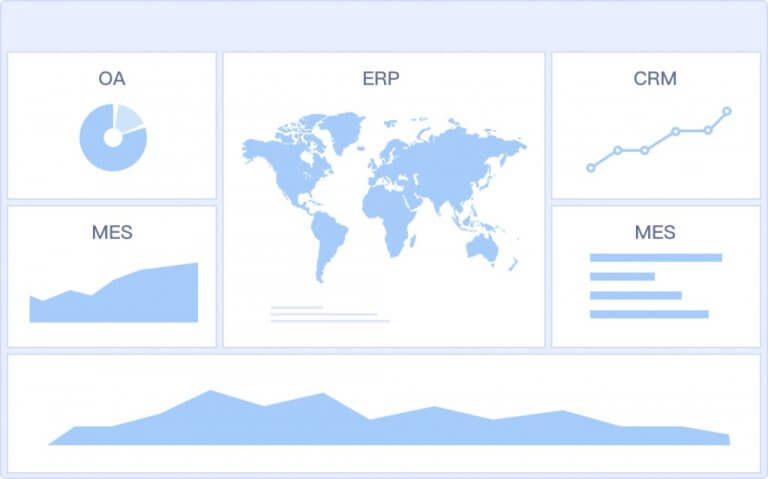
One common mistake is prioritizing attractive dashboards over data reliability and workflow fit. A visually impressive interface cannot compensate for weak source transparency, poor governance, or shallow integration.
Another mistake is buying broad monitoring without clarifying response ownership. If an alert appears but no one knows who should act, risk visibility does not create resilience.
A third mistake is underestimating implementation complexity. Teams often focus on the platform and overlook the work required for integration, supplier segmentation, report design, threshold setup, permissions, and governance.
A fourth mistake is failing to test actionability. During pilots, organizations should verify whether the tool actually helps users make faster and better decisions. Can it produce trusted reporting? Can users understand the alert? Can teams trace the issue, assign ownership, and follow up?
A simple evaluation framework to use internally
Use this simple internal framework to keep selection practical:
-
Define goals, reporting needs, and decision points
Identify target use cases, stakeholder reporting needs, and which decisions the system should support. -
Shortlist vendors based on core use cases and integration fit
Eliminate options that look good in theory but do not fit your systems, reporting model, or governance standards. -
Run a pilot with realistic supplier scenarios and escalation workflows
Test the platform with actual supplier criticality, disruption events, and reporting outputs. -
Measure reporting quality, usability, and actionability before final selection
Evaluate whether the tool improves visibility, trust, speed of escalation, and owner follow-up.
Actionable best practices
To make supply chain risk management tools work in the enterprise, focus on implementation discipline as much as software selection.
1. Standardize KPI definitions, report templates, and exception rules
If supplier criticality, incident severity, or response status mean different things across teams, reporting will break down. Standard definitions create a reliable foundation for both dashboards and AI summaries.
2. Build a semantic layer inside the reporting workflow
This is one of the most important AI-specific practices. Dora performs best when business terms, KPI logic, filters, and report structures are governed. FineReport provides the trusted reporting layer that makes this possible.
3. Treat data quality as part of the AI implementation
AI does not fix weak data. It amplifies whatever reporting foundation exists. Before expanding Dora workflows, validate source quality, update cadence, ownership rules, and threshold logic.
4. Start with high-value recurring reports
Another important AI-specific practice is to start narrow. Focus on recurring reports such as weekly supplier risk review, daily exception briefing, or monthly executive risk summary. These scenarios have clear value and are easier to operationalize.
5. Preserve permission governance and use human review where needed
AI-generated report narratives should respect FineReport access controls and role boundaries. For higher-stakes supply chain decisions, keep human review in the loop and expand Skills gradually as confidence and governance mature.
FineReport + Dora Solution Pitch
Building this manually is complex. FineReport helps teams standardize trusted reports, operational cockpits, templates, and reporting workflows. Dora turns those assets into an AI assistant that can answer report questions in chat, generate structured summaries, push scheduled briefings, monitor exceptions, and follow up with responsible owners.
For supply chain risk management, this combination is especially practical. FineReport gives enterprises the foundation to bring together supplier risk metrics, exposure dashboards, escalation lists, mitigation trackers, and management-ready report templates. Dora then acts as the enterprise Data Agent layer that helps users consume and act on those assets faster.
This matters because most organizations do not struggle only with visibility. They struggle with turning visibility into repeatable action. FineReport + Dora helps close that gap through:
- trusted reporting and operational cockpit design
- natural-language access to governed report assets
- structured report summaries and chart explanations
- scheduled daily and weekly briefings
- exception monitoring and owner-based alert pushes
- reusable digital employees for recurring workflows
- auditable, Skills-based execution instead of raw prompt-only behavior
FineReport + Dora is not only a reporting upgrade; it is a practical fourth-generation Agentic BI path. FineReport provides governed reports and operational cockpits. Dora provides the AI assistant layer for scenario execution, with more controlled Skills, lower token waste, faster execution paths, and more stable workflows than prompt-only agents.
Get Ready-to-Use Dashboard Templates in Fine Gallery
The strongest Dora pitch is scenario + product + service: FineReport provides the trusted reporting foundation, Dora provides the AI digital employee, and implementation service connects data, governance, semantic setup, Skills, report templates, permissions, and rollout.
If your enterprise is evaluating supply chain risk management tools, do not stop at monitoring features. Evaluate whether the solution can support trusted reporting, role-based actionability, and AI-assisted execution in real operating scenarios.
FAQs
Start with business outcomes such as clearer reporting, faster escalation, and more consistent follow-up instead of focusing only on feature lists. The best tools connect risk detection to real operating workflows and management decisions.