Supply chain management software architecture is not just an IT diagram. It determines how fast your teams can respond to demand shifts, how accurately inventory moves across systems, how reliably partners exchange data, and how quickly leaders can turn operational signals into action.
In most enterprises, the challenge is not a lack of systems. It is fragmented flow between ERP, warehouse, logistics, procurement, supplier collaboration, reporting, and exception handling. That is why architecture must cover both the transaction backbone and the reporting layer that business users depend on every day.
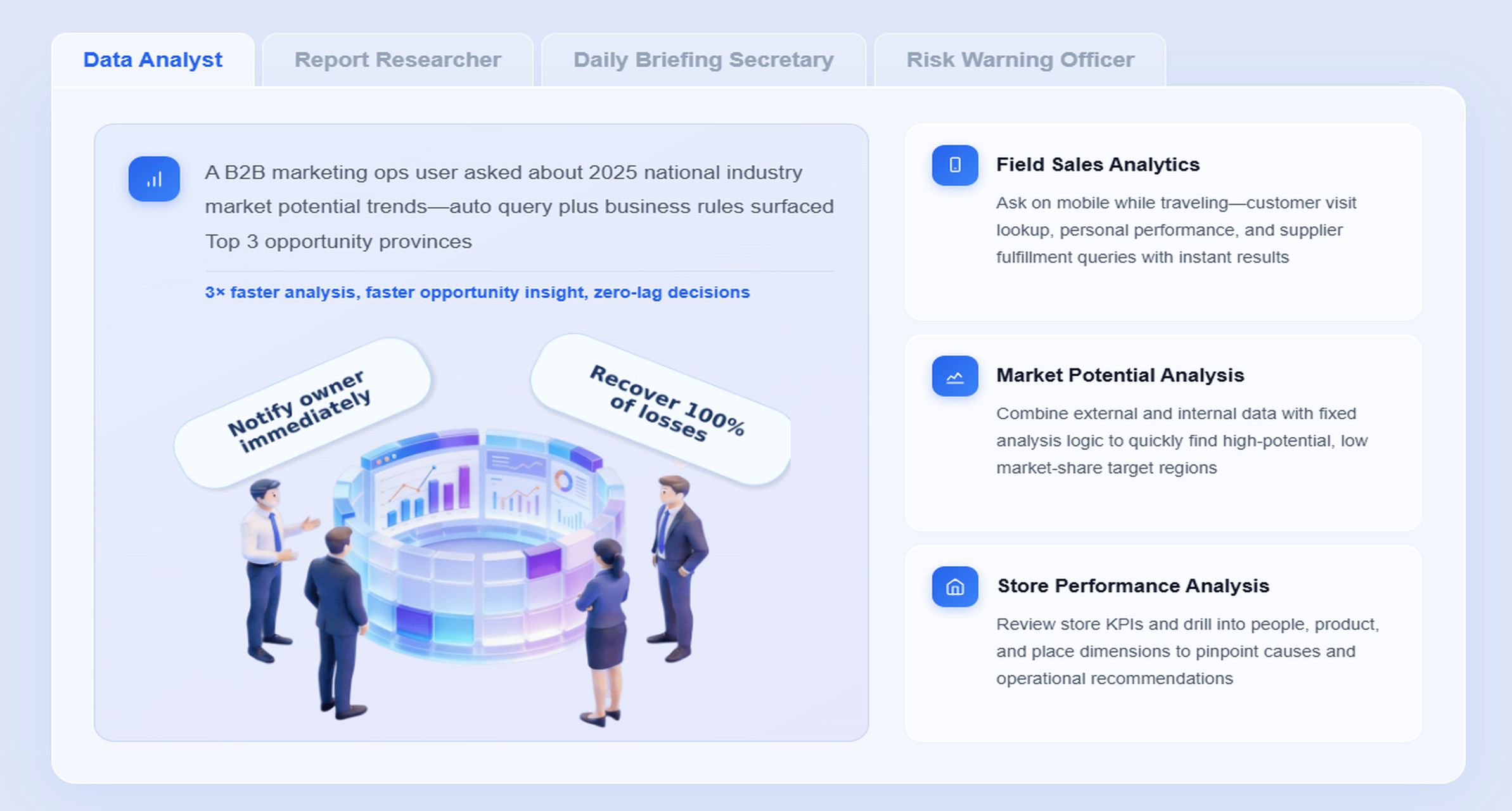
With FineReport + Dora, teams can ask for a report summary in chat, generate structured narratives from trusted report assets, receive scheduled briefings, and push exceptions to the right owner. That makes supply chain architecture not only a systems integration topic, but also an operational intelligence topic.
Click To Try The Dashboard
All reports in this article are built with FineReport
What supply chain management software architecture really covers
A modern supply chain platform spans far more than order processing. It usually includes demand planning, sourcing, procurement, production coordination, inventory management, warehousing, transportation, fulfillment, returns, service-level monitoring, and executive reporting. The architecture behind it must support both business execution and decision support.
From a business perspective, supply chain management software architecture defines how work moves across functions. It decides whether planners, buyers, warehouse teams, logistics coordinators, finance, and executives are using the same operational truth or fighting over inconsistent numbers.
From a technical perspective, it defines how applications, integrations, workflows, data pipelines, analytics, security, and infrastructure fit together. These choices affect:
Resilience: whether operations continue during delays, partner outages, or demand spikes
Visibility: whether teams can see order, shipment, inventory, and supplier status end to end
Cost control: whether redundant tools, duplicated logic, and poor data quality drive up operational waste
Speed of change: whether new processes, partners, KPIs, and automations can be introduced without rewriting everything
To make these dependencies practical, this guide uses a seven-layer model. The model connects operations, data, governance, and intelligence so teams can design for both today’s process demands and future AI-enabled reporting.
The 7-layer blueprint for supply chain management software architecture
Layer 1: Core business systems and ERP integration
The first layer is the operational system backbone. In most enterprises, ERP remains the central system for finance-linked transactions, purchasing, inventory accounting, and master data. Around it sit specialized systems such as:
WMS for warehouse execution
TMS for transport planning and shipment tracking
CRM for customer orders and service commitments
Supplier portals for confirmations, schedules, ASN updates, and collaboration
Manufacturing or MES systems where production status affects supply availability
The architectural question is not whether these systems exist. It is how they exchange trusted data and transactions.
Typical integrations include:
order creation and status updates
inventory balances and reservations
purchase orders and supplier acknowledgments
shipment events and delivery milestones
invoices, receipts, and reconciliation data
item, location, supplier, and customer master data
A strong integration architecture makes clear which system owns each process step. For example, ERP may own financial inventory valuation, while WMS owns bin-level execution and TMS owns in-transit movement status. Without that clarity, teams end up with duplicated logic and conflicting states.
Key report elements at this layer
Order status by lifecycle stage Definition: Open, allocated, picked, shipped, delivered, invoiced, returned. Business value: Helps operations see where backlog, delay, or handoff failure occurs. AI use:Dora can summarize delayed order segments, explain stage-level bottlenecks, and include them in a scheduled operations briefing.
Inventory position Definition: On-hand, reserved, available-to-promise, in-transit, safety stock. Business value: Supports replenishment, service levels, and working capital control. AI use:Dora can highlight low-coverage SKUs, compare stock risk by warehouse, and push shortage alerts to responsible teams.
Procurement execution status Definition: Purchase order release, supplier confirmation, receipt progress, overdue deliveries. Business value: Improves supplier follow-up and reduces supply disruption risk. AI use:Dora can generate a supplier delay summary and flag orders breaching agreed lead times.
Layer 2: Application services and domain capabilities
The second layer focuses on business capabilities. Instead of thinking only in terms of applications, architecture should reflect stable operational domains such as:
This matters because service boundaries should follow business responsibilities, not just current org charts or team silos. If one service tries to own too many unrelated processes, change becomes expensive. If services are split too early without domain clarity, the result is integration sprawl.
A capability-oriented design improves ownership. Demand planning teams can evolve forecasting logic without breaking warehouse workflows. Transportation changes can be isolated from order promising. Returns can be managed separately from outbound fulfillment while still sharing common data contracts.
For enterprise architects, this layer is where product thinking begins. A supply chain platform should be organized around business outcomes, not around technical convenience.
Layer 3: Data, events, and interoperability
Supply chains depend on constant movement of data across internal and external boundaries. That is why interoperability is a dedicated architectural layer.
Common connectivity mechanisms include:
APIs for synchronous application access
EDI for structured B2B exchange with suppliers, carriers, and distributors
message queues for reliable asynchronous internal processing
event streams for high-volume operational updates such as shipment milestones or inventory changes
batch pipelines for scheduled reconciliations and legacy exchanges
Each has a place. APIs work well for query and request-response patterns. EDI remains common for procurement and logistics partner exchange. Message queues improve resilience for internal business events. Event streams are better when teams need timely visibility into status changes at scale.
This layer also needs a canonical data model. A platform should define shared meanings for key entities such as:
order
shipment
inventory position
supplier
warehouse
route
item
customer promise date
service-level event
Without canonical definitions and data contracts, integration turns into endless field mapping. One system’s “shipment date” may mean planned departure, while another means actual carrier pickup. Those mismatches destroy reporting trust.
Synchronization rules are equally important. Some data should be event-driven, some periodically reconciled, and some mastered in a single system. Architecture should document latency expectations and conflict resolution rules up front.
Operational work rarely stops at data exchange. Supply chains need workflows that coordinate approvals, exceptions, escalations, and handoffs across functions.
Typical cross-functional workflows include:
supplier onboarding and approval
expedited purchase requests
order allocation under shortage conditions
carrier reassignment for delayed shipments
return authorization and inspection
inventory exception review
disruption response and escalation
This layer combines business rules with process orchestration. Rules may define reorder thresholds, service-level breach conditions, preferred carrier logic, or approval limits. Workflow determines who acts, in what order, with what evidence.
A key design choice is orchestration versus choreography.
Orchestration works best when one process needs central control, visibility, and auditability. Example: a late shipment escalation flow involving procurement, transport, warehouse, and customer service.
Choreography works better when loosely coupled services react to events independently. Example: several downstream systems updating themselves after inventory receipt is confirmed.
In practice, supply chain architecture often uses both. Highly regulated or exception-heavy flows benefit from orchestration. High-volume status propagation often works better through choreographed events.
Layer 5: Analytics, reporting, and AI intelligence
Analytics should not sit outside architecture as an afterthought. In supply chain environments, reporting is operational infrastructure. Teams depend on dashboards, cockpit views, periodic reports, and exception lists to manage daily execution.
trend analysis across service levels, lead times, shortages, and cost drivers
forecasting and anomaly detection
decision support for follow-up actions
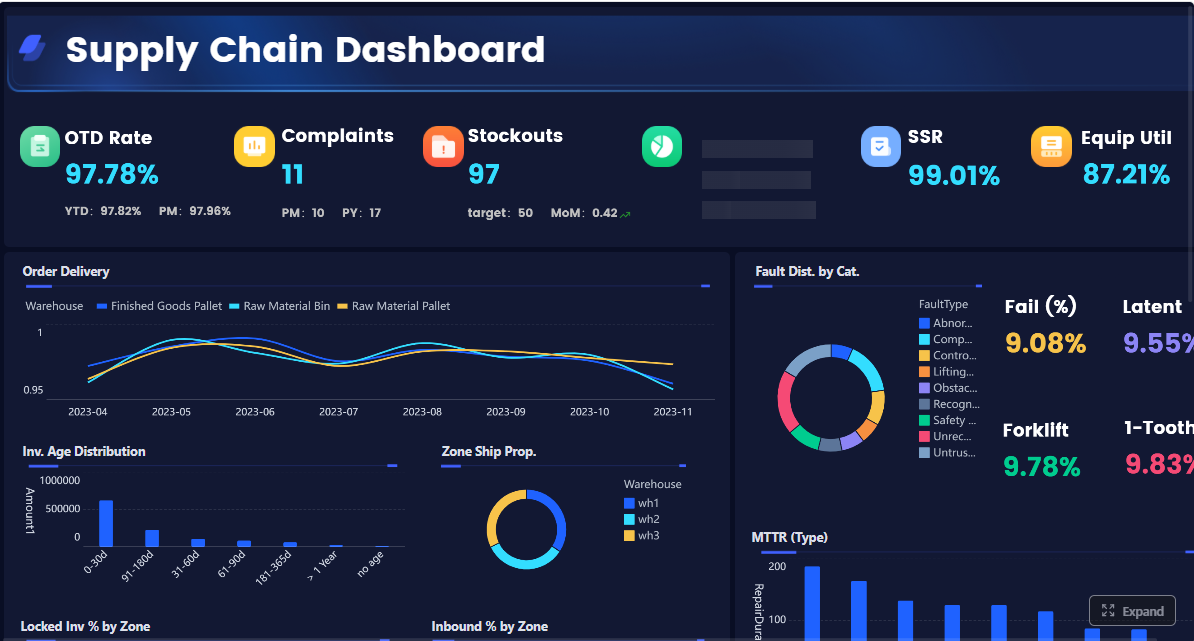
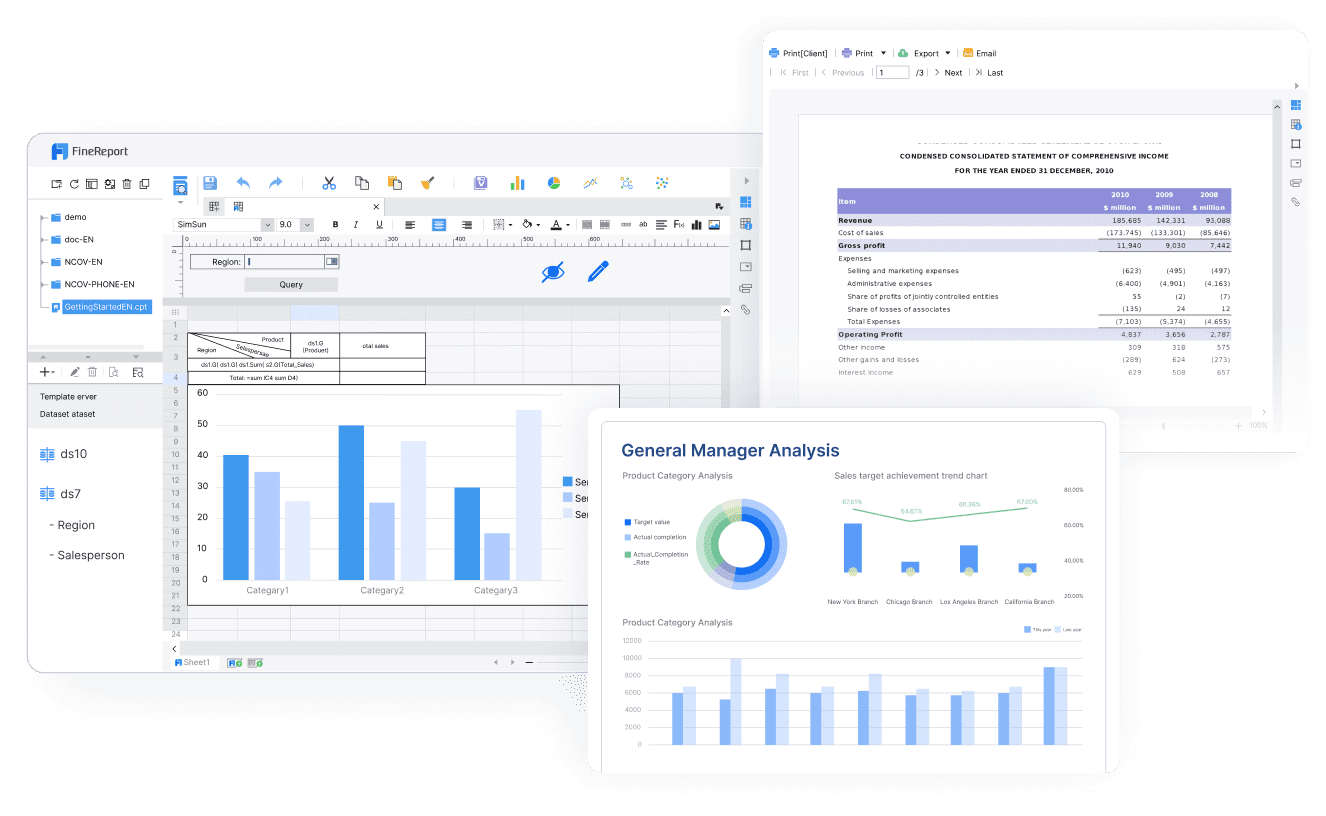
FineReport fits here as the trusted reporting foundation. It can standardize formatted reports, operational cockpits, exception lists, management summaries, and reporting workflows across supply chain functions.
A strong reporting architecture includes more than charts. It needs governed KPI definitions, role-based access, report templates, drill paths, and operational views that align with business decisions.
This is also where AI becomes practical. Dora acts as an enterprise Data Agent layer on top of trusted report and data assets. Instead of asking analysts to manually interpret every dashboard, business users can interact with reports through natural language, receive structured summaries, and get exception pushes on time.
Core supply chain KPI and report element framework
On-time delivery rate Definition: Percentage of orders delivered by the committed date. Business value: Measures service reliability and customer promise performance. AI use:Dora can explain service-level declines, summarize delayed regions or carriers, and generate a management narrative for weekly review.
Order cycle time Definition: Time from order entry to delivery completion. Business value: Reveals process speed and bottlenecks across fulfillment stages. AI use:Dora can compare cycle time shifts by product line, channel, or warehouse and identify abnormal segments.
Inventory and replenishment
Inventory days of supply Definition: Estimated number of days current stock can support demand. Business value: Balances service protection against excess working capital. AI use:Dora can summarize low-coverage SKUs, link to source reports, and push risk alerts to planners.
Stockout rate Definition: Frequency of demand that cannot be fulfilled due to insufficient inventory. Business value: Shows where availability failures hurt revenue and service levels. AI use:Dora can highlight recurring stockout patterns and include impacted suppliers or plants in a follow-up summary.
Procurement and supplier performance
Supplier on-time-in-full Definition: Percentage of supplier deliveries received complete and on time. Business value: Indicates supplier reliability and inbound risk exposure. AI use:Dora can generate supplier scorecard summaries and flag vendors breaching thresholds.
Purchase order aging Definition: Open purchase orders grouped by overdue duration. Business value: Improves buyer prioritization and exception management. AI use:Dora can detect overdue clusters, explain potential business impact, and push tasks to procurement owners.
Logistics and transportation
Shipment delay rate Definition: Share of shipments arriving later than planned milestones. Business value: Helps control service failures, penalties, and disruption costs. AI use:Dora can summarize top delay causes by route, carrier, or lane and support pre-meeting briefing packs.
Freight cost per unit or order Definition: Transportation cost allocated per shipment, order, or delivered unit. Business value: Connects logistics efficiency to margin and pricing. AI use:Dora can explain abnormal cost spikes and compare trends against volume shifts.
Fill rate Definition: Percentage of demand fulfilled without backorder or substitution. Business value: Combines planning, procurement, and execution effectiveness. AI use:Dora can create a structured executive summary linking fill-rate decline to inventory, supplier, or transport issues.
Exception backlog Definition: Open unresolved supply chain issues requiring action. Business value: Shows whether the organization is controlling operational risk fast enough. AI use:Dora can produce a daily exception digest and route the right issues to the right owners.
Layer 6: Security, governance, and compliance
Supply chain systems often involve internal users, external partners, finance-linked records, customer information, and cross-border operations. That makes governance essential.
This layer should include:
identity and authentication controls
role-based access to data and reports
partner-specific access restrictions
audit trails for transactions, workflow actions, and report consumption
data lineage for KPI trust and compliance reviews
retention and privacy controls where customer or employee data is involved
Governance is not only a security requirement. It is what makes AI reporting usable in enterprises. If access rights, KPI definitions, and semantic rules are unclear, AI outputs become hard to trust. FineReport supports governed report distribution and permission-based access, while Dora should operate within those same boundaries rather than bypass them.
For IT teams, this is a major shift in the AI era. The goal is no longer to manually answer every reporting question. It is to manage data quality, semantic consistency, permissions, templates, and reusable AI Skills so that business users can safely self-serve.
Layer 7: Infrastructure, reliability, and delivery operations
Supply chain platforms support business-critical processes that often run across time zones, warehouses, carriers, plants, and partner networks. Reliability therefore needs architectural attention from the start.
This layer includes:
deployment model choices such as cloud, hybrid, or on-premises
monitoring and observability across applications, integrations, and data pipelines
disaster recovery and backup design
scaling for seasonal peaks and operational bursts
release management and rollback capability
service-level objectives for uptime and processing reliability
A good architecture defines what “business-critical” means in practice. For example:
how quickly delayed events must be reprocessed
what report refresh windows are acceptable
how integration failures are detected and escalated
what fallback modes exist during partner outages
how global operations are supported outside central office hours
Without this layer, even well-designed applications fail under real operating pressure.
Choosing architectural patterns for scale and change
When microservices make sense in supply chain platforms
Microservices are useful when a supply chain platform has clear domain boundaries, multiple teams need independent release cycles, and change speed differs significantly across capabilities.
They are often a good fit when:
warehouse, transportation, and order management evolve at different speeds
integrations need isolated scaling characteristics
teams need domain-level ownership with clear APIs
certain capabilities require different technology stacks or deployment cadences
the platform must support broad regional or product variation without affecting the whole system
But microservices also add cost. They increase the burden of:
distributed transaction management
observability across many services
end-to-end testing
version control of APIs and events
operational complexity and service sprawl
Supply chain leaders should avoid adopting microservices as a status symbol. If domain boundaries, ownership, and platform discipline are immature, the architecture becomes harder to manage, not easier.
When modular monoliths or hybrid models are the better fit
Many organizations are better served by a modular monolith or hybrid model, especially when ERP remains central and modernization needs to happen in stages.
A modular monolith works well when:
the business still needs strong process consistency
one platform team owns most of the capability set
release coordination is acceptable
the architecture is still clarifying domain boundaries
operational simplicity matters more than independent deployment
Hybrid architectures are common in supply chain transformation because legacy systems rarely disappear overnight. ERP, WMS, or partner EDI networks may remain central while newer capabilities are added around them. In these cases, selective decoupling is usually more practical than a full rebuild.
The key is discipline in module boundaries. Even if services are not physically split yet, teams should define ownership, interfaces, and data responsibility as if they might be later.
Designing software components around business capabilities
Components should be grouped around stable domain responsibilities, not temporary team structures.
Good component boundaries typically align with:
order lifecycle management
inventory availability and allocation
supplier collaboration
transport planning and tracking
returns and claims
exception management
reporting and operational intelligence
Each component should have clear answers to three questions:
What business outcome does it own?
What data does it authoritatively manage?
What events or APIs does it expose to others?
This reduces coupling and makes process change cheaper. If changing a warehouse rule requires edits across procurement, finance, reporting, and transport codebases, the architecture is already too tangled.
Building the data and reporting foundation
Creating a reference architecture for trusted supply chain data
A reference architecture for trusted supply chain data connects five essential elements:
Operational systems such as ERP, WMS, TMS, supplier platforms, and order channels
Integration pipelines using APIs, EDI, queues, event streams, and batch jobs
Storage and processing layers for operational, historical, and curated data
Semantic models that define shared KPI logic and business terms
BI and reporting tools that turn trusted data into usable operational and management outputs
The most important outcome is not just centralization. It is shared meaning.
Organizations need common definitions for:
orders and order status
shipments and milestone status
inventory positions and availability
suppliers and supplier performance
service-level commitments
costs and exception classifications
FineReport helps turn that model into usable outputs: formatted operational reports, management reports, exception lists, and cockpit views. This matters because many supply chain users do not just need raw dashboards. They need highly structured reporting that supports daily operations, executive review, and auditability.
Supporting executive reporting and AI-driven insights
There is a practical maturity path from descriptive reporting to AI-driven insight.
Descriptive: What happened?
Diagnostic: Why did it happen?
Predictive: What is likely to happen next?
Prescriptive: What action should be considered?
Most enterprises get stuck between descriptive and diagnostic because trusted reporting itself is fragmented. The foundation must come first: clean master data, governed KPIs, clear semantic rules, and report templates that users trust.
Once that exists, Dora can extend the value of reporting through Agentic BI workflows. Executives do not want another dashboard to search through. They want a timely, structured explanation of what changed, what matters, and where follow-up is needed.
For executives, the ROI is concrete: Dora is not an AI experiment. It is a landed digital employee for recurring reporting work such as weekly service-level summaries, inventory risk briefings, supplier delay reports, freight cost reviews, and owner follow-up.
In supply chain environments, the hardest reporting task is often not building a dashboard. It is getting the right people to consume it, understand exceptions, and follow up quickly.
A concrete chat-style example might look like this:
“Summarize this week’s supply chain operations report, highlight delayed shipments, low-stock SKUs, and overdue purchase orders, then list the owners who need follow-up.”
Here is a practical AI workflow:
Retrieve trusted FineReport assets Dora accesses the relevant FineReport operational cockpit, weekly report, or exception list rather than generating answers from ungoverned raw prompts.
Understand KPI definitions and semantic rules Dora uses the governed business context behind the report, including what counts as a delay, how inventory risk is calculated, and which owner is responsible for each exception type.
Generate a structured report summary Dora creates a chart-based answer or management narrative in chat, covering service levels, shipment delays, stock risks, procurement exceptions, and key changes versus prior periods.
Detect and prioritize exceptions
Using thresholds and business rules, Dora highlights threshold breaches, abnormal changes, overdue items, or supplier risks that deserve attention.
Push summaries and alerts to responsible users Dora can support scheduled briefings, exception pushes, and team-specific notifications so planners, buyers, warehouse leads, or executives receive the right information on time.
Create follow-up visibility Dora can support follow-up records, recurring digests, and review-oriented outputs so teams can track whether issues were addressed after the briefing.
This is where the FineReport foundation matters. FineReport provides the trusted reporting layer: operational cockpits, formatted reports, KPI logic, permissions, report templates, and enterprise reporting workflows. Dora does not replace that foundation. It turns it into a scenario-specific AI assistant or AI digital employee for report consumption and operational follow-through.
Compared with raw prompt-only agents, this governed approach is better suited to enterprise reporting because it can work through trusted semantics, controlled Skills, permission boundaries, and report-linked outputs. That improves landing capability in real organizations and helps reduce token waste while supporting faster, more stable execution paths.
For business users, the result is lower friction. They do not have to search across multiple reports, ask analysts for explanations, or manually summarize every metric before a meeting. They can receive timely briefings, chat-based answers, and exception pushes based on trusted supply chain reporting assets.
Define measurable outcomes such as shorter exception response time, fewer manual reconciliations, improved report consistency, or faster management review cycles.
Phase 2: Stabilize integration and data definitions
Phase 4: Add Dora for high-value recurring reporting workflows
Introduce Dora where the reporting workload is frequent, manual, and action-oriented, such as:
daily supply chain briefings
weekly service-level summaries
supplier delay exception pushes
inventory risk reviews
meeting preparation and follow-up summaries
Phase 5: Expand governed AI Skills gradually
Add more controlled Agentic BI workflows over time, keeping human review where needed and expanding only after KPI governance and data quality are stable.
Risks that weaken architecture over time
Several patterns repeatedly degrade supply chain architecture:
duplicated business logic across ERP, custom apps, and reporting tools
inconsistent KPI definitions across teams
brittle integrations with unclear ownership
poor master data governance
tool-led decisions that ignore process design
excessive service decomposition without domain maturity
AI initiatives launched before semantic rules and report trust are in place
These risks often emerge slowly. A platform may appear functional while hidden complexity accumulates. Then every process change becomes expensive.
What a practical target state looks like
A practical target state is not perfect centralization. It is an architecture that is integrated, observable, secure, and ready for continuous improvement.
It should have the following characteristics:
clear system ownership for transactions and master data
domain-aligned application boundaries
reliable API, EDI, queue, and event integration patterns
consistent workflow and exception management
governed KPI definitions and trusted reports
role-based access and auditability
observable infrastructure and integration operations
support for scheduled and timely reporting
AI-assisted report consumption built on trusted enterprise assets
1. Standardize KPI definitions, report templates, and exception rules first
Supply chain AI reporting fails when core terms are ambiguous. Define what counts as an overdue PO, a delayed shipment, an inventory risk event, or a service-level breach. FineReport works best when report templates and operational views already reflect these standards. Dora becomes more useful when it can summarize a governed report rather than interpret inconsistent logic.
2. Build the semantic layer inside the reporting workflow
Do not treat semantics as a separate documentation exercise. KPI logic, business terms, filter rules, and ownership mappings should live close to the reporting assets business users actually consume. This gives Dora a stronger trusted foundation for chat-based report answers, structured summaries, and exception explanations.
3. Start with recurring, high-value reporting scenarios
Do not try to automate every report. Begin with reports that are frequent, cross-functional, and time-sensitive, such as daily logistics briefings, weekly inventory risk reports, or supplier delay summaries. These scenarios have the highest landing potential for a Daily Briefing Secretary or Risk Alert Officer workflow.
4. Preserve permission governance when enabling AI report access
AI outputs must respect FineReport access boundaries. Users should only receive summaries, linked reports, and alerts for data they are authorized to view. This is one of the clearest differences between enterprise Data Agent deployment and generic chatbot behavior.
5. Keep human review in the loop as AI workflows expand
Use Dora to accelerate report consumption, not to bypass governance. Structured summaries, chart explanations, scheduled push messages, and follow-up digests should be reviewed in early rollout stages. As data quality, report consistency, and Skills mature, teams can expand automation with more confidence.
Building this manually is complex. FineReport helps teams standardize trusted reports, operational cockpits, templates, and reporting workflows. Dora turns those assets into an AI assistant that can answer report questions in chat, generate structured summaries, push scheduled briefings, monitor exceptions, and follow up with responsible owners.
That combination is especially relevant in supply chain management software architecture because reporting is tightly linked to action. Teams do not just need a dashboard. They need reliable execution support around delays, shortages, supplier exceptions, and service-level commitments.
FineReport can serve as the reporting foundation for:
supply chain control towers
warehouse and logistics dashboards
procurement and supplier scorecards
inventory risk reports
executive management summaries
exception tracking and reporting workflows
Dora can then activate those assets through enterprise Data Agent scenarios such as:
a Report Researcher producing structured weekly supply chain summaries
a Daily Briefing Secretary sending scheduled morning operations digests
a Risk Alert Officer pushing alerts on delayed shipments, overdue POs, or stock risk exceptions
FineReport + Dora is not only a reporting upgrade; it is a practical fourth-generation Agentic BI path.FineReport provides governed reports and operational cockpits. Dora provides the AI assistant layer for scenario execution, with more controlled Skills, lower token waste, faster execution paths, and more stable workflows than prompt-only agents.
Get Ready-to-Use Dashboard Templates in Fine Gallery
The strongest Dora pitch is scenario + product + service: FineReport provides the trusted reporting foundation, Dora provides the AI digital employee, and implementation service connects data, governance, semantic setup, Skills, report templates, permissions, and rollout.
If your current supply chain platform still depends on people manually preparing reports, manually explaining charts, and manually chasing owners after exceptions appear, there is a more practical path forward. Start with trusted reporting. Then turn that reporting into governed AI-assisted execution.
It is the structure that connects core business systems, integrations, workflows, data, analytics, and governance across the supply chain. Its goal is to keep operations and reporting aligned so teams can act on a shared version of the truth.
ERP usually serves as the transaction backbone for purchasing, inventory, finance, and master data. Strong ERP integration reduces duplicate logic, prevents conflicting records, and improves end-to-end process visibility.
Most architectures include ERP, WMS, TMS, CRM, supplier portals, manufacturing or MES systems, and a reporting layer. These systems work together to support planning, procurement, warehousing, transportation, fulfillment, and executive monitoring.
Reporting turns operational data into dashboards, KPI tracking, and exception monitoring for daily decisions. AI adds faster summaries, natural language access, scheduled briefings, and automated alerts based on trusted report data.
They need clear ownership of each process and data object, reliable integrations between systems, and timely exception handling. A layered architecture also helps teams scale changes, support real-time monitoring, and respond faster to disruptions.
Product Trial
FineReport
Pixel-perfect reports · Interactive dashboards · Easy data entry · Digital twins