Law firm financial reporting should do more than close the books. It should help leadership understand which practice areas are generating healthy margins, which partners are driving profitable growth, where cash is getting stuck, and which matters deserve different pricing or staffing decisions.
For most firms, the challenge is not a lack of numbers. It is turning billing, time, collections, WIP, AR, and matter data into reporting that leaders can actually use. The next challenge is speed: finance teams often spend too much time preparing reports manually, while partners wait too long for answers.
With FineReport + Dora, teams can ask for a report summary in chat, generate structured narratives from trusted report assets, receive scheduled briefings, and push exceptions to the right owner. That means law firm leaders can move from static month-end packets to governed, timely, scenario-based reporting supported by an enterprise AI assistant and Data Agent layer.
Click To Try The Dashboard
All reports in this article are built with FineReport
What law firm financial reporting should help you answer
Effective law firm financial reporting should answer practical business questions that influence partner compensation, staffing, pricing, collections, and growth planning.
At a minimum, reporting should help leadership answer questions such as:
Are we converting billed work into collected cash efficiently?
Which partners and practice groups are contributing the strongest margins?
Where is lockup growing, and which matters need collection follow-up?
Are current staffing models improving leverage or creating excess cost?
Which matter types are profitable, and which ones consume capacity without acceptable return?
Are monthly results improving because of sustainable performance, or only because of one-time factors?
Show which reports support better decisions on cash flow, profitability, staffing, and growth
A well-designed reporting system usually includes several layers:
Practice group report: Revenue quality, staffing leverage, utilization, profitability, and trend analysis
Matter profitability report: Hours, rates, staffing mix, write-downs, direct costs, and collected margin
Collections and aging report: WIP aging, AR aging, overdue balances, and owner follow-up status
Each report serves a different decision. Finance may need detail for operational control, while managing partners need a concise management view with trend indicators and exceptions.
Clarify the difference between compliance-focused reporting and management reporting for day-to-day leadership
Many firms still rely heavily on accounting outputs built for compliance, audit, or historical reporting. Those reports are necessary, but they are not enough for management.
Compliance-focused reporting typically emphasizes:
For example, an income statement may show total revenue and expense, but management reporting should explain why realization fell in one practice area, why collections are slowing for a specific partner portfolio, or why certain matter types are producing weak margin despite high billings.
Identify the questions partners, firm administrators, and practice leaders need answered each month
Different stakeholders need different answers from the same reporting foundation.
Partners want to know:
How are my billings, collections, realization, and originations trending?
Which matters are helping or hurting profitability?
Are my write-downs or aging balances increasing?
Firm administrators and finance leaders want to know:
Is cash flow stable?
Where is lockup increasing?
Which teams need intervention on billing discipline, collections, or staffing?
Are pricing and matter intake decisions supporting firm goals?
Practice leaders want to know:
Which teams are over- or under-utilized?
Are we using the right leverage model?
Which matter types are growing profitably?
Where are discounting and write-downs eroding performance?
The best law firm reporting environment brings these perspectives together through one governed reporting foundation rather than disconnected spreadsheets and one-off partner requests.
Strong law firm financial reporting starts with a clear KPI framework. Not every firm needs dozens of metrics. Most firms benefit more from a disciplined set of definitions, consistent time periods, and reliable ownership of the numbers.
Below are the core KPI groups that matter most.
Revenue, collections, and realization
Revenue quality matters more than revenue volume alone. A firm can post strong billings and still underperform if realization weakens or collections slow.
Billed fees: Total fees invoiced in the period. Business value: Shows billing output and supports revenue trend analysis. AI use:Dora can summarize whether billed fees are rising because of higher hours, stronger rates, or changes in matter mix.
Collected fees: Cash collected on billed work. Business value: Reflects actual cash conversion and supports liquidity planning. AI use:Dora can compare collections against billings and flag which partner portfolios need follow-up.
Collection rate: Collected fees as a percentage of billed fees or receivables, depending on the firm's definition. Business value: Indicates how effectively the firm turns invoices into cash. AI use:Dora can explain collection deterioration by office, partner, client segment, or aging band.
Realization: The percentage of standard value converted into billed or collected revenue. Business value: Measures pricing discipline, discounting pressure, and write-down impact. AI use:Dora can generate a structured report summary showing where realization is weakening and whether the issue is concentrated in certain matter types or fee arrangements.
Comparing these metrics across timekeepers and practice areas is critical. The reporting periods should be consistent, with clear month-over-month and year-over-year views. Without that discipline, leadership may react to noise instead of trend.
Utilization, productivity, and leverage
A profitable law firm does not only bill more. It also deploys its people effectively.
Worked hours: Total hours recorded, including billable and non-billable time. Business value: Helps assess capacity and operational load. AI use:Dora can identify whether rising worked hours are translating into stronger billable output.
Billable hours: Hours eligible for client billing. Business value: Core measure of fee-earning activity. AI use:Dora can summarize top and bottom performers and highlight shifts by team or office.
Utilization rate: Billable hours divided by available or worked hours, based on the firm’s standard. Business value: Indicates whether staffing capacity is being used effectively. AI use:Dora can explain utilization gaps and prepare manager briefings for underutilized groups.
Leverage: Ratio of associates or other fee earners to partners, or mix of junior-to-senior staffing on matters. Business value: Shows whether work is being delivered with an economically sound staffing model. AI use:Dora can compare leverage across similar practices and summarize where partner-heavy delivery is compressing margins.
Law firms can appear healthy on paper while facing cash pressure because work is slow to bill or collect.
WIP days: Average days work remains unbilled. Business value: Shows delay between work performed and invoicing. AI use:Dora can monitor growing WIP aging and push reminders to responsible owners.
AR days: Average days invoices remain unpaid. Business value: Measures collection speed and client payment behavior. AI use:Dora can flag clients, partners, or matters where AR is deteriorating.
Lockup: Combined WIP days and AR days, or total capital tied up before cash collection. Business value: One of the most important indicators of law firm working capital efficiency. AI use:Dora can produce a chart-based answer showing whether lockup is being driven more by billing delay or collection delay.
Cash position: Current liquidity and available operating cash. Business value: Supports compensation planning, hiring, and capital decisions. AI use:Dora can generate scheduled finance briefings linking cash trends to collections, seasonal billings, and overdue balances.
Early warning matters here. Aging balances should be visible before they become major collection problems. A law firm reporting cockpit should make exceptions obvious, not bury them in long spreadsheets.
Building reports for partner performance
Partner performance reporting is one of the most sensitive parts of law firm financial reporting. It influences compensation, staffing decisions, client strategy, and firm politics. That is why fairness in definitions matters as much as the numbers themselves.
Metrics that create fair comparisons
Partner reporting should not rely on one headline metric. A balanced scorecard is more defensible and more useful.
Common components include:
Originations: Business generated by the partner Business value: Measures client development contribution. AI use:Dora can summarize origination trends and show whether growth is converting into profitable, collectible work.
Responsible attorney credit: Ongoing management responsibility for the client or matter Business value: Reflects relationship management and matter ownership. AI use:Dora can explain differences between origination and execution portfolios.
Billings: Revenue invoiced under the partner's matters Business value: Indicates production and billing activity. AI use:Dora can detect whether billings are growing faster than collections, which may signal future lockup risk.
Collections: Cash received on the partner’s billed work Business value: Shows whether economic value is being realized in cash. AI use:Dora can create exception lists for partners with increasing overdue balances.
Margin contribution: Revenue less direct or allocated costs based on the firm’s methodology Business value: Moves evaluation beyond volume toward economic contribution. AI use:Dora can generate a structured narrative comparing margin contribution across partner cohorts.
Fair comparisons require adjustment for:
practice mix
matter type
fee arrangement
staffing structure
client profile
strategic versus routine work
A litigation partner with long-running contingent or complex matters should not necessarily be judged using the same pattern as a high-volume commercial transactions partner. Reporting design needs to reflect that reality.
One-period snapshots can mislead. Partner performance should be evaluated through trend views, not isolated monthly results.
Useful trend dimensions include:
month-over-month movement
year-over-year comparisons
rolling 12-month averages
seasonality patterns
collections timing effects
matter lifecycle stage
Quantitative measures should also be paired with qualitative context:
client development
leadership contribution
supervision quality
team development
cross-practice collaboration
This is where structured management reporting becomes especially valuable. Finance can provide the numbers, but leadership needs interpretation. A trusted FineReport dashboard can show the metrics and trends, while Dora can generate a concise management narrative that explains what changed and where follow-up is needed.
Common reporting mistakes to avoid
Several mistakes repeatedly weaken partner reporting:
Overemphasizing originations without profitability context
Rewarding high billings even when realization is falling
Ignoring write-downs and collection quality
Comparing partners without adjusting for practice or matter mix
Relying on manually prepared reports with inconsistent definitions
Looking only at one month instead of sustained trends
A better approach is to balance growth, collections, realization, and contribution. High billings are not automatically positive if they are followed by large write-downs, slow collections, or weak margin.
Measuring matter profitability in a practical way
Matter profitability is where law firm reporting becomes strategically powerful. It connects pricing, staffing, and client selection decisions to real economic outcomes.
The data inputs that matter most
Matter profitability reports should be practical before they are perfect. Firms do not need a theoretical model that nobody trusts. They need a transparent model with consistent definitions.
Core inputs often include:
Rates: Standard, agreed, and effective rates Business value: Shows pricing power and discount effect. AI use:Dora can explain whether margin pressure is driven by lower rates or higher labor input.
Hours: Total worked and billable hours by role Business value: Identifies effort consumed and staffing intensity. AI use:Dora can summarize whether the matter is tracking above or below expected effort.
Write-downs: Reductions before billing Business value: Signals pricing weakness, scope issues, or poor matter management. AI use:Dora can flag matters with repeated write-down patterns for review.
Staffing mix: Partner, associate, paralegal, and other resource allocation Business value: Shows whether work is being delivered at the right cost level. AI use:Dora can compare margin across similar matters with different staffing structures.
Direct costs: Matter-specific expenses and disbursements Business value: Improves visibility into actual contribution. AI use:Dora can include these in margin summaries and exception alerts.
Collection outcomes: What portion of billed value is actually collected Business value: Prevents firms from overestimating profitability based only on billed amounts. AI use:Dora can distinguish billed margin from collected margin in management summaries.
Firms should define whether profitability is measured at:
billed margin
collected margin
fully loaded margin
That definition should remain stable. Otherwise, leaders may compare reports that are not actually comparable.
Two matters with the same fee total can produce very different margin outcomes. That is why law firm reporting should examine staffing and pricing together.
For example:
A partner-heavy model may support quality and client confidence but compress margin on routine work.
An associate-led model may improve leverage if supervision is strong and work is delegated appropriately.
An alternative staffing model may increase margin for process-heavy or repeatable work if scope and quality are controlled.
Pricing also matters:
flat fees may improve predictability but hurt margin if staffing is not disciplined
discounts may help win work but become harmful if realization and collection outcomes also weaken
premium pricing can support margin when matched to complexity, expertise, or urgency
A strong matter profitability report should let leaders compare similar matters by:
staffing mix
fee arrangement
write-down level
collection timing
margin outcome
Using profitability insights to make better decisions
Matter profitability should shape decisions, not just appear in retrospective reports.
Use it to:
refine pricing policies
improve matter intake decisions
set more realistic budgets
adjust staffing models
identify client segments that create strong contribution
spot matters that consume effort without acceptable returns
This is especially useful for firms trying to balance growth with partner capacity. If certain clients or matter types consistently absorb senior time, create frequent write-downs, and collect slowly, leadership should know early enough to change terms or resource allocation.
How an AI Data Agent Automates Report Consumption
Traditional reporting still leaves many law firm leaders with a practical problem: even when the dashboard exists, someone still has to open it, interpret the numbers, prepare a summary, identify exceptions, and chase follow-up.
That is where Dora adds value as an enterprise Data Agent layer on top of trusted reporting assets.
For this scenario, the most relevant Dora digital employees are:
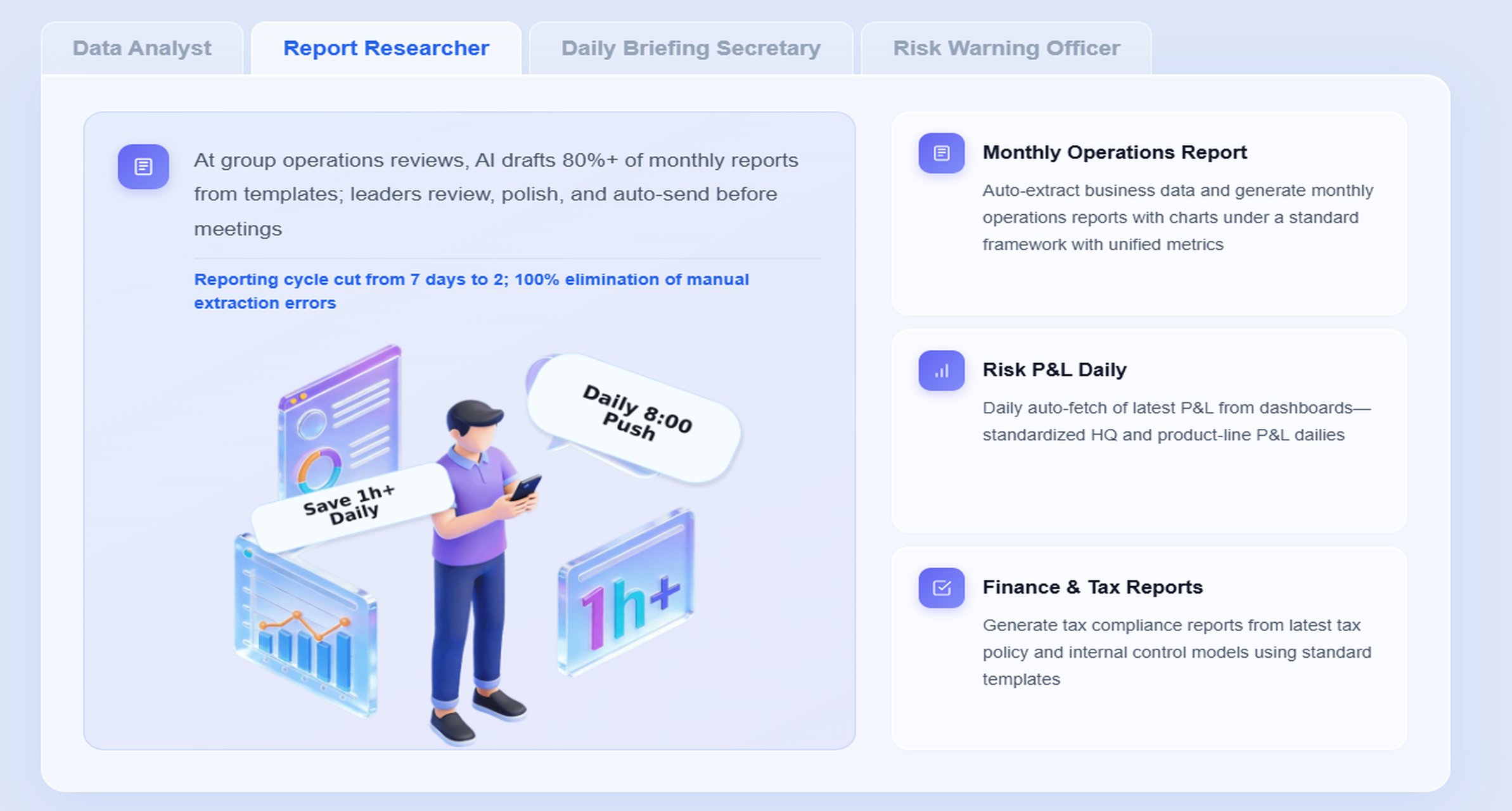
Report Researcher for structured report generation from FineReport outputs, templates, charts, and business knowledge
Daily Briefing Secretary for scheduled monthly and weekly finance summaries
Risk Alert Officer for monitoring lockup, aging balances, realization drops, and underperforming partner portfolios
FineReport remains the reporting foundation. It provides the trusted reports, operational cockpits, formatted financial statements, partner scorecards, matter profitability templates, and governed KPI definitions. Dora turns that governed foundation into a scenario-specific AI assistant that helps users consume reports faster and act on exceptions sooner.
A practical chat-style request might look like this:
“Summarize this month’s law firm financial reporting package, highlight any decline in realization or collections by practice group, identify matters with the highest lockup increase, and list the responsible partners who need follow-up.”
Dora can support a governed AI workflow like this:
Retrieve trusted FineReport report or operational cockpit data. Dora accesses the approved monthly finance dashboard, partner scorecard, and matter profitability report built in FineReport.
Understand KPI definitions, report templates, filters, business terms, and semantic rules. Dora uses the firm’s governed semantic layer so realization, lockup, WIP days, AR days, and margin are interpreted consistently.
Generate structured report summaries and chart explanations through chat. Dora returns a management-friendly summary that explains revenue quality, collections movement, utilization trends, and profitability changes.
Detect exceptions and threshold breaches. Dora identifies abnormal drops in realization, rising WIP or AR aging, partner portfolios with weak collection patterns, and matters with deteriorating contribution.
Push alerts and suggested follow-up to responsible users.
A Risk Alert Officer can notify finance leaders, practice managers, or responsible partners about overdue balances or lockup growth.
Produce follow-up records and scheduled briefings.
A Daily Briefing Secretary can prepare recurring monthly or weekly summaries for leadership meetings and preserve follow-up context.
This matters because report consumption is often the real bottleneck. The dashboard may already exist, but executives still need:
a fast summary
clear exception identification
plain-language explanation
links back to the source report
owner-based follow-up
Dora improves execution through chat, summaries, alerts, pushes, and follow-up. It is not a generic chatbot and it is not a replacement for FineReport. It is an Agentic BI layer that works with governed report assets, permissions, KPI logic, report templates, and reusable Skills.
That governance is important in law firms. Financial reporting often depends on sensitive partner, client, and matter-level data. A raw prompt-only AI tool may produce inconsistent answers if definitions are unclear or permissions are not respected. Dora is designed for stronger enterprise fit through:
permissions control
semantic rules
KPI governance
report templates
data quality alignment
skills-based execution for more auditable workflows
It also gives firms better landing capability than feature-only agent comparisons because it starts from real reporting scenarios: monthly management packs, collections follow-up, partner reviews, profitability analysis, and exception alerts.
For executives, the message is simple: Dora is not an AI experiment. It is a landed AI digital employee for recurring reporting work such as monthly management reports, collections risk summaries, matter profitability reviews, and owner follow-up.
For IT and reporting teams, the role shifts from manually producing every summary to improving the governed reporting layer: data connections, KPI definitions, report templates, permissions, semantic logic, and reusable AI Skills.
For business users, Dora reduces friction. Instead of searching through multiple reports or waiting for analysts, they can get timely summaries, chart-based answers, scheduled briefings, and exception pushes based on trusted FineReport assets.
Turning reporting into better firm decisions
The value of law firm financial reporting does not come from dashboard production alone. It comes from turning reporting into recurring management action.
Create a reporting cadence leaders will actually use
A practical cadence often looks like this:
Monthly dashboards for revenue, collections, realization, cash flow, lockup, and partner performance
Quarterly reviews for practice profitability, staffing leverage, and pricing effectiveness
Exception-based follow-up for underperforming matters, aging balances, and realization deterioration
Cadence matters because many firms either report too slowly or overload leaders with too much information. A concise monthly cockpit, supported by deeper drill-down views, usually creates better decision discipline.
Consistency matters too. Report definitions should not shift every month. If realization or margin is calculated differently across reports, leadership will lose confidence in the numbers.
Align finance, operations, and practice leadership
The best reporting environments create one shared scorecard. Finance, billing, operations, and attorneys should work from the same governed metrics.
That alignment should connect reports to actions such as:
pricing changes for low-margin work
collection plans for aging receivables
staffing adjustments for partner-heavy matters
tighter billing discipline on long WIP matters
matter intake review for weak-return work
This is another strong use case for FineReport + Dora. FineReport can standardize the operational cockpit and scorecard. Dora can turn that scorecard into a usable management workflow through scheduled summaries, exception push notifications, and chat-based explanations.
Improve data quality over time
No AI reporting workflow is stronger than the reporting foundation underneath it. Law firms should improve data quality as part of the reporting initiative, not as a separate later phase.
Priority areas include:
standardized matter coding
disciplined time entry
consistent billing status updates
reliable expense tracking
clear partner and matter ownership fields
agreed KPI definitions
Start with a manageable KPI set and expand gradually. Firms often get better results by establishing trust in a few core indicators first, then widening the scope once users rely on the outputs.
Actionable Best Practices
Below are practical steps that help law firms make reporting useful and enterprise-ready.
1. Standardize report templates and KPI definitions first
Before expanding automation, define:
realization logic
lockup calculation
partner credit rules
profitability methodology
time period comparisons
exception thresholds
This gives FineReport a stable reporting structure and gives Dora a trusted semantic foundation for accurate summaries and chart explanations.
2. Start with high-value recurring reports, not every report
4. Define alert thresholds, responsibility rules, and escalation paths
AI reporting is most useful when it drives action. Firms should define:
what counts as abnormal realization decline
when WIP aging becomes a follow-up case
which overdue AR thresholds trigger alerts
who owns collection follow-up
when unresolved items escalate
This allows Dora to operate as a practical Risk Alert Officer, not just a passive answer tool.
5. Use human review for AI-generated management narratives
AI-generated summaries should support decision-making, not replace professional judgment. Start with human review for monthly narratives, exception commentary, and partner-facing outputs. As governance improves, the firm can expand the range of approved Skills and summary workflows.
FineReport + Dora for law firm financial reporting
Building this manually is complex. FineReport helps teams standardize trusted reports, operational cockpits, templates, and reporting workflows. Dora turns those assets into an AI assistant that can answer report questions in chat, generate structured summaries, push scheduled briefings, monitor exceptions, and follow up with responsible owners.
For a law firm, that means one platform strategy can support:
natural-language query over trusted reporting assets
chat-based AI assistant for report consumption
report, cockpit, metric, and exception retrieval from FineReport assets
structured report summaries and management narratives
scheduled summaries, briefings, and push notifications
digital employees for repeatable reporting workflows
skills-based execution for more controllable and auditable AI workflows
FineReport + Dora is not only a reporting upgrade; it is a practical fourth-generation Agentic BI path. FineReport provides governed reports and operational cockpits. Dora provides the AI assistant layer for scenario execution, with more controlled Skills, lower token waste, faster execution paths, and more stable workflows than prompt-only agents.
Get Ready-to-Use Dashboard Templates in Fine Gallery
The strongest Dora pitch is scenario + product + service: FineReport provides the trusted reporting foundation, Dora provides the AI digital employee, and implementation service connects data, governance, semantic setup, Skills, report templates, permissions, and rollout.
For law firms trying to improve reporting without creating another disconnected AI experiment, that combination is what makes adoption practical. Finance gets a stronger reporting foundation. Leadership gets faster answers and structured summaries. Practice leaders get timely exception visibility. IT gets a more governable AI path built on trusted enterprise assets.
The most useful KPIs usually include billed fees, collected fees, realization, WIP, accounts receivable, lockup, matter profitability, and partner or practice group margin. Together, they show how well the firm turns work into cash and profit.
Standard financial reporting focuses on historical accuracy, close results, and compliance needs. Management reporting is designed to explain performance, highlight exceptions, and support decisions on pricing, staffing, collections, and growth.
High billings do not always mean a matter is financially healthy because write-downs, staffing mix, direct costs, and slow collections can reduce margin. Matter profitability helps firms see which work actually creates sustainable returns.
Firms usually improve collections by monitoring WIP and AR aging closely, enforcing billing discipline, and assigning follow-up accountability to the right partner or owner. Faster visibility into overdue balances also helps leaders act before cash gets stuck.
FineReport and Dora can help firms turn billing, collections, and matter data into governed dashboards, narrative summaries, scheduled briefings, and exception alerts. This reduces manual reporting work and gives leaders faster answers for operational decisions.
Product Trial
FineReport
Pixel-perfect reports · Interactive dashboards · Easy data entry · Digital twins