Operations leaders do not need more software for its own sake. They need the right mix of systems to improve planning accuracy, execution discipline, service performance, and response speed when disruptions hit. That is why understanding the types of supply chain management software matters before comparing vendors, approving budgets, or launching a transformation roadmap.
At a practical level, supply chain management software spans the full operating model: planning, sourcing, procurement, production, warehousing, transportation, order fulfillment, visibility, and after-sales flows. The challenge is that many teams evaluate tools category by category, while the real business problems cut across functions. Inventory bloat, expediting cost, supplier delays, low fill rates, and poor exception handling rarely sit inside one system alone.
With FineReport + Dora, teams can ask for a report summary in chat, generate structured narratives from trusted report assets, receive scheduled briefings, and push exceptions to the right owner. That makes software selection and operations management more actionable, because leaders do not just implement systems; they also improve how people consume reports, monitor performance, and follow up on exceptions across those systems.
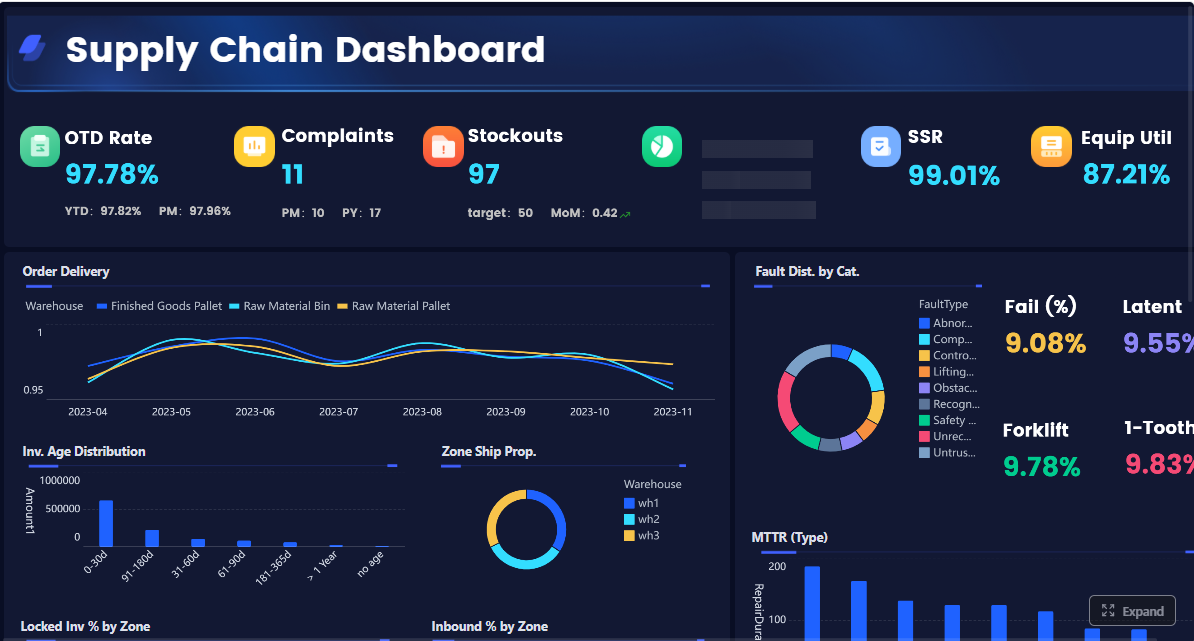 Click To Try The Dashboard
All reports in this article are built with FineReport
What operations leaders should know about types of supply chain management software
Supply chain management software is a broad category of business systems used to coordinate the flow of materials, information, orders, inventory, capacity, and service activities across the value chain. In most enterprises, this means software that supports five major domains:
- Planning: forecasting, inventory targets, supply balancing, scenario analysis
- Sourcing and procurement: supplier collaboration, requisitions, purchasing, contracts, spend analysis
- Production: scheduling, shop-floor execution, material availability, throughput management
- Logistics and fulfillment: warehouse operations, transportation execution, order orchestration
- Service and returns: reverse logistics, claims, repairs, returns, after-sales follow-up
For operations leaders, the main reason to understand the different software categories is simple: not every problem should be solved with the same platform. A warehouse delay is not a forecasting issue. A supplier compliance problem is not the same as an order routing problem. A visibility gap may require reporting and alerting improvements even before a new transactional system is deployed.
Understanding software categories helps teams:
- Avoid buying overlapping tools
- Identify the real source of performance issues
- Build a phased digital roadmap instead of a fragmented shopping list
- Align operations, procurement, IT, and finance around measurable goals
- Separate vendor marketing claims from actual category fit
This is also where reporting and AI-assisted report consumption become critical. Many enterprises already have ERP, WMS, TMS, procurement, and planning tools, but still struggle to turn those systems into timely operational decisions. FineReport provides the trusted reporting and operational cockpit foundation across supply chain metrics, while Dora adds an enterprise Data Agent layer so business users can query, summarize, and follow up on those assets in a governed way.
For executives, the value is concrete: Dora is not an AI experiment. It is a landed digital employee for recurring reporting work such as weekly supply review packs, inventory risk summaries, supplier delay alerts, logistics exception briefings, and owner follow-up.
For IT teams, the role shifts from manually answering every business question to improving data connections, KPI governance, semantic rules, report templates, permissions, and reusable agent Skills.
For business users, the benefit is lower friction: timely summaries, chat-based answers, scheduled briefings, and exception pushes without hunting through dashboards or waiting on analysts.
The 12 core software categories used across the supply chain
Planning and forecasting systems
Planning systems shape upstream decisions before cost and service problems become visible downstream. They help teams anticipate demand, align supply, and allocate working capital more effectively.
Demand planning and forecasting tools
- Report Element: Demand forecast by product, channel, region, or customer segment.
Business value: Better forecasts reduce stockouts, overstocks, markdown risk, and emergency replenishment.
AI use: Dora can summarize forecast changes, explain which product families drove the revision, and generate a scheduled management briefing from the FineReport forecast dashboard.
Demand planning tools typically use historical demand, seasonality, promotions, and business assumptions to estimate future demand. For operations leaders, the real question is not whether the software has forecasting algorithms, but whether teams can understand forecast variance and act on it quickly.
FineReport can consolidate forecast accuracy, bias, and demand trend reporting into an executive-ready cockpit. Dora can then help planners and operations managers ask natural-language questions such as which SKUs had the largest forecast miss last week and what that means for replenishment risk.
Supply planning and inventory optimization platforms
- Report Element: Recommended inventory targets, safety stock, replenishment plans, and supply-demand balance.
Business value: Supports working capital control while protecting service levels and production continuity.
AI use: Dora can identify inventory exceptions, summarize slow-moving and at-risk items, and push alerts to planners or plant owners.
These tools determine how much inventory to hold, where to position it, and when to replenish. They are especially important in volatile networks where service targets, lead times, and storage costs conflict.
From a reporting perspective, operations leaders need more than static inventory snapshots. They need trusted views of excess stock, stockout exposure, days of supply, and aging inventory. FineReport can standardize those reports across sites and business units. Dora can turn those assets into structured report summaries and exception-based follow-up.
Sales and operations planning support systems
- Report Element: Consensus demand, capacity constraints, inventory outlook, and scenario comparison.
Business value: Improves cross-functional coordination between sales, operations, procurement, and finance.
AI use: Dora can generate pre-meeting summaries, highlight unresolved gaps, and create a chat-based management narrative from the FineReport S&OP cockpit.
S&OP support systems help organizations bridge commercial demand with operational reality. In practice, many S&OP failures come less from missing software and more from poor visibility, inconsistent KPI definitions, and slow meeting preparation.
This is a strong use case for FineReport + Dora. FineReport can standardize the operating pack and KPI logic. Dora, acting as a Daily Briefing Secretary or Report Researcher, can prepare periodic summaries, explain plan-vs-actual changes, and push unresolved issues to stakeholders before review meetings.
Sourcing, procurement, and supplier management systems
Procurement-led modernization often delivers early wins because spend visibility, supplier compliance, and contract discipline directly affect cost and resilience.
E-procurement and purchasing tools
- Report Element: Purchase requisitions, approval status, PO cycle time, maverick spend, and compliance rate.
Business value: Improves purchasing control, reduces manual processing, and supports policy compliance.
AI use: Dora can summarize overdue approvals, identify unusual purchase patterns, and send scheduled procurement briefings.
E-procurement systems manage requisitions, approvals, purchase orders, catalogs, and buying workflows. For operations leaders, these tools are valuable not just for efficiency but for control. They make it easier to see where purchasing activity deviates from policy or budget.
FineReport can combine procurement KPIs into a control cockpit for operations and finance. Dora can help users query trusted spend and approval data in natural language and generate chart-based answers for recurring reviews.
Supplier relationship and performance management software
- Report Element: On-time delivery, quality performance, lead time stability, responsiveness, and supplier scorecards.
Business value: Strengthens supplier accountability, reduces disruption risk, and supports sourcing decisions.
AI use: Dora can explain performance deterioration, flag suppliers breaching thresholds, and create follow-up records for supplier review meetings.
Supplier performance systems help teams manage scorecards, corrective actions, collaboration, and risk signals across vendors. This matters most when supply chain resilience depends on a small number of critical suppliers.
FineReport can present supplier scorecards in a comparable format across plants, categories, or regions. Dora, acting as a Risk Alert Officer, can monitor threshold breaches and push timely alerts when supplier OTIF, defect rates, or lead times degrade.
Contract and spend analysis platforms
- Report Element: Contract utilization, savings tracking, spend by category, off-contract buying, and supplier concentration.
Business value: Protects margins, improves negotiation leverage, and supports better sourcing governance.
AI use: Dora can produce structured spend summaries, identify concentration risks, and answer chat-based questions about cost changes from trusted report assets.
Contract and spend analysis tools help enterprises see where money is going and whether negotiated terms are actually being used. These systems are especially useful in multi-site operations where local purchasing behavior can erode central savings plans.
FineReport can unify category spend, savings performance, and compliance reporting. Dora can turn that into periodic briefings for procurement and operations leaders, reducing the time spent assembling monthly reviews.
Execution and fulfillment systems
Execution systems run the physical movement of goods. They matter because service failures usually become visible here first.
Warehouse management systems
- Report Element: Inventory location accuracy, picking productivity, dock performance, order cycle time, and aging backlog.
Business value: Increases warehouse accuracy, throughput, labor efficiency, and order readiness.
AI use: Dora can summarize shift performance, identify throughput bottlenecks, and push exception alerts for backlogs or accuracy issues.
A WMS manages receiving, putaway, inventory control, picking, packing, and shipping inside the warehouse. For operations leaders, the key is whether warehouse data can be turned into actionable performance management.
FineReport can provide operational cockpits for inbound, outbound, labor, and aging orders. Dora can help frontline managers consume those reports faster through chat-based summaries and scheduled shift briefings.
Transportation management systems
- Report Element: Freight cost, route performance, carrier utilization, on-time delivery, and exception shipments.
Business value: Controls logistics spend, improves delivery reliability, and reduces manual coordination.
AI use: Dora can highlight delayed lanes, explain freight cost spikes, and notify logistics owners about exceptions needing action.
TMS platforms help plan loads, select carriers, execute shipments, and track transportation performance. For many organizations, transportation is one of the fastest places to capture savings, but only if cost and service data are visible enough to manage by lane, carrier, and customer impact.
FineReport can consolidate freight dashboards and carrier scorecards. Dora can monitor exceptions and push targeted summaries to logistics teams or executives who do not need to log into multiple systems.
Order management systems
- Report Element: Order status, fill rate, allocation status, backorders, split shipments, and customer exceptions.
Business value: Improves customer experience, revenue capture, and coordinated order fulfillment across channels.
AI use: Dora can explain delayed orders, summarize backlog drivers, and generate customer-service-ready narratives from FineReport reports.
Order management systems are especially important in omnichannel environments where inventory, availability, and fulfillment choices change dynamically. Operations leaders should view OMS not only as an order tracking tool but as a control point for service-level performance.
FineReport can present backlog, fill-rate, and exception views by channel or customer tier. Dora can serve as a Data Analyst digital employee, answering questions like which orders are delayed due to warehouse shortage versus transport delay.
Manufacturing, visibility, and returns systems
These systems support production control, end-to-end visibility, and the handling of non-linear flows such as returns and repairs.
Manufacturing execution and production scheduling software
- Report Element: Production plan adherence, OEE-related output views, work-in-process, downtime, and schedule attainment.
Business value: Improves throughput, schedule reliability, and plant-level decision-making.
AI use: Dora can summarize line performance, explain schedule misses, and create periodic operation summaries for plant leaders.
Manufacturing execution and scheduling software helps align plans with actual shop-floor execution. In asset-heavy businesses, this category is often central because production constraints ripple through inventory, customer service, and procurement decisions.
FineReport can standardize production and scheduling reports across plants. Dora can convert those trusted outputs into management narratives that highlight exceptions, overdue actions, and daily follow-up items.
Supply chain visibility and control tower platforms
- Report Element: End-to-end milestone tracking, ETA changes, cross-node exceptions, shortage signals, and risk event dashboards.
Business value: Improves disruption response, cross-functional coordination, and decision speed.
AI use: Dora can monitor abnormal changes, summarize enterprise-wide exceptions, and push role-based alerts linked to source reports.
Visibility and control tower platforms pull data across suppliers, logistics providers, plants, warehouses, and customer orders to provide a broader operating picture. This category is often the most strategic, but also the most dependent on strong data integration and governance.
For many enterprises, the real value is unlocked only when visibility data is translated into prioritized action. FineReport provides the trusted cockpit layer. Dora adds the enterprise Data Agent capability to summarize exceptions, explain impacts, and follow up with owners.
Returns, reverse logistics, and after-sales service tools
- Report Element: Return rate, return reasons, turnaround time, recovery value, service SLA, and recurring defect patterns.
Business value: Protects margin, improves customer retention, and reduces waste in post-sale operations.
AI use: Dora can summarize return trends, highlight recurring causes, and support periodic service briefings with linked FineReport outputs.
Returns and after-sales tools are increasingly important in industries with warranty, repair, refurbishment, or omnichannel return complexity. They influence customer satisfaction as much as forward logistics does.
FineReport can make returns and service performance visible at product, region, or service-center level. Dora can generate structured summaries and exception pushes so leaders see whether the issue is quality, fulfillment, or customer handling.
How to match each software type to operational goals
Cost control and margin protection
If the primary goal is cost control, operations leaders should focus on categories that reduce waste, excess inventory, and avoidable logistics spend.
The strongest combinations usually include:
- Demand planning and forecasting tools to reduce overbuying and rush reactions
- Supply planning and inventory optimization platforms to lower carrying cost and obsolescence
- E-procurement and spend analysis tools to improve buying discipline and contract compliance
- Transportation management systems to reduce expedite fees and improve freight decisions
The important point is that software should not only execute transactions but also support disciplined review. FineReport helps expose margin leakage through trusted KPI reporting. Dora helps teams consume those reports faster through summaries, exception pushes, and chat-based analysis.
Example: a logistics director can receive a weekly freight variance summary, ask Dora to explain cost increases by lane and carrier, and push follow-up items to the responsible transportation manager.
Service levels and customer experience
If service performance is the priority, operations leaders should connect software categories that influence order promise, fulfillment accuracy, and exception response.
Key categories include:
- Order management systems
- Warehouse management systems
- Transportation management systems
- Supply chain visibility and control tower platforms
These systems together improve fill rate, delivery reliability, order status transparency, and issue resolution. But service-level improvement also depends on how quickly users understand exceptions.
FineReport can create a service-level cockpit spanning order backlog, warehouse backlog, carrier delays, and customer exceptions. Dora can then summarize what changed, identify the highest-priority failures, and push timely alerts to owners who need to act.
Risk resilience and cross-functional coordination
For resilience, the priority is not just visibility but coordinated response. That usually requires combining:
- Supplier relationship and performance management software
- Planning and scenario support systems
- Visibility and control tower platforms
- Manufacturing and scheduling tools where internal capacity matters
This stack helps teams anticipate shortages, model scenarios, understand impact, and manage escalation. It also makes cross-functional reviews more productive when everyone works from the same KPI definitions and trusted report templates.
FineReport supports this through governed reporting, while Dora helps convert signals into action-oriented briefings and follow-up.
How an AI Data Agent Automates Report Consumption
Most enterprises already have some combination of ERP, WMS, TMS, procurement, planning, and manufacturing systems. The bottleneck is often not the absence of data. It is the manual effort required to gather reports, interpret changes, summarize issues, and follow up with owners.
This is where Dora adds value as an enterprise Data Agent on top of FineReport’s reporting and operational cockpit foundation.
The Dora digital employee for this scenario
For supply chain operations leaders, the most relevant Dora digital employees are:
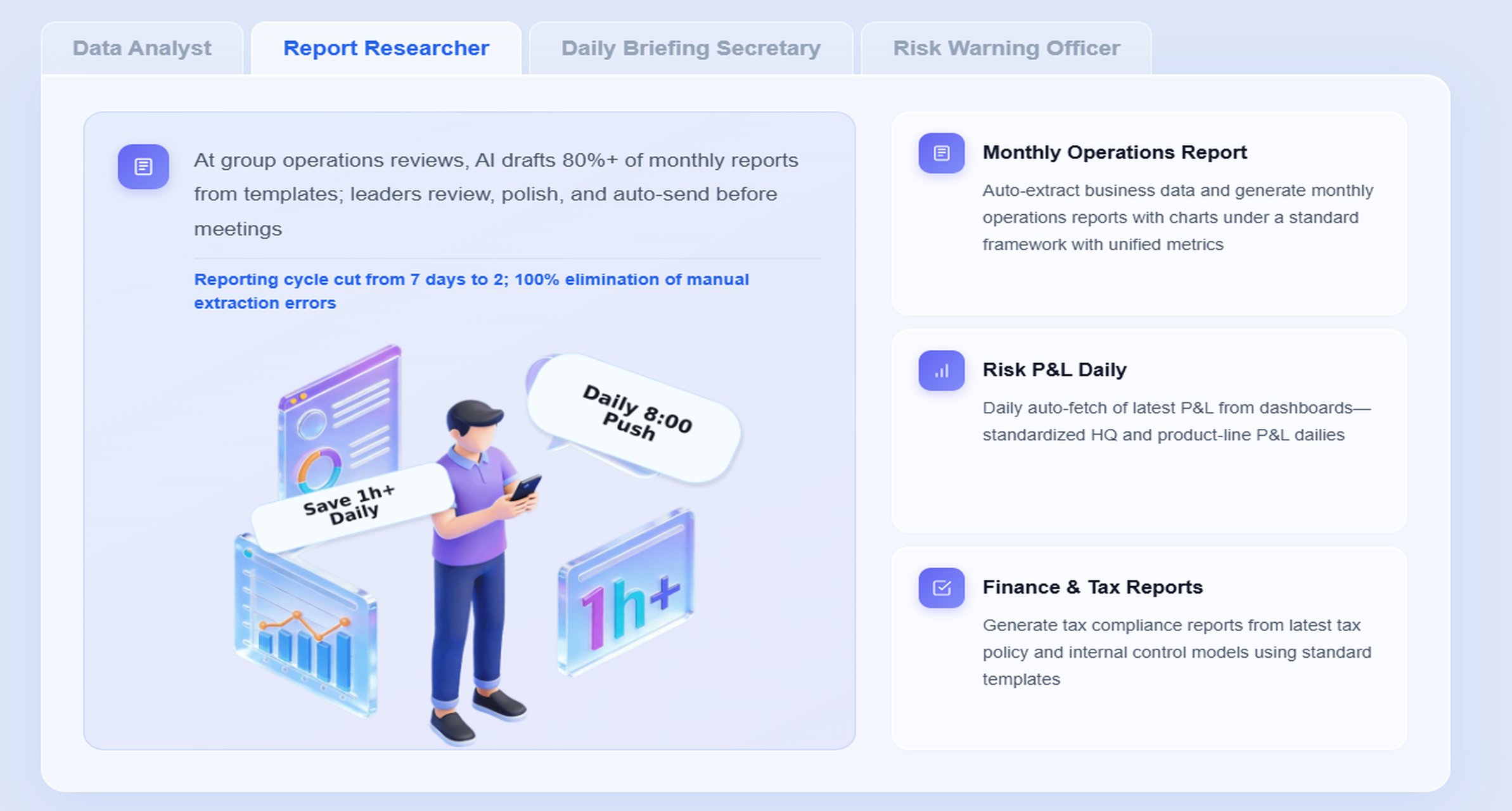
- Daily Briefing Secretary for scheduled supply chain summaries and meeting prep
- Report Researcher for structured report generation from existing FineReport assets
- Risk Alert Officer for exception monitoring and owner notification
- Data Analyst digital employee for natural-language KPI explanation and follow-up analysis
FineReport provides the trusted reporting and semantic foundation: KPI definitions, report templates, chart logic, filters, permissions, and cross-system operational cockpits. Dora uses that governed foundation to deliver more controllable and auditable AI workflows than raw prompt-only agents.
A concrete chat-style example
An operations leader might ask:
“Summarize this week’s supply chain performance, highlight abnormal inventory and transport cost changes, list delayed suppliers affecting customer orders, and identify the owners who need follow-up.”
Dora can respond with a structured report summary based on trusted FineReport assets rather than unguided text generation. It can also link users back to the source report for drill-through and review.
A practical 6-step AI workflow
-
Retrieve trusted FineReport report or operational cockpit data
Dora accesses the approved supply chain dashboard, such as inventory risk, supplier performance, logistics cost, and order backlog reports. -
Understand KPI definitions, filters, business terms, and semantic rules
Because FineReport provides governed report logic, Dora can distinguish between planned inventory, at-risk inventory, confirmed delays, and actual service failures. -
Generate a structured report summary through chat
Dora produces a management-ready narrative: what changed, where the risk sits, and which trends require attention. -
Detect exceptions and threshold breaches
Dora identifies abnormal freight cost spikes, overdue purchase orders, low fill-rate regions, delayed suppliers, or inventory positions below policy thresholds. -
Push summaries, alerts, and suggested follow-up
Dora can send scheduled briefings to operations leaders, alert plant or logistics owners, and route issue summaries to the right responsibility center. -
Produce follow-up records or periodic review summaries
Dora can support daily or weekly review cycles by tracking unresolved exceptions and generating a fresh briefing for the next meeting.
Why this works better in an enterprise setting
A supply chain AI workflow only lands if the reporting foundation is trusted. That means:
- controlled permissions
- stable KPI definitions
- governed report templates
- consistent business terminology
- connected source systems
- usable exception rules
That is why Dora should be positioned as an AI assistant and digital employee layer, not as a replacement for FineReport. FineReport builds the reporting backbone. Dora turns that foundation into Agentic BI for report consumption and follow-up.
In practical terms, Dora improves execution through:
- natural-language query over trusted reporting assets
- chat-based AI assistant for report consumption
- report, cockpit, metric, and exception retrieval from FineReport assets
- generation of structured report summaries and chart explanations
- scheduled summaries and daily or weekly briefings
- exception alerts and push notifications
- skills-based execution for controllable and auditable workflows
- better enterprise fit through permissions, semantic rules, KPI governance, and data quality
For operations teams, this means less time collecting updates and more time resolving issues.
How supply chain software types fit into common operating models
Centralized, decentralized, and hybrid supply chain structures
The right software mix depends heavily on governance.
Centralized models usually benefit from stronger standardization in planning, procurement, visibility, and reporting. A centralized team often wants common KPI definitions, harmonized supplier scorecards, and enterprise-wide control towers.
Decentralized models typically need systems that allow business-unit flexibility while preserving baseline reporting consistency. In these environments, local WMS, procurement, or manufacturing processes may vary, so FineReport becomes especially useful as a unifying reporting layer across heterogeneous systems.
Hybrid models are the most common. They often centralize policy, reporting, and certain planning functions while leaving execution choices to plants, regions, or business units. Dora fits well here because it can serve different user groups with the same trusted reporting assets while respecting access boundaries.
Asset-heavy, outsourced, and omnichannel networks
Operating model also determines which software categories matter most.
Asset-heavy networks usually prioritize:
- manufacturing execution and scheduling
- supply planning
- warehouse management
- transportation management
These businesses need plant-level visibility, schedule adherence, and inventory control.
Outsourced networks often prioritize:
- supplier relationship management
- visibility and control tower platforms
- order management
- transportation coordination
They depend more on collaboration and milestone visibility across third parties.
Omnichannel networks typically need:
- order management systems
- warehouse management systems
- transportation management systems
- returns and after-sales tools
Their complexity comes from order routing, service expectations, and reverse logistics.
In each model, the reporting requirement remains the same: leaders need a trustworthy, role-specific operational cockpit. FineReport supports that. Dora makes the cockpit easier to consume and act on.
Procurement-led modernization priorities
In many organizations, procurement is the fastest place to start modernization because the benefits are visible and measurable.
Modern supply chain management software for procurement can create quick wins through:
- better spend visibility
- faster approval workflows
- improved contract compliance
- stronger supplier performance oversight
- clearer collaboration between procurement and operations
For example, a procurement-led roadmap might start with e-procurement, supplier performance management, and spend analytics, then connect those outputs into FineReport dashboards for executive oversight. Dora can then provide scheduled procurement summaries, exception alerts, and chat-based answers without requiring every stakeholder to manually inspect multiple reports.
What to look for when evaluating software in 2026
Core selection criteria for operations leaders
When evaluating the types of supply chain management software, category fit should come first, but not by itself. Operations leaders should assess each category against the following criteria:
Integration with ERP and existing platforms
Software should fit the enterprise architecture, not create another silo. Check how it connects with ERP, procurement, manufacturing, logistics, and reporting platforms.
Data quality, usability, analytics, and workflow automation
Even strong software underperforms if users cannot trust the data or if workflows remain manual. Reporting usability matters as much as transactional capability.
Scalability, implementation effort, total cost of ownership, and vendor support
A tool that solves one site’s problem but does not scale across plants, regions, or channels may become expensive technical debt. Selection should consider rollout complexity and operating model fit.
Operations leaders should also assess whether the software improves decision velocity, not just recordkeeping. That includes whether exceptions can be surfaced, summarized, and routed effectively through reports and AI-assisted workflows.
Building a practical shortlist and roadmap
A strong shortlist starts with business pain points, not market hype.
Good prioritization questions include:
- Where are the biggest cost leaks today?
- Which service failures most affect customers?
- What disruptions create the most revenue or margin risk?
- Which processes already have system coverage but weak reporting or follow-up?
- Where can cross-functional visibility create the fastest operational payoff?
In many cases, the right roadmap is phased:
- Fix the highest-impact category first
- Standardize KPI definitions and report templates
- Build trusted operational cockpits in FineReport
- Add Dora for chat-based summaries, alerts, and follow-up
- Expand to adjacent workflows with reusable semantic rules and Skills
This approach separates real category fit from vendor storytelling. It also avoids overinvesting in large suites before the organization is ready to use them effectively.
Actionable best practices
1. Standardize KPI definitions, business terms, and report templates first
If fill rate, supplier delay, inventory risk, or transport cost means different things across teams, no software category will fully solve the problem. FineReport is valuable here because it helps standardize trusted reports and operational cockpits before AI consumption is layered on.
2. Treat data quality as part of the AI and reporting implementation
Dora works best when report assets are governed. That means data quality, source alignment, filters, and semantic setup should be part of the project scope, not an afterthought.
3. Start with high-value recurring reports, not every workflow at once
A practical first use case might be a weekly supply chain review, daily warehouse briefing, supplier exception summary, or transport cost alert. Dora lands fastest where recurring report consumption is frequent, manual, and decision-relevant.
4. Define alert thresholds, owners, and escalation paths
AI-generated summaries are useful, but real execution requires clear responsibility rules. For example, if supplier OTIF falls below threshold or freight cost exceeds plan, Dora should be able to push the issue to a named owner and support follow-up.
5. Preserve permission governance and use human review for important narratives
AI outputs should respect FineReport access boundaries. For executive and customer-facing narratives, human review remains important, especially during early rollout. Expand Dora Skills gradually as governance matures.
FineReport + Dora solution pitch
Building this manually is complex. FineReport helps teams standardize trusted reports, operational cockpits, templates, and reporting workflows. Dora turns those assets into an AI assistant that can answer report questions in chat, generate structured summaries, push scheduled briefings, monitor exceptions, and follow up with responsible owners.
For supply chain operations leaders, that matters because most transformation programs do not fail from lack of dashboards. They fail because people still spend too much time searching, reconciling, summarizing, and escalating. FineReport addresses the reporting foundation. Dora adds the execution layer for AI-assisted report consumption.
FineReport + Dora is not only a reporting upgrade; it is a practical fourth-generation Agentic BI path. FineReport provides governed reports and operational cockpits. Dora provides the AI assistant layer for scenario execution, with more controlled Skills, lower token waste, faster execution paths, and more stable workflows than prompt-only agents.
This makes the combination especially relevant when enterprises already have multiple supply chain systems but need better landing capability than feature-only agent comparisons. Instead of asking AI to operate without context, FineReport + Dora works from trusted metrics, governed semantic rules, report templates, and permission boundaries.
Get Ready-to-Use Dashboard Templates in Fine Gallery
The strongest Dora pitch is scenario + product + service: FineReport provides the trusted reporting foundation, Dora provides the AI digital employee, and implementation service connects data, governance, semantic setup, Skills, report templates, permissions, and rollout.
Final takeaway: choosing the right mix instead of chasing every system
The best answer to the question of types of supply chain management software is not a single platform. It is the right combination of categories for your strategy, network design, process maturity, and execution gaps.
Some organizations need stronger planning and inventory optimization. Others need warehouse and transportation discipline. Others need procurement visibility, supplier performance control, or end-to-end exception management. The right roadmap starts with operational pain points and measurable outcomes, then builds in phases.
For operations leaders, there is also a second decision beyond software selection: how the enterprise will consume the data those systems produce. FineReport helps build the trusted reporting and operational cockpit layer. Dora helps teams move from manually preparing and interpreting reports to AI-assisted query, summary, alerting, and follow-up.
That is how supply chain software becomes more than a stack of systems. It becomes a practical operating model for faster decisions, better coordination, and more consistent execution.
FAQs
The main categories usually include planning and forecasting, procurement and sourcing, production, warehouse management, transportation management, order management, visibility platforms, and returns or service systems. Each category supports a different part of the supply chain operating model.