
AI & Data
Ripping the Fig Leaf off AI Commercialization: Why a Projected 100% Efficiency Gain Still Leaves Your Product Worthless
In my previous post, we discussed the do-or-die nature of technical architecture: how, in our battle against LLM hallucinations, my team and I eventually fell back on what seemed like the most boring path — the NL2DSL (Natural Language to Domain-Specific Language) approach. But after building an airtight data firewall under the hood with DSL and pushing our accuracy to 99%, we were blindsided by a much harsher reality: technical perfection doesn’t mean customers will actually open their wallets.
After auditing dozens of real-world enterprise AI deployments in 2025, we found a trail of shattered expectations. Countless product managers are sitting in their offices, patting themselves on the back over beautiful DAU curves, completely oblivious to the fact that to the executives signing the checks, the project is already dead in the water.
Now, I’m going to shatter the three most deceptive fairy tales in this industry.

Fairytale 1: Data Democratization and the Math Nobody Wants to Do
Empowering the frontline with data is a noble-sounding slogan plastered across almost every AI startup’s pitch deck. Yet, the reality check hits hard.
We once deployed a project at a top-tier FMCG company, and the initial results were exhilarating: around 500 frontline sales reps were actively using our conversational AI tool daily to query data and track their progress. But during the year-end post-mortem meeting, the client’s Head of IT poured cold water on our enthusiasm: Is it useful? Sure. Is it worth paying hundreds of thousands to renew? Absolutely not.
Why? Let’s do the math:
- Frontline Sales: 100% efficiency gain × 0.1 organizational weight = 10 points of perceived value
- Senior Management: 40% efficiency gain × 1.0 organizational weight = 40 points of perceived value
User value does not equal product value, and it certainly doesn’t equal commercial value. Saving 500 grassroots sales reps 15 minutes a day looking up spreadsheets, that’s user value. But from the enterprise’s perspective, those 15 minutes are highly likely to be pocketed as free time, rather than converting into incremental revenue. If an AI tool cannot directly move the needle on the KPIs of the “decision-makers holding the budget,” then its so-called “empowerment” is nothing but a worthless pseudo-demand in a commercial context.
Fairytale 2: ChatBI Reduced to a Dashboard 2.0 Vanity Project
Remember the data dashboard craze that swept through enterprises a few years back? Executives pounded the table demanding them, IT departments tore their hair out pulling all-nighters to build them, and ultimately, business units paid a steep trial-and-error tax, leaving behind a digital graveyard of giant, untouched screens.
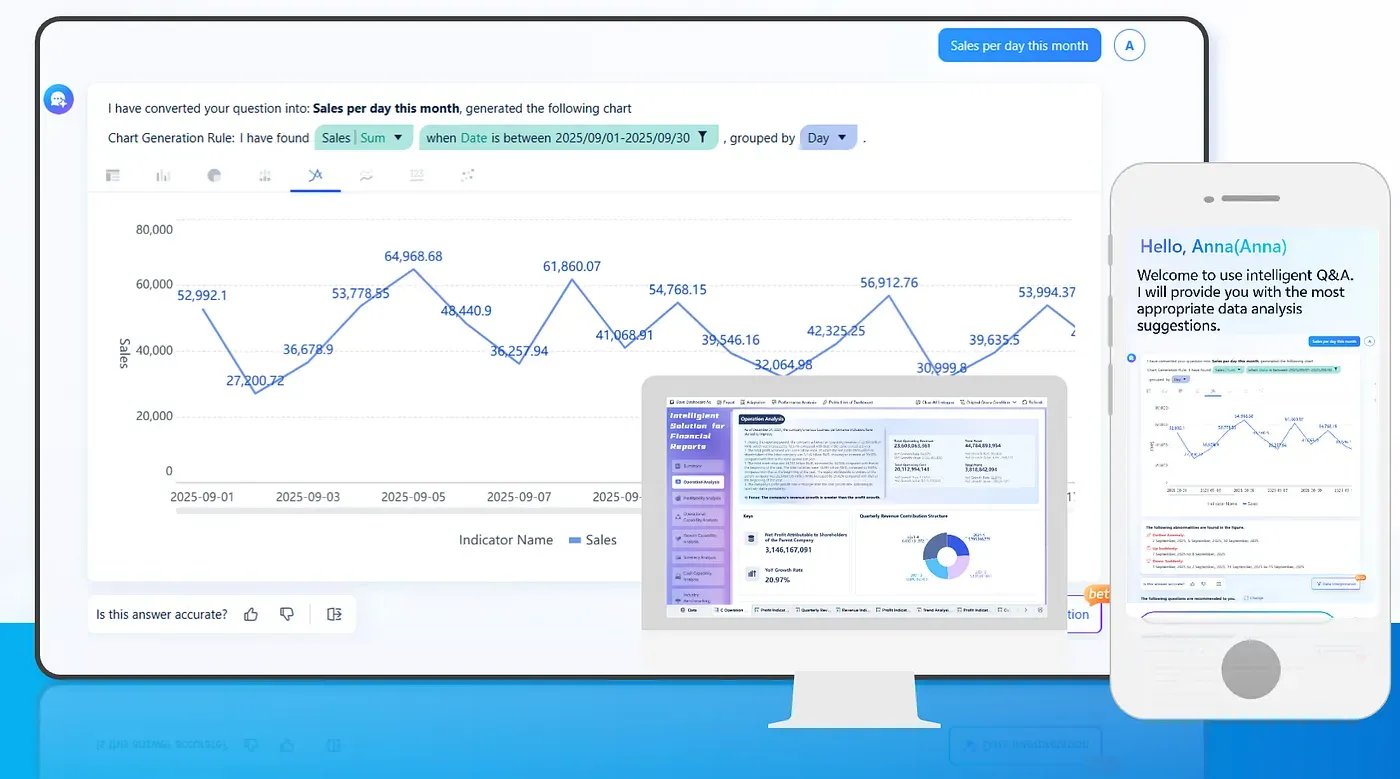
Today’s ChatBI and various AI analytics tools are marching down this exact same disastrous path. At a recent industry summit, the Head of IT from a pharmaceutical distribution giant proudly showcased over a dozen innovative AI use cases. Yet, he remained dead silent about the ChatBI system they had paid a premium for. Off the record, he confessed: “The results fell far short of expectations. Everyone is still just doing things the old way.”
For many enterprises, current AI data projects are nothing more than AI vanity projects. They are procurement-driven (designed to make the company look tech-savvy), rather than problem-driven. If you fail to spot the telltale signs of a “political project” from day one, your delivery team will be dragged into a bottomless pit of deployment hell. Acknowledging this brutal reality is the first step to ensuring your product actually survives.
Fairytale 3: The U-Curve of Death for the Semi-Digital Enterprise
Many B2B practitioners operate on the gut assumption that the higher a client’s digital maturity, the better their AI readiness, making for an easier win.
Wrong. The reality actually maps to a bizarre and unforgiving U-curve:
- High Digital Maturity ➔ Zero opportunity for you. They’ve already patched their pain points internally with complex, in-house systems.
- Zero Digital Maturity ➔ Hard pass. They haven’t even done basic data cleansing, let alone AI.
- Medium Digital Maturity ➔ The ultimate death trap.
These “semi-digital” companies usually rely on clunky legacy systems that “sort of” work. They are the easiest targets for AI sales reps to crack. But this is exactly where deployments go to die. Why? Because while the old workflow is a terrible experience, it’s still “good enough”; meanwhile, the actual ROI of bringing in AI remains frustratingly fuzzy.
The moment a user realizes they still have to manually reconcile the AI’s numbers, the switching cost skyrockets. They will unhesitatingly retreat back to their shabby but familiar Excel spreadsheets.
My takeaway is this: stop trying to optimize workflows that are merely “okay.” Hunt for scenarios where the legacy experience is an absolute, unavoidable, daily disaster. If you can’t find one, simply walk away from the deal.
The Playbook: Hunting for Mandatory Business Pain Points
After wading through this illusion of traction, we finally found the muddy trenches where real commercial value is actually forged. Our deployment with a Fortune 500 energy giant remains the gold standard within our team.
Operating on a classic B2B distribution model, they require high-frequency communication with distributors and face cutthroat sales targets. They didn’t chase any grandiose “data democratization for all” vision. Instead, they laser-focused on one hyper-specific use case: tracking service volumes across different time slots, then deciding when to schedule their weekly stand-ups.
Why was this use case such a massive success?
- Embedded in the workflow: It was the direct input for shift-scheduling decisions, rather than a siloed data-querying tool.
- Quantifiable pain points: The turnaround time for traditional dashboard development simply couldn’t keep pace with their rapid business pivots.
- Crystal clear ROI: Replacing manual reporting with AI directly saved 2 full-time headcounts at 200k each, leading to 400k in hard annual cost savings.
- The clincheris, mandatory pressure: No data, means no stand-up meeting, leading to no strategic alignment, causing missed sales targets. Coverage is irrelevant, compulsion is everything.
Final Thoughts
Are we relying too heavily on a ‘tool-centric’ logic to justify our product’s value, while remaining completely blind to human needs and organizational realities?

This was the single most unsettling reflection to emerge from our internal post-mortems. In 2026, the raw intelligence of large language models, the execution speed of your code, and the accuracy of your parsing are nothing more than table stakes.
The true moat is never built inside a code repository. It lies in whether you can decipher the political economy of an organization. It lies in whether you possess the ruthless discipline to quantify value. And it lies in whether you can hunt down and relentlessly latch onto those absolutely mandatory, “do-or-die without data” scenarios.
Got questions? Ping me on Linkedin.

Article by
Saber Chen
AI Product Architect & CPO
Saber has 15 years of experience in enterprise software, where he has guided 43,000+ clients and managed teams of 500+, building top-tier data intelligence solutions. When not building scalable B2B architecture, he's on the basketball court or diving into vibe coding.


Keep Learning
 Fast Answers Are Not Enough: Why Data Agents Need AI-Ready Data
See why enterprise Data Agents need AI-ready data—and how trusted metrics, traceable sources, secure access, timely updates, and business context build trust.
 The Next Step for Enterprise AI: From Productivity Tools to Data Agents That Get Work Done
See how enterprise AI is evolving from productivity tools to Data Agents like Dora, which turn trusted BI into analysis, reports, alerts, and action.
 Stop Calling BI “Dashboards.” The Real Work Is Underwater.
The visualization is the visible 10%. The real work happens underwater, in the crushing depths where no one looks and no one credits.