
If you are researching Databricks vs Snowflake, you are likely trying to answer a practical question: which platform better fits your data architecture, analytics workflow, team skills, and AI roadmap in 2026?
This comparison matters to BI leaders, data engineers, analytics managers, platform owners, and AI-focused organizations because Databricks and Snowflake now overlap in more areas than they used to. Both support modern analytics at scale, both continue expanding beyond their original strengths, and both can sit at the center of a cloud data strategy. But they are still built on different design philosophies.
In simple terms, Databricks is often favored for engineering-heavy, ML-oriented, and lakehouse-centric workloads, while Snowflake is often favored for governed SQL analytics, business reporting, and managed cloud data operations. The better choice depends less on vendor positioning and more on your primary workload, your operating model, and how much complexity your team is prepared to manage.
Databricks vs Snowflake: Quick Comparison Table
| Criteria | Databricks | Snowflake |
|---|---|---|
| Best for | Data engineering, ML, large-scale processing, notebook-driven workflows | SQL analytics, governed reporting, data sharing, managed warehouse operations |
| Core architecture | Lakehouse built around open storage and processing frameworks | Cloud data platform with strong separation of storage and compute |
| Ease of use | Strong for technical users; steeper for business-led teams | Generally easier for SQL-centric analytics teams to onboard |
| Data preparation | Powerful for complex transformations and pipelines | Strong for SQL-based transformation and managed data workflows |
| BI and dashboard serving | Capable, especially in broader modern data stacks | Common fit for BI-heavy environments and self-service SQL analytics |
| Collaboration model | Engineering and data science collaboration through notebooks and shared platform workflows | Cross-team analytics collaboration through governed data access and warehouse-based query patterns |
| Deployment style | Flexible and open for multi-stage data and AI pipelines | Managed simplicity for elastic analytics and reporting workloads |
| Learning curve | Higher for non-technical users | Lower for analysts and SQL-heavy teams |
| Ideal users | Data engineers, data scientists, ML teams, platform teams | BI teams, analysts, finance, operations, governed enterprise analytics teams |
This table gives the short answer, but the real decision comes down to how each platform behaves in practice.
Databricks vs Snowflake at a Glance
Databricks and Snowflake are both major cloud data platforms, but they come from different origins.
- Databricks grew out of the Apache Spark ecosystem and is closely associated with the lakehouse model.
- Snowflake grew as a cloud-native data warehouse platform and later expanded into a broader cloud data ecosystem.
That difference shapes how teams use them.
Databricks typically appeals to organizations that want to unify:
- data engineering
- large-scale transformation
- notebook-based development
- machine learning
- structured and semi-structured data processing
Snowflake typically appeals to organizations that prioritize:
- SQL-first analytics
- governed reporting
- elastic warehouse scaling
- data sharing
- lower day-to-day platform management overhead
For 2026, the short version is this:
- Choose Databricks when your roadmap is led by engineering, AI, complex pipelines, or open-format data workflows.
- Choose Snowflake when your roadmap is led by business analytics, governed SQL access, reporting performance, and operational simplicity.
- Consider both if your organization separates engineering and business analytics layers or is migrating in stages.
Core Differences between Databricks and Snowflake in Architecture and Platform Design
How Databricks approaches the lakehouse model
Databricks is built around the idea that organizations should not need separate systems for raw data storage, large-scale processing, analytics, and machine learning. Its lakehouse approach aims to combine the flexibility of a data lake with some of the reliability and performance expectations of a warehouse.
In practice, that means Databricks is often used for:
- ingesting and processing large volumes of data
- transforming data across multiple stages
- working with structured, semi-structured, and sometimes unstructured data
- enabling data scientists and engineers to collaborate in shared environments
- supporting batch, streaming, and ML workflows in one platform
This architecture is especially useful for teams that need deep control over pipelines and prefer an ecosystem that works across open data formats and code-heavy workflows. Notebook development, iterative experimentation, and multi-language support are part of why Databricks is frequently chosen by technical teams.
How Snowflake approaches the cloud data platform model
Snowflake takes a more managed approach. It is known for its cloud-native design, especially its separation of storage and compute. That model lets teams scale analytics resources independently from storage, which is valuable for variable workloads and concurrent business reporting.
In practice, Snowflake is often used for:
- centralized analytics data platforms
- SQL-heavy transformation and querying
- enterprise reporting
- governed data access
- cross-team data sharing
- business intelligence workloads that need stable performance and simpler operations
Snowflake’s design is attractive to organizations that want to reduce infrastructure tuning and make analytics more accessible to SQL-based users. Its managed experience often shortens time to value for analytics teams that do not want to spend as much effort managing underlying processing frameworks.
What is the difference between Databricks and Snowflake in practice?
The difference between Databricks and Snowflake is not just technical architecture. It affects how teams work every day.
Here is what usually changes in practice:
Data storage patterns
Databricks is more closely associated with data lake and lakehouse patterns, where teams often work with open storage layers and broader data processing flexibility.
Snowflake is more closely associated with managed warehouse-style experiences, even as it broadens its platform capabilities.
Workload management
Databricks is often stronger when workloads include:
- engineering pipelines
- large batch transformations
- streaming
- model experimentation
- custom frameworks
Snowflake is often stronger when workloads include:
- repeated SQL queries
- business dashboards
- governed ad hoc analysis
- high-concurrency reporting
- straightforward warehouse scaling
Governance and operating model
Snowflake is commonly chosen by teams that want a more centralized, governed analytics environment with lower platform friction for analysts.
Databricks is commonly chosen by teams that want flexibility, code-centric workflows, and cross-functional engineering and AI development.
User experience
Databricks tends to feel more natural for engineers and data scientists.
Snowflake tends to feel more natural for SQL analysts, BI teams, and organizations building a managed analytics layer for broad business use.
These distinctions matter because they affect:
- how quickly teams onboard
- how much administrative effort is required
- how costs scale with workload type
- how easy it is to support both technical and business users
Databricks vs Snowflake: Pros and Cons by Team and Workload
When Databricks is the stronger choice
Databricks is often the stronger choice when your data platform needs go beyond reporting and into heavy engineering or AI development.
It is typically a good fit for organizations that need:
- Advanced data engineering: Complex transformations, multi-stage pipelines, and large-scale distributed processing
- Machine learning experimentation: Collaborative environments for model development and iteration
- Notebook-driven workflows: Teams that work in Python, Scala, SQL, or mixed development environments
- Streaming and batch in one ecosystem: Useful when real-time and historical processing need to coexist
- More control over data processing frameworks: Valuable for technically mature data platform teams
Pros of Databricks
- Strong support for engineering-led workflows
- Well aligned to ML and AI use cases
- Flexible for open and evolving data architectures
- Good fit for organizations handling varied data types and processing styles
Cons of Databricks
- Can introduce more platform complexity
- Often requires stronger technical skills
- May be less intuitive for business-only users
- Cost management can become difficult if workloads are not governed carefully
When Snowflake is the stronger choice
Snowflake is often the stronger choice when the main priority is making analytics reliable, scalable, and broadly accessible across the business.
It is usually a good fit for organizations that need:
- SQL-heavy analytics: A strong environment for analysts and reporting teams
- Self-service BI readiness: Easier data access patterns for dashboards and ad hoc business questions
- Straightforward operations: Less hands-on management compared with more engineering-centric platforms
- Data sharing and governed access: Useful when multiple teams or external stakeholders need trusted data access
- Fast onboarding: Helpful for companies standardizing analytics without building a highly customized platform first
Pros of Snowflake
- Managed user experience for analytics teams
- Strong fit for governed reporting and business intelligence
- Scales well for elastic query workloads
- Generally easier for SQL-centric teams to adopt
Cons of Snowflake
- May feel less flexible for custom engineering-heavy workflows
- Advanced ML and experimentation may not feel as native as in engineering-focused environments
- Total cost can still grow quickly depending on query patterns and warehouse usage
- Organizations with broad open-format processing needs may prefer a more lakehouse-oriented model
Common trade-offs to consider
Most platform evaluations come down to trade-offs, not absolute winners.
Cost predictability versus flexibility
Snowflake may feel more predictable in managed analytics scenarios, but actual cost depends heavily on warehouse sizing, concurrency, and query behavior.
Databricks offers flexibility across many workloads, but that flexibility can make cost optimization harder without strong platform governance.
Ease of use versus engineering depth
Snowflake usually wins on usability for SQL analysts and reporting teams.
Databricks usually wins when engineering depth, custom pipelines, and AI workflows matter more than simplicity.
Managed experience versus ecosystem openness
Snowflake tends to appeal to teams that want a more managed platform.
Databricks tends to appeal to teams that want openness, extensibility, and deeper technical control.
Databricks vs Snowflake: Pricing, Performance, and Operations in 2026
How pricing models differ
Pricing is one of the most misunderstood parts of the databricks vs snowflake decision.
On paper, both are usage-based cloud platforms. In reality, your cost depends on:
- compute consumption
- storage volume
- query or job frequency
- concurrency
- data movement patterns
- optimization discipline
- idle or underused resources
Snowflake pricing is commonly discussed in terms of:
- storage
- compute warehouses
- workload separation
- consumption by query and reporting activity
Databricks pricing is commonly discussed in terms of:
- compute for jobs and interactive workloads
- workload type
- cluster usage or platform processing resources
- engineering and notebook activity
- broader AI and pipeline consumption patterns
The key point is this: real-world cost depends more on workload shape than vendor list pricing.
For example:
- A BI-heavy team with stable SQL reporting may find Snowflake easier to tune operationally.
- A pipeline-heavy engineering team may find Databricks more cost-aligned for large-scale processing.
- An undisciplined deployment on either platform can become expensive.
Performance considerations for BI, ETL, and AI
Performance should also be matched to workload, not vendor marketing.
For BI and dashboard workloads
Snowflake is often well suited to:
- ad hoc SQL
- dashboard concurrency
- repeatable warehouse-backed reporting
- elastic scaling for business users
Databricks can support analytics and BI use cases too, but many organizations still see it as more natural for technical teams than broad business-user reporting environments.
For ETL and transformation
Databricks is often strong for:
- large transformations
- pipeline orchestration
- batch processing
- streaming
- complex engineering logic
Snowflake is also widely used for transformation, especially in SQL-centric data teams, but architecture preferences may differ when pipelines become highly customized or engineering-intensive.
For AI and ML
Databricks is often preferred where teams need:
- experimentation environments
- model development workflows
- tight connection between processing and ML work
- unified access across large data preparation and training pipelines
Snowflake continues to expand AI-related capabilities, but many organizations still associate Databricks more directly with engineering-led AI workflows.
Operational complexity, governance, and security
Operationally, Snowflake often feels simpler for organizations that want a governed analytics layer with less infrastructure decision-making.
Databricks often gives more flexibility, but that usually comes with:
- more architectural choices
- more tuning decisions
- stronger dependency on technical team maturity
Governance and security are important in both platforms, but the operational experience differs.
Snowflake tends to be attractive to teams that want:
- broad analyst enablement
- centralized controls
- simpler warehouse operations
- faster path to standard BI and analytics use cases
Databricks tends to be attractive to teams that want:
- a platform for engineering, ML, and analytics in one place
- more technical control
- support for complex processing patterns
- a foundation for custom data and AI applications
Platform maturity matters because time to value is not only about features. It is also about how much effort your team spends on setup, optimization, enablement, and governance.
2026 Use Cases: Which Platform Fits Better?
Best choice for BI and analytics reporting
For BI and analytics reporting, Snowflake is often the more straightforward fit.
That is especially true when your goals include:
- serving dashboards to business users
- enabling ad hoc SQL analysis
- supporting finance, sales, operations, or executive reporting
- maintaining governed and reusable data models
- scaling concurrent user access with less engineering involvement
Snowflake’s managed approach and SQL-centric experience often align well with traditional BI delivery.
That said, many organizations still need a dedicated front-end BI layer on top of their data platform. The warehouse or lakehouse alone is not always enough to deliver intuitive, self-service analytics to business users.
Best choice for data engineering and pipeline development
For engineering-heavy environments, Databricks is often the better fit.
It is especially compelling when you need:
- large-scale transformations
- batch and streaming support
- engineering-first development patterns
- notebook collaboration
- flexible processing logic
- closer alignment between data engineering and ML teams
Organizations building modern pipelines across raw, semi-structured, and large-scale operational data often prefer the control and extensibility Databricks provides.
Best choice for AI, ML, and modern data applications
For AI and ML, Databricks usually has the clearer advantage when experimentation, feature engineering, model workflows, and unified engineering environments are central to the platform strategy.
This does not mean Snowflake cannot support modern AI-oriented data programs. It means Databricks is often the more natural home when:
- data science is a primary stakeholder
- teams want notebooks and code-centric workflows
- model development sits close to the data platform
- large-scale experimentation is expected
When a hybrid or staged approach makes sense
Many enterprises do not choose one platform in a pure sense.
A hybrid or staged model can make sense when:
- Databricks supports engineering and AI, while Snowflake supports governed analytics
- one platform exists today and the other is introduced gradually
- business reporting and technical experimentation have different operating needs
- teams want to migrate in phases rather than replace architecture all at once
This is common in large organizations where platform strategy evolves by role, not by a single all-or-nothing standard.
Final Verdict: How to Choose Between Databricks and Snowflake
The best way to choose between Databricks and Snowflake is to start with your primary workload, not the broadest possible feature list.
A simple decision framework
Choose Databricks if:
- your platform is led by data engineering needs
- machine learning and AI are core priorities
- your team is comfortable with notebooks and code-centric workflows
- you need flexibility across data types and processing styles
- you want one environment for engineering, analytics, and ML collaboration
Choose Snowflake if:
- your platform is led by analytics and reporting
- SQL is the main language of your data team
- business-user access and governed BI matter most
- you want a more managed operating model
- you need to reduce platform overhead for analytics delivery
Consider both if:
- engineering and BI have different workflow needs
- you are in a transitional architecture phase
- one team optimizes for AI and pipelines while another optimizes for business reporting
- migration risk makes phased adoption more practical
Key questions to ask before committing
Before choosing either platform, ask:
-
What workload drives most of our value today?
Reporting, engineering, data products, ML, or all of the above? -
Who are the primary users?
Analysts, engineers, data scientists, or a mixed audience? -
How much platform complexity can we support?
Do we have the skills and bandwidth to manage a more engineering-led environment? -
How important is governed self-service analytics?
Do business teams need broad, easy access to trusted data? -
How will costs scale with our usage patterns?
Have we modeled concurrency, idle compute, transformation frequency, and growth?
Practical Recommendations for Evaluating Databricks vs Snowflake
Based on real-world BI and data platform assessments, here are five practical recommendations:
-
Map workloads before comparing features
Separate BI, ETL, streaming, data science, and AI use cases. A platform that looks strong in demos may be weak for your dominant workload. -
Test with real user groups, not just architects
Include analysts, engineers, and business stakeholders in pilots. Usability differences often matter more than feature checklists. -
Model cost by workload pattern
Evaluate not just average usage, but peak concurrency, failed jobs, iterative development, and idle compute. -
Assess governance at the semantic layer
Trusted metrics, reusable definitions, and business-friendly data access matter just as much as raw platform power. -
Do not confuse the data platform with the BI experience
Even with a strong warehouse or lakehouse, many organizations still need a front-end layer that makes dashboards, drill-down, and self-service analytics practical for business teams.
Where FineBI + Dora Fits in a Modern Databricks or Snowflake Stack
Tools like Databricks and Snowflake are widely used in the data platform market, but teams that need a more business-user-friendly, self-service BI platform may also consider FineBI.
This is especially relevant when the challenge is no longer just storing or processing data. It is about helping business users actually consume, explore, and act on trusted data.
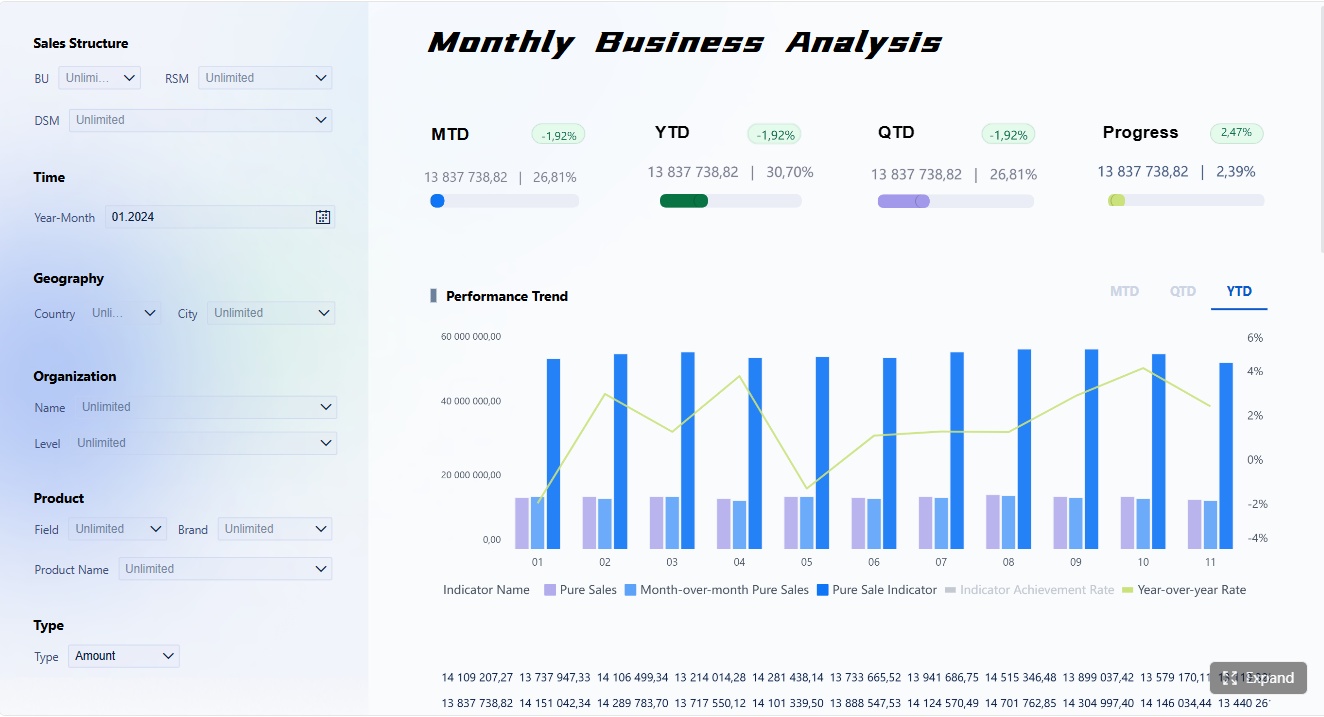
FineBI is designed for:
- self-service BI for business users
- interactive dashboard creation
- drag-and-drop analysis
- drill-down and guided exploration
- dashboard sharing and collaboration
- faster iteration between central data teams and business departments
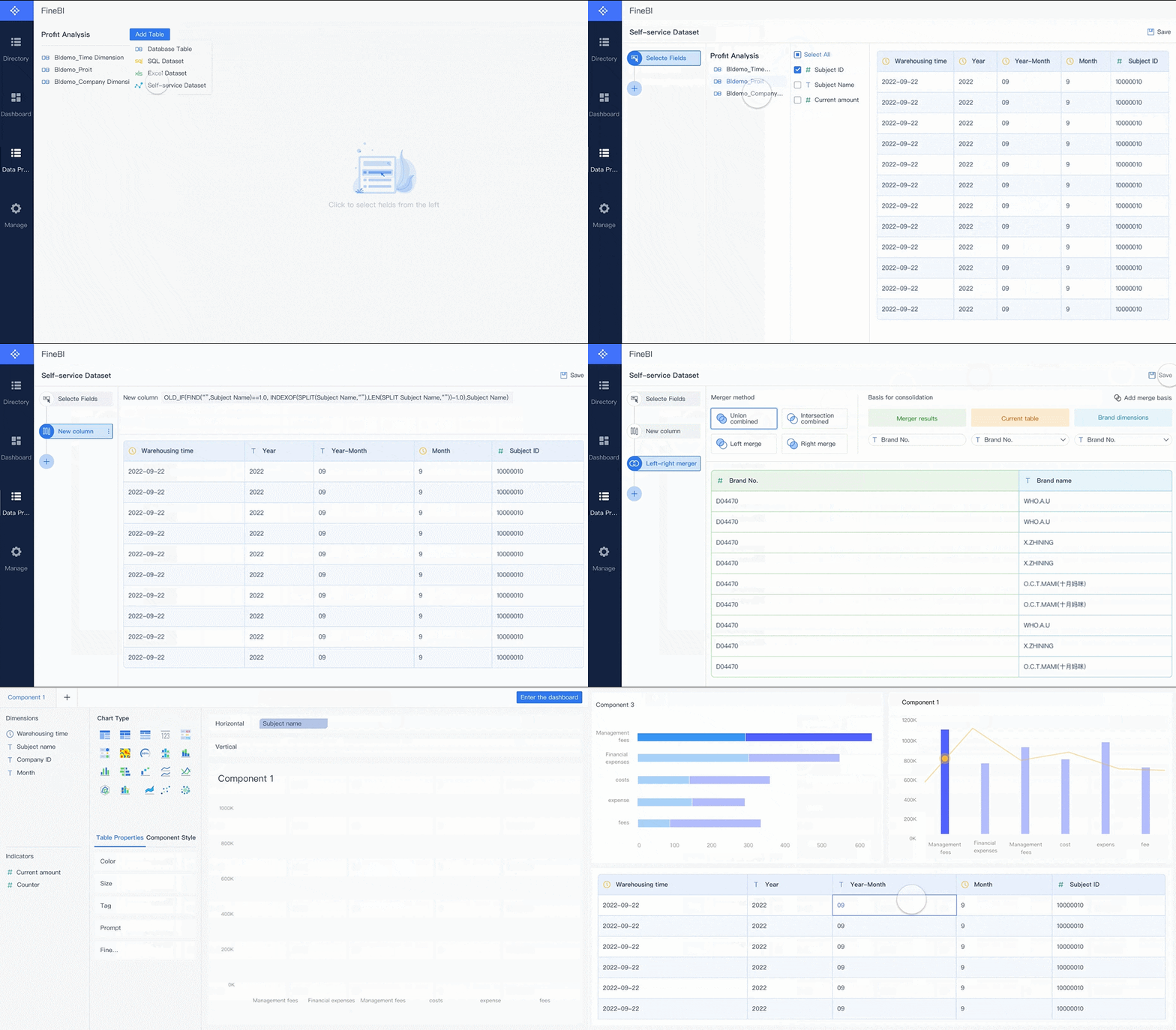 FineBI's drag-and-drop analysis
That means a company can use Databricks or Snowflake as the data foundation, then use FineBI to make analytics more accessible to the people who need dashboards and operational insight every day.
For example:
- A company running Snowflake for governed analytics can use FineBI to create more accessible dashboards for finance, sales, and operations.
- A company running Databricks for data engineering and AI can use FineBI as the business-facing layer for KPI monitoring and cross-functional analysis.
Dora adds another layer to this model.
Dora is FanRuan’s enterprise Data Agent platform. It acts as an AI assistant and AI digital employee layer on top of FineBI and existing enterprise data assets. Together, FineBI + Dora helps enterprises move from people manually checking dashboards to AI helping users ask, analyze, summarize, generate, alert, and follow up within governed workflows.
This is best understood as Agentic BI:
- natural-language request
- trusted semantic foundation
- governed query or skill execution
- answer, chart, summary, action, and follow-up
In that model:
- FineBI builds the trusted dashboard, metric, and semantic foundation
- Dora turns that foundation into a scenario-specific enterprise Data Agent
Depending on the use case, Dora can support scenarios such as:
- Data Analyst digital employee
- Report Researcher
- Daily Briefing Secretary
- Risk Alert Officer
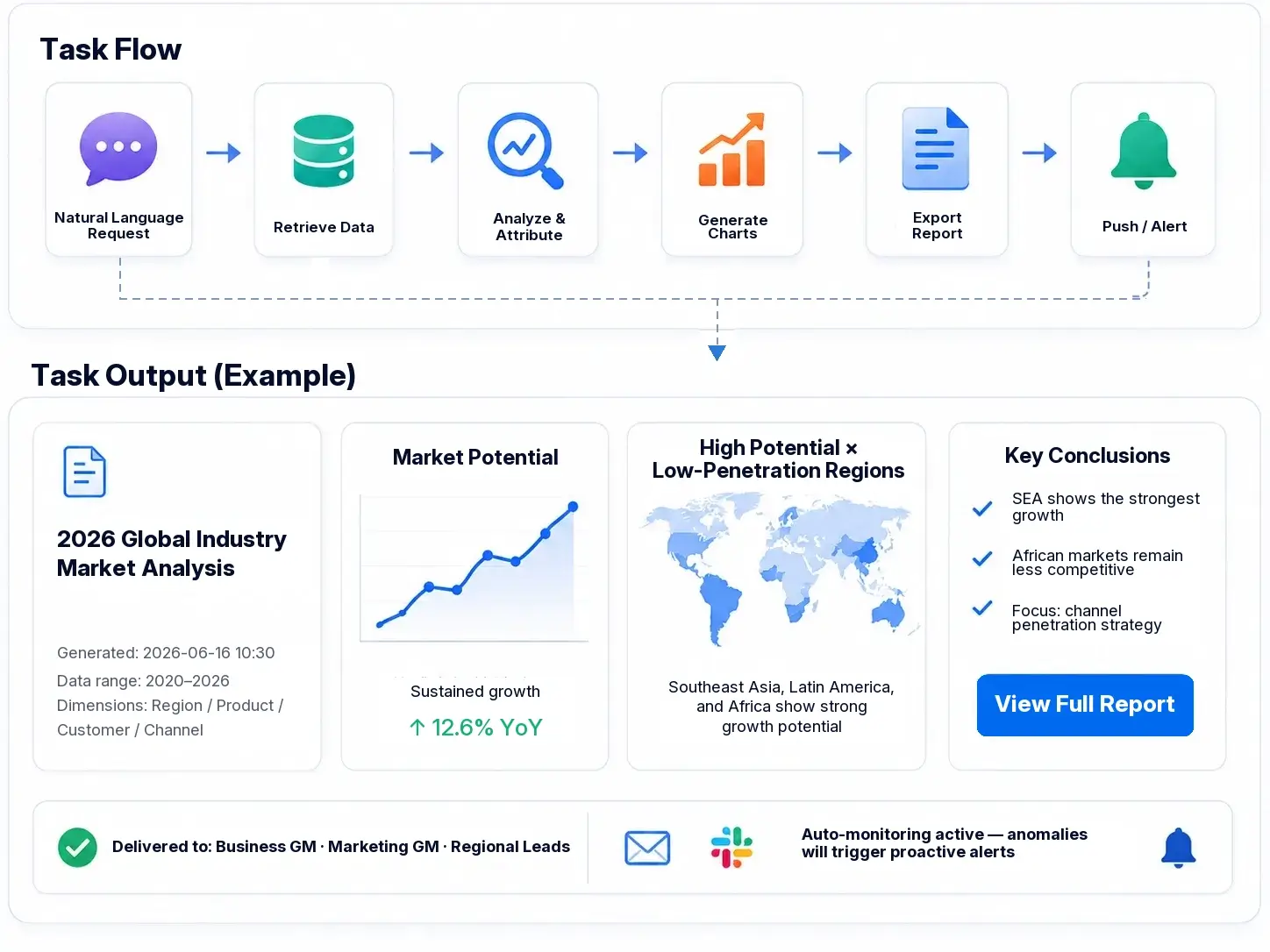 Dora's Workflow
This is useful for enterprises that already have strong data assets in Databricks, Snowflake, or other platforms, but want a more practical way for business teams to interact with data through dashboards and governed AI workflows.
Get Ready-to-Use Dashboard Templates in Fine Gallery
Final Takeaway
The databricks vs snowflake decision is really a decision about operating model.
- If you need engineering depth, flexible pipelines, and strong ML alignment, Databricks is often the better fit.
- If you need governed SQL analytics, business reporting, and a more managed experience, Snowflake is often the better fit.
- If you need business-friendly dashboarding and self-service analytics on top of either platform, FineBI can be a practical addition.
- If you want to extend trusted BI into governed AI assistance and digital employee workflows, Dora adds an enterprise Data Agent layer on top.
The best architecture in 2026 is not always the one with the longest feature list. It is the one that helps your teams get from data to decisions with the least friction.
FAQs
Databricks is generally stronger for engineering, large-scale data processing, and machine learning in a lakehouse model. Snowflake is usually easier for SQL analytics, governed reporting, and managed warehouse-style operations.