
Sales performance management is the operating system behind predictable revenue. For sales leaders, it is not just a way to review numbers after the quarter closes. It is the structured process of defining targets, tracking execution, coaching behavior, identifying risk early, and improving how managers and reps perform over time.
In practice, that means combining the visibility of BI dashboards with the execution power of an AI assistant. With FineBI + Dora, business users can ask for analysis in chat, generate chart-based answers or dashboard-style views from trusted BI assets, and receive scheduled summaries before the next meeting. For a sales VP, regional manager, or revenue operations leader, this closes the gap between seeing performance and acting on it.
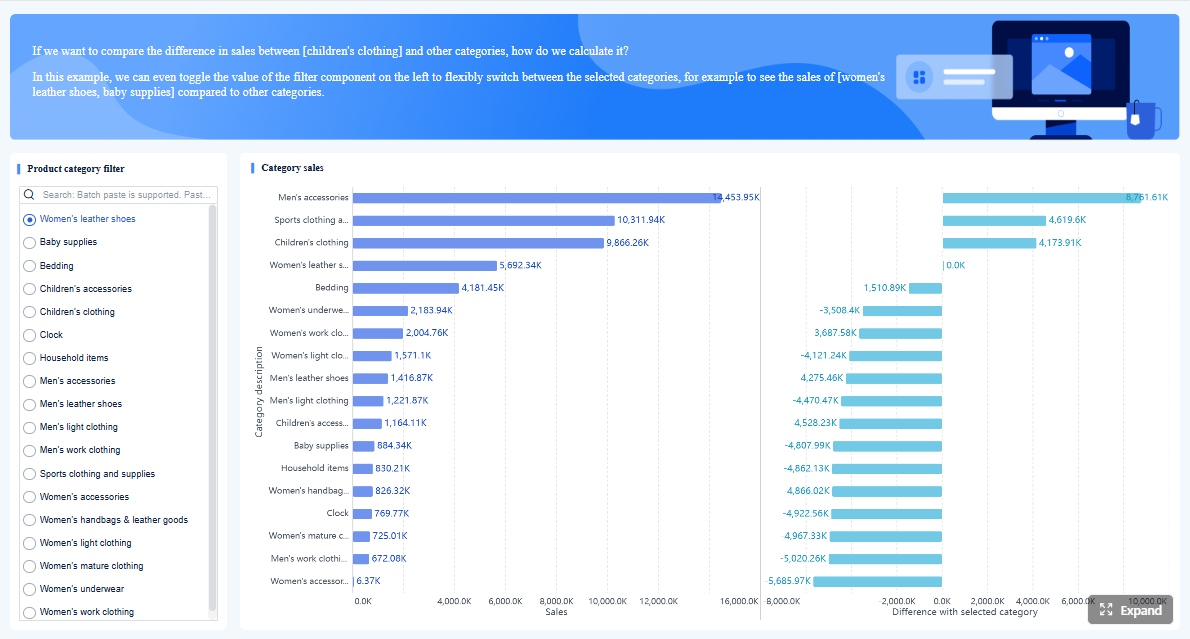 Click To Try The Dashboard
All dashboards in this article are built with FineBI
What sales performance management means for modern sales leaders
Sales performance management is the disciplined process of improving sales outcomes by connecting business targets, team behavior, manager coaching, and performance data. It is broader than CRM, broader than forecasting, and broader than incentive compensation.
A CRM records customer and opportunity activity. Forecasting estimates likely revenue. Incentive compensation aligns pay with results. Sales performance management sits above these functions and asks a bigger question: Are we helping the sales organization perform better in a measurable, repeatable way?
For modern sales leaders, that matters because revenue problems rarely come from one issue alone. Missed targets can stem from weak pipeline quality, poor follow-up, inconsistent manager coaching, uneven rep capability, or unclear accountability. A strong sales performance management approach helps leaders connect those dots.
At a practical level, sales leaders use sales performance management to:
- Translate company growth strategy into team and individual targets
- Define the KPIs that show whether execution is on track
- Create coaching loops that improve rep behavior
- Hold managers and reps accountable through review cadences
- Use technology to monitor risk, surface insights, and accelerate action
- Build continuous improvement into the sales operating rhythm
The core components usually include:
- Goals: clear targets by team, region, segment, and rep
- Metrics: leading and lagging indicators that show performance quality
- Coaching: structured manager interventions that improve execution
- Accountability: ownership, review cadence, and follow-up discipline
- Technology: dashboards, semantic metrics, alerts, and AI assistance
- Continuous improvement: regular adjustment based on what the data shows
For executives, the value is concrete: better forecast confidence, stronger manager effectiveness, and more repeatable revenue execution. For IT and RevOps teams, the goal is to move from fragmented reports to governed metrics, trusted analysis, and reusable AI workflows. For frontline sales leaders, the outcome is simpler: less time chasing spreadsheets and more time coaching the team toward quota.
The core KPIs that make sales performance management measurable
Sales performance management only works when the KPI system is clear, trusted, and actionable. Too many organizations track dozens of sales metrics but still cannot explain why performance is improving or declining. The right KPI structure should help sales leaders answer three questions:
- Are we on track to hit revenue goals?
- Are reps executing the right behaviors?
- Is the team becoming stronger and more consistent over time?
FineBI helps build this KPI structure with governed dashboards, metric modeling, and reusable semantic assets. Dora then turns those trusted KPI definitions into a chat-based AI assistant experience, so leaders can ask questions, receive chart-based answers, and push follow-up actions without relying on ad hoc manual analysis.
Revenue and pipeline indicators
These metrics show whether the team is creating and converting enough demand to achieve targets.
-
Revenue attainment: Actual closed revenue compared with target or quota.
Business value: Shows whether teams and reps are delivering expected results.
AI use: Dora can retrieve attainment by team, manager, region, or rep in chat and summarize where gaps are emerging. -
Pipeline coverage: Open pipeline value divided by future quota for a given period.
Business value: Indicates whether pipeline volume is sufficient to support target achievement.
AI use: Dora can compare current coverage against target thresholds and flag segments that need pipeline generation support. -
Conversion rate: Percentage of leads or opportunities moving from one stage to the next or to close.
Business value: Helps leaders identify where deals are getting stuck and whether sales process quality is improving.
AI use: Dora can highlight stage-by-stage drop-off and generate a chart-based answer for managers preparing pipeline reviews. -
Average deal size: Mean revenue value of closed won deals.
Business value: Shows changes in selling motion, pricing power, account mix, or product strategy.
AI use: Dora can compare average deal size by segment, rep, industry, or time period to surface shifts early. -
Sales cycle length: Average time from qualified opportunity to closed deal.
Business value: Measures sales efficiency and helps forecast timing more accurately.
AI use: Dora can identify where cycle length is extending and point managers toward stalled stages or slow follow-up patterns. -
Forecast accuracy: Difference between predicted and actual closed results.
Business value: Improves planning confidence and reveals whether pipeline inspection discipline is strong enough.
AI use: Dora can generate periodic forecast variance summaries and push them to leaders before forecast calls.
Activity and productivity metrics
These metrics evaluate whether sellers are performing the behaviors that support better pipeline quality and better close rates.
-
Outreach quality: Quality-adjusted emails, calls, touches, or prospecting sequences rather than simple activity volume.
Business value: Prevents teams from mistaking activity for effectiveness.
AI use: Dora can summarize whether high activity is translating into meeting conversion and opportunity creation. -
Meetings held: Number of completed customer meetings or discovery sessions.
Business value: Shows whether pipeline-building motion is active enough and whether rep calendars reflect selling effort.
AI use: Dora can compare meetings held against target benchmarks and include them in manager briefings. -
Follow-up speed: Time between customer interaction, lead creation, or stage movement and rep response.
Business value: Faster follow-up often correlates with better conversion and customer experience.
AI use: Dora can detect delayed follow-up patterns and notify managers or reps when response windows are slipping. -
Opportunity progression: Rate at which opportunities advance through pipeline stages.
Business value: Reveals execution quality and whether reps are moving deals forward with clear next steps.
AI use: Dora can find opportunities with no recent movement, summarize stalled deal patterns, and support weekly deal reviews. -
Time spent selling: Share of rep time used for selling versus admin work, reporting, or internal coordination.
Business value: Helps leaders identify process friction that reduces revenue productivity.
AI use: Dora can combine workflow and performance views to help leaders spot where process redesign may improve rep capacity.
Team health and capability signals
These metrics help leaders understand whether current performance is sustainable and scalable.
-
Ramp time: Time required for a new rep to reach expected productivity.
Business value: Affects hiring ROI, territory readiness, and growth planning.
AI use: Dora can compare ramp speed across managers, roles, and onboarding cohorts to identify enablement gaps. -
Win-loss patterns: Reasons deals are won or lost by segment, competitor, or rep group.
Business value: Supports better coaching, messaging, and competitive strategy.
AI use: Dora can summarize win-loss patterns in plain language for leadership review or coaching preparation. -
Coaching adoption: Completion and follow-through rate for coaching actions, scorecards, or one-on-one improvement plans.
Business value: Shows whether management routines are being executed consistently.
AI use: Dora can remind managers of pending coaching reviews and generate meeting-ready summaries. -
Rep retention: Voluntary and involuntary turnover across teams and performance bands.
Business value: Helps leaders evaluate morale, manager quality, and organizational stability.
AI use: Dora can combine performance and retention patterns in periodic talent-performance briefings. -
Performance consistency: Distribution of attainment and execution quality across the team.
Business value: A more balanced team is usually more resilient than one driven by a few top performers.
AI use: Dora can surface uneven performance patterns and help leaders prioritize coaching resources where they matter most.
How the sales performance management process works in practice
A good sales performance management program is not a one-time dashboard project. It is an ongoing operating rhythm that translates strategy into execution, then turns execution data into coaching and adjustment.
Set goals, benchmarks, and ownership
The process starts by breaking down company-level revenue objectives into team, region, product, segment, and rep-level expectations. That requires more than assigning numbers. Leaders need clear definitions, timelines, and ownership.
Best practice includes:
- Setting quota and attainment targets by role and market reality
- Defining KPI formulas consistently
- Assigning metric ownership to sales, RevOps, or finance stakeholders
- Clarifying review periods for weekly, monthly, and quarterly tracking
- Aligning benchmarks with role type, territory maturity, and segment differences
This is where trusted BI matters. FineBI gives teams a governed semantic layer so terms like pipeline coverage, forecast category, follow-up delay, and stage conversion mean the same thing across managers and regions. Without that consistency, sales performance management becomes an argument about numbers instead of a process for improving results.
Run coaching loops that improve execution
The most effective sales organizations do not stop at reporting. They turn performance signals into behavior change through coaching loops.
A coaching loop usually includes:
- Reviewing KPI trends and deal-level data
- Identifying a specific execution issue
- Diagnosing likely root causes
- Agreeing on actions with the rep
- Following up in the next one-on-one or review
Common coaching inputs include call reviews, deal inspections, stage progression checks, activity-to-outcome analysis, and rep scorecards. The key is not just to point out underperformance, but to turn data into a practical next step.
For example, if a rep has strong meeting volume but weak conversion to proposal stage, the issue may not be effort. It may be qualification quality, discovery skill, or poor stakeholder mapping. Sales performance management should help managers find that pattern faster and coach more precisely.
Create a review cadence that drives accountability
Review cadence is the discipline layer of sales performance management. It ensures that insights lead to action and that action is tracked.
A practical cadence often includes:
- Weekly reviews: pipeline movement, stalled deals, activity quality, near-term risks
- Monthly reviews: attainment progress, conversion trends, manager coaching follow-up, benchmark comparisons
- Quarterly reviews: quota performance, territory quality, team capability, forecast accuracy, improvement priorities
When cadence is weak, teams drift into reactive management. When cadence is strong, managers know what to review, reps know what is expected, and leaders can spot issues early enough to intervene.
This is also where AI becomes useful in a real enterprise setting. Rather than asking managers to prepare every review manually, Dora can retrieve trusted FineBI dashboard metrics, generate summaries, surface anomalies, and push reminders before meetings. That does not replace manager judgment. It makes the review process more timely and more consistent.
Why coaching loops matter more than dashboards alone
Dashboards are necessary, but they are not sufficient. A dashboard can tell a manager that win rates are down, forecast risk is rising, or follow-up speed is slowing. It cannot, on its own, improve rep behavior. That is the role of coaching loops.
The difference is simple:
- Reporting on performance tells you what happened.
- Improving performance changes what happens next.
Sales leaders often invest heavily in dashboards and still struggle to improve execution because managers lack a repeatable process for turning KPI signals into coaching action. That is why the best sales performance management programs focus on manager behavior as much as rep behavior.
A useful coaching loop does three things well:
-
Makes feedback specific
Instead of saying, “Your pipeline hygiene needs work,” managers can say, “Your stage 2 opportunities with no next meeting scheduled are converting 30% below team average.” -
Links behavior to business outcomes
Coaching becomes more effective when reps see why it matters. Faster follow-up, better discovery, or cleaner deal progression should connect clearly to attainment and forecast confidence. -
Creates documented follow-up
Coaching should not disappear after the one-on-one. Managers need a simple way to log actions, revisit progress, and track whether behavior changes are producing better results.
Practical tips for making coaching more effective:
- Use a small scorecard tied to a few critical KPIs
- Standardize one-on-one review templates across managers
- Require action notes and follow-up dates
- Focus first on high-impact behaviors, not every metric
- Review both leading indicators and results
- Recognize improvement, not just quota attainment
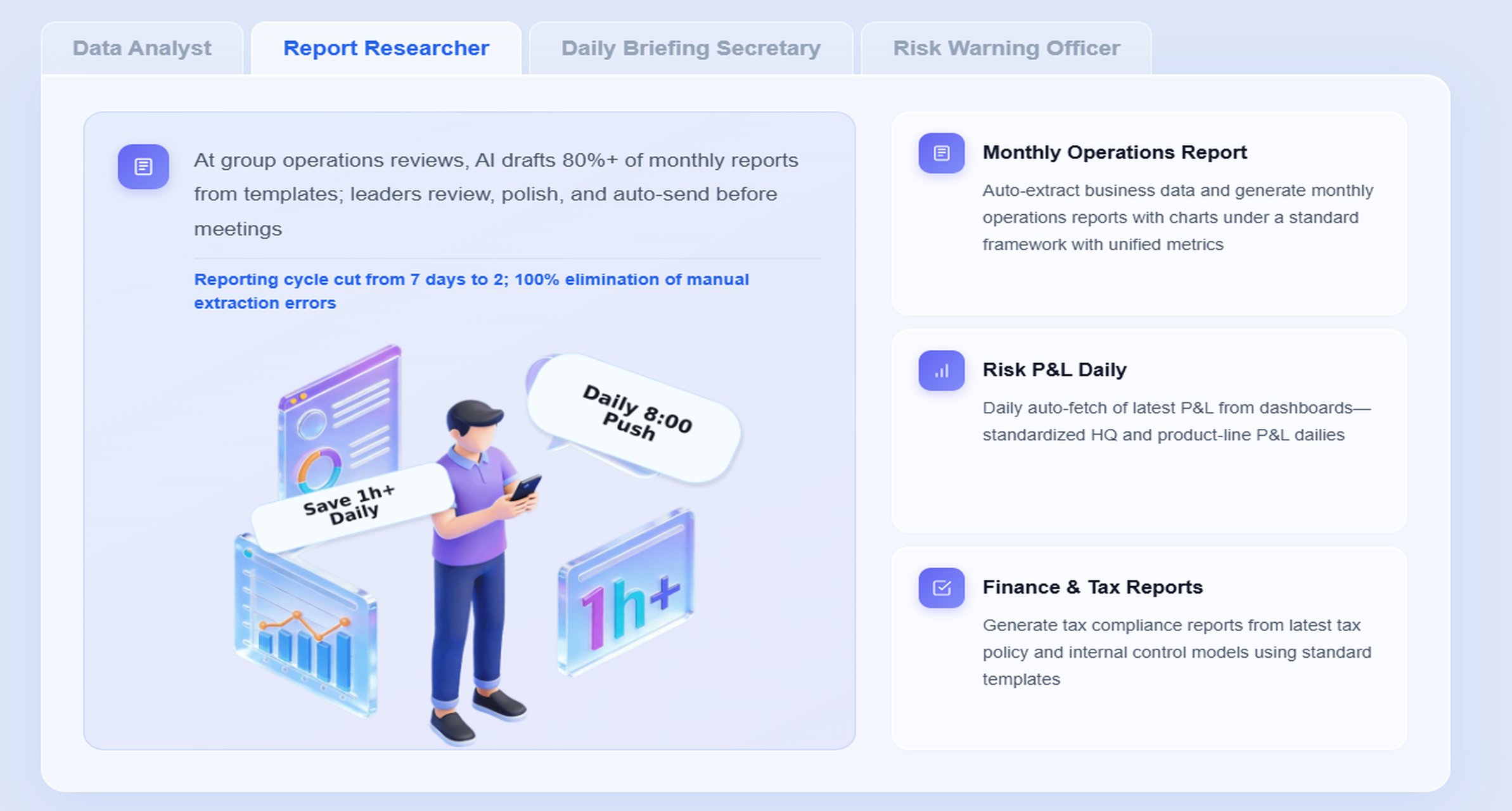
This is also an area where FineBI + Dora can help land real business value. FineBI provides the trusted scorecard and manager dashboard foundation. Dora can act as a Data Analyst digital employee or Daily Briefing Secretary, retrieving rep performance context, summarizing coaching-relevant changes, and preparing concise briefings before manager meetings.
How AI-driven execution strengthens sales performance management
AI becomes valuable in sales performance management when it supports real workflows, not when it adds another disconnected interface. Sales leaders need timely insight, controlled analysis, and practical follow-up. That is why an enterprise Data Agent approach matters.
With FineBI + Dora, AI is built on governed metrics, permissions, and semantic definitions. FineBI provides the trusted dashboard, metric, and semantic foundation. Dora turns that foundation into a scenario-specific AI assistant or AI digital employee for recurring sales management work.
Use AI to surface risks and opportunities earlier
Many sales issues become visible before they show up in missed quota. The challenge is noticing them early enough.
Dora can help leaders and managers identify:
- Stalled deals with no recent movement
- Opportunities missing required stakeholder engagement
- Weak or delayed follow-up patterns
- Declining conversion rates by stage or team
- Forecast gaps that need immediate attention
- Performance inconsistency across regions or managers
Instead of waiting for end-of-month reporting, managers can receive scheduled summaries, threshold alerts, and targeted push notifications. This is especially useful for recurring workflows such as weekly pipeline inspection, manager forecast prep, or regional performance review.
Apply AI to coaching and workflow guidance
AI is also useful when it helps managers prepare and act faster.
Dora can support sales performance management by:
- Retrieving KPI trends through natural-language query
- Generating chart-based answers from trusted FineBI assets
- Summarizing performance changes before one-on-ones
- Highlighting risk patterns in pipeline and execution
- Preparing manager briefings for forecast or QBR meetings
- Suggesting where follow-up is needed based on governed rules
- Pushing scheduled updates to responsible owners
This is stronger than a prompt-only AI experience because Dora uses controlled Skills-based execution over enterprise BI assets. That means a more auditable workflow, better permission handling, stronger KPI governance, and more stable enterprise landing capability than asking a generic model to improvise from raw data.
Balance automation with human judgment
AI should strengthen sales leadership, not replace it. Sales performance management still depends on good data, clear KPI ownership, and strong manager judgment.
Sales leaders should expect human review in areas such as:
- Validating unusual AI-generated interpretations
- Confirming deal context before taking action
- Adjusting coaching based on rep capability and market conditions
- Managing change and trust with frontline teams
- Refining semantic definitions and thresholds as the process matures
The right message to the business is not “AI will run sales management for you.” The right message is: Dora helps business teams get timely metrics, chat-based answers, scheduled summaries, and exception pushes without waiting for analysts or searching through dashboards.

How an AI Data Agent Handles This Scenario
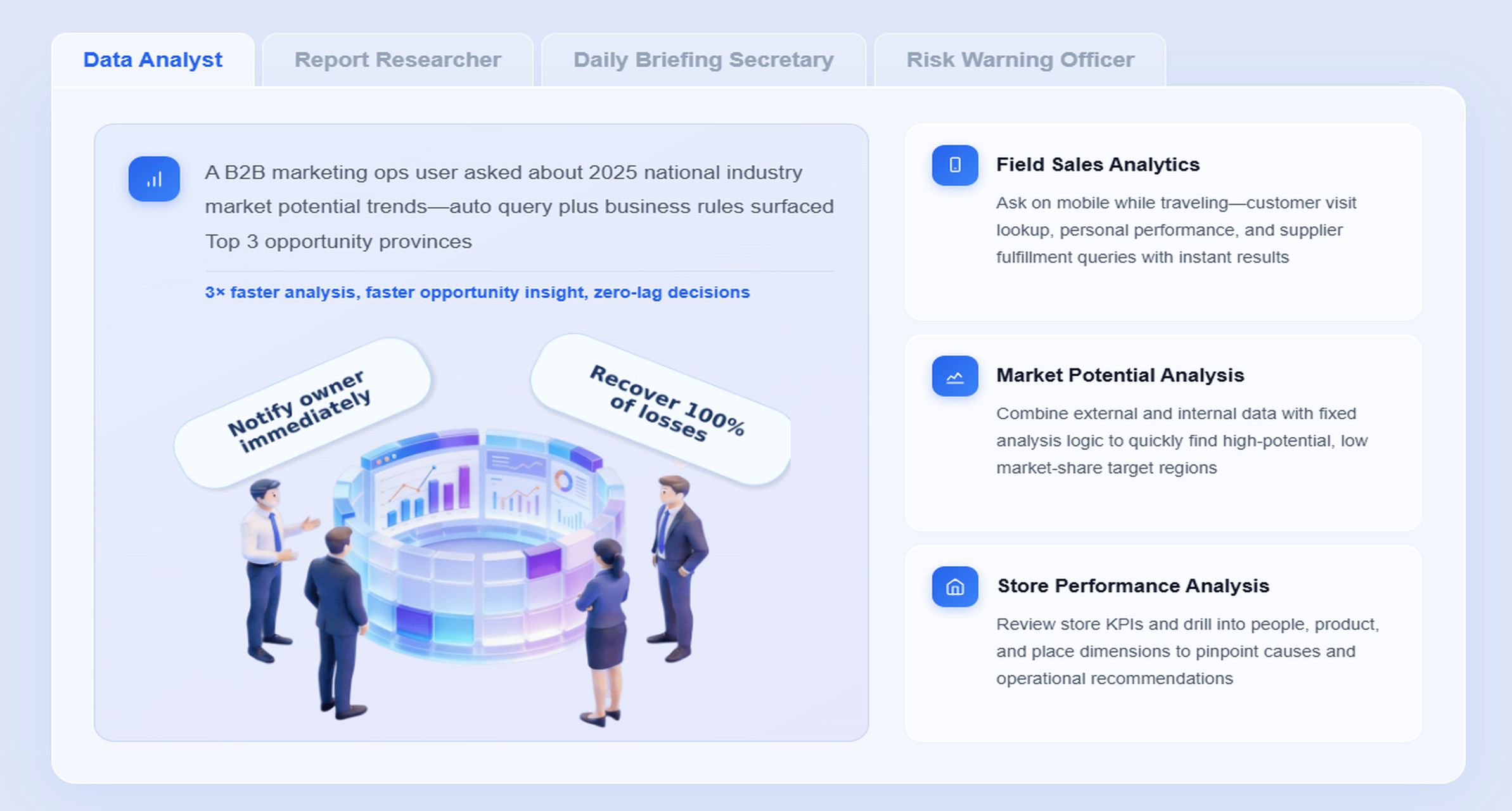
For sales performance management, the most relevant Dora digital employee is often a combination of Data Analyst digital employee and Daily Briefing Secretary, with Risk Alert Officer support for exception monitoring.
A typical scenario: a regional sales director is preparing for Monday pipeline review and wants to know where the team is off track, which managers need help, and which deals require immediate follow-up.
Example chat query:
“Show me this month’s sales performance by region, quota attainment, pipeline coverage, forecast gap, and top stalled deals. Summarize the biggest risks and prepare a briefing for today’s manager meeting.”
Here is how Dora handles that scenario in a governed Agentic BI workflow:
-
Retrieve trusted FineBI dashboard or analysis-subject data
Dora accesses the approved FineBI sales performance dashboards, KPI models, and semantic assets for attainment, coverage, conversion, and pipeline status. -
Understand KPI definitions, filters, business terms, and semantic rules
Dora interprets terms like “forecast gap,” “stalled deals,” “regional team,” or “this month” using the governed metric logic already built in FineBI. -
Generate chart-based answers and dashboard-style analysis views in chat
Dora returns a concise summary with supporting charts, tables, or breakdowns by region, manager, or rep, instead of forcing the user to open multiple dashboards manually. -
Detect abnormal changes or threshold breaches
If pipeline coverage drops below target, follow-up delays rise, or stage conversion weakens, Dora can highlight those exceptions for leadership attention. -
Push insights, alerts, or suggested actions to responsible users
The system can send scheduled briefings to sales leaders, notify managers about specific risk accounts, or push exception views before forecast and coaching meetings. -
Produce follow-up summaries for meetings or management review
After a review, Dora can help generate a concise meeting recap or ongoing progress summary for the next checkpoint.
Why this matters operationally:
- FineBI provides the trusted BI foundation: dashboards, governed metrics, semantic definitions, permission controls, and visual analysis assets.
- Dora provides the AI assistant layer: natural-language data query, chart-based answers, scheduled briefings, anomaly alerts, and follow-up workflow support.
This is a practical form of fourth-generation Agentic BI:
- natural-language request
- trusted semantic layer
- governed query or Skill execution
- answer, chart, summary, action, and follow-up
For sales leaders, that means less manual preparation and faster action. For IT and RevOps, it means AI is grounded in enterprise governance rather than disconnected experimentation.
How to evaluate and improve your approach in 2026
Sales performance management in 2026 should be evaluated on whether it helps leaders improve execution, not just measure it. That means reviewing both your toolset and your operating process.
What to look for in tools and internal processes
When evaluating your current sales performance management approach, look for strength in these areas:
- Visibility: Can leaders see attainment, pipeline, activity, team health, and coaching signals in one trusted environment?
- Usability: Can managers and business users get answers quickly without relying on analysts for every question?
- Coaching support: Does the process help turn KPI trends into structured action?
- Workflow automation: Can the system deliver scheduled summaries, alerts, and push notifications for recurring reviews?
- Reporting depth: Can leaders move from high-level performance to deal, rep, or region-level diagnosis?
- Integration readiness: Can your data foundation connect CRM, sales activity systems, finance data, and existing BI assets cleanly?
This is where FineBI + Dora fits well for enterprise teams. FineBI supports trusted semantic assets and governed analysis. Dora adds a controllable AI assistant layer that can execute repeatable data work with better enterprise fit than feature-only agent comparisons.
Common mistakes to avoid
Several patterns repeatedly weaken sales performance management efforts:
- Tracking too many metrics without a clear hierarchy
- Using inconsistent KPI definitions across teams
- Treating dashboards as the end state instead of the input to coaching
- Failing to assign ownership for metrics and review cadence
- Relying too heavily on lagging indicators like closed revenue alone
- Ignoring data quality and permission governance in AI initiatives
- Launching AI broadly before defining a few valuable recurring use cases
- Assuming managers will naturally adopt coaching discipline without structure
If AI is part of the plan, another mistake is treating it like a generic chatbot layer. Enterprise AI needs governed metric logic, access boundaries, reusable Skills, and business-specific semantics. Otherwise, trust drops quickly.
A simple improvement roadmap for sales leaders
A pragmatic roadmap usually looks like this:
-
Establish a baseline
Review your current KPIs, dashboards, coaching practices, and performance review cadence. -
Prioritize a small KPI set
Focus first on the few measures most tied to quota attainment, pipeline quality, and manager effectiveness. -
Standardize definitions and ownership
Build a semantic layer so KPI formulas, filters, and terms are trusted across teams. -
Pilot coaching loops
Choose one region or manager group and implement repeatable scorecards, one-on-one templates, and follow-up tracking. -
Add AI to recurring workflows
Use Dora for high-value scenarios such as weekly performance briefings, stalled-deal alerts, forecast preparation, and manager review summaries. -
Refine through regular review
Adjust thresholds, coaching templates, and AI Skills based on adoption, trust, and business impact.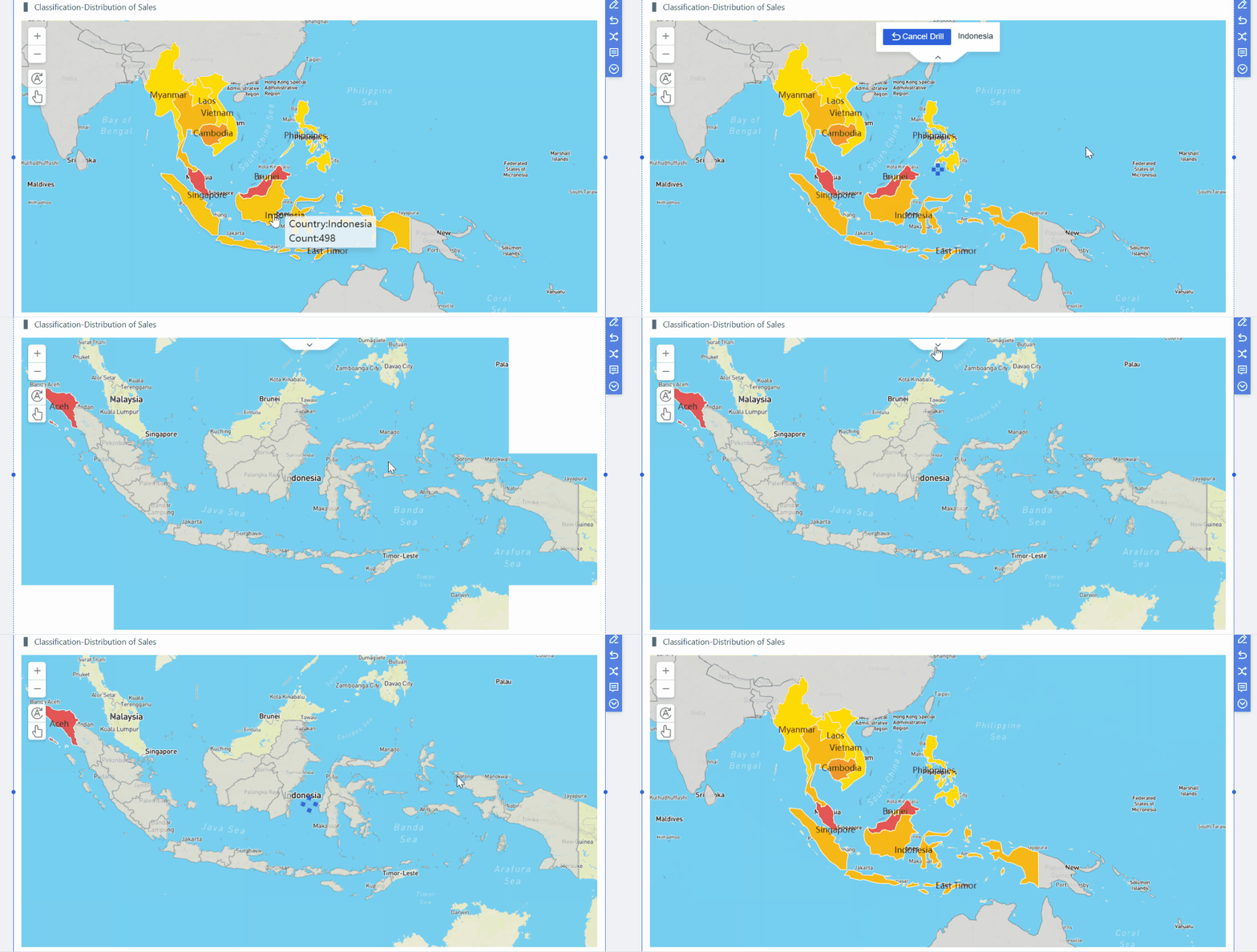
Actionable Best Practices
To make sales performance management work in the real world, sales leaders should focus on a small number of disciplined, high-impact practices.
1. Standardize KPI definitions, synonyms, filters, and ownership
If “pipeline coverage” or “forecast gap” means different things across regions, your process will break down in every review meeting. Build clear metric definitions, assign ownership, and document common business terms and synonyms so reporting and AI retrieval stay aligned.
2. Build a semantic layer inside the BI workflow
This is one of the most important AI-specific practices. Dora performs best when FineBI already contains trusted dashboards, governed metrics, and reusable semantic assets. AI should operate on a business-ready foundation, not on raw inconsistent data fields.
3. Start with high-value recurring workflows instead of automating everything
Another critical AI/Data Agent best practice is to begin with repeatable scenarios such as:
- weekly sales leader briefings
- stalled deal alerts
- manager pipeline review prep
- forecast variance summaries
- monthly regional performance recaps
These are easier to govern, easier to adopt, and more likely to produce visible business value quickly.
4. Define alert thresholds, responsibility rules, and escalation paths
If AI surfaces a risk, someone must own the next step. Set clear rules for what counts as a stalled deal, low coverage warning, or follow-up delay, and define who gets notified and when escalation happens.
5. Preserve permission governance and human review
AI outputs should respect FineBI access boundaries. A regional manager should only see data they are authorized to view. Also, use human review for AI-generated summaries and reports, especially in early rollout stages, then expand Dora Skills gradually as trust grows.
FineBI + Dora Solution Pitch
Building this manually is complex. FineBI helps teams build trusted dashboards, metrics, and semantic assets. Dora turns those assets into an AI assistant that can answer questions in chat, generate dashboard-style analysis views, push scheduled summaries, monitor anomalies, and follow up with responsible owners.
For sales performance management, that combination is especially powerful:
- FineBI gives sales leaders a governed source of truth for quota attainment, pipeline, activity, and team health metrics.
- Dora adds a scenario-ready enterprise Data Agent layer for recurring review, briefing, alerting, and follow-up workflows.
- IT and RevOps teams gain stronger control through permissions, semantic rules, KPI governance, and reusable Skills-based execution.
- Managers and executives get faster access to timely insight without sacrificing trust.
FineBI + Dora is not only a BI upgrade; it is a practical fourth-generation Agentic BI path. FineBI provides governed metrics and visual analysis. Dora provides the AI assistant layer for scenario execution, with more controlled Skills, lower token waste, faster execution paths, and more stable workflows than prompt-only agents.
Get Ready-to-Use Dashboard Templates in Fine Gallery
For enterprise buyers, the strongest message is not AI for AI’s sake. It is a landed scenario. Sales performance management needs trusted data, repeatable coaching rhythms, timely alerts, and easier manager execution. FineBI provides the trusted BI foundation, Dora provides the AI digital employee, and implementation service connects data, governance, semantic setup, Skills, and rollout.
If your sales organization wants to move from passive reporting to timely, AI-assisted execution, this is the practical path.
FAQs
Sales performance management is the process of setting sales targets, tracking the right KPIs, coaching reps and managers, and improving execution over time. It helps leaders turn performance data into actions that support more predictable revenue.