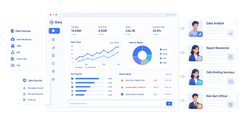
FineReport is an enterprise reporting and dashboard platform that can complement sustainability reporting software by turning ESG, finance, operations, and supplier data into governed, highly customizable reports and executive dashboards.
Below is a practical comparison of 10 widely discussed sustainability reporting software platforms for 2026. The focus is on reporting depth, carbon accounting support, workflow strength, and fit by company size. While many buyers search for one platform to handle everything, the reality is that the best sustainability reporting software depends on your reporting scope, system landscape, and internal team capacity.
1. Workiva
One-sentence overview: Workiva is a strong choice for organizations that need controlled, collaborative ESG and financial reporting with auditability and enterprise governance.
Key Features:
Connected reporting across ESG and financial disclosures
Strong workflow controls, approvals, and audit trails
Pros: Strong assurance readiness; good for highly governed reporting processes; well suited to cross-functional disclosure teams.
Cons: Can require meaningful setup; may need partner support for advanced ESG data model design; carbon accounting depth may depend on ecosystem choices.
Best For (Target user/scenario): Large enterprises managing multi-stakeholder reporting, especially teams already mature in finance reporting controls.
Pricing approach: Typically custom enterprise pricing.
Implementation complexity: Moderate to high.
Time-to-value: Faster for companies with established reporting processes; slower if ESG data ownership is fragmented.
2. Persefoni
One-sentence overview: Persefoni is best known for carbon accounting depth and is often shortlisted by companies where emissions measurement is the hardest part of ESG reporting.
Key Features:
Scope 1, 2, and 3 carbon accounting
Emissions calculation engine and methodology support
Regulatory and stakeholder emissions reporting workflows
Supplier emissions collection capabilities
Scenario analysis and decarbonization planning support
Pros & Cons:
Pros: Strong climate data depth; useful for carbon-intensive businesses; credible fit for organizations prioritizing emissions transparency.
Cons: Broader ESG coverage may not feel as comprehensive as platforms built for full-spectrum ESG management; implementation can be data-intensive.
Best For (Target user/scenario): Companies with complex emissions profiles, decarbonization mandates, or significant Scope 3 exposure.
Pricing approach: Custom pricing, often based on scope and complexity.
Implementation complexity: Moderate to high.
Time-to-value: Good if carbon data is already mapped; slower when supplier and activity data are immature.
3. Sphera
One-sentence overview: Sphera is a robust enterprise platform for organizations that need deep environmental performance, risk, and operational sustainability capabilities.
Key Features:
Environmental and sustainability reporting
Product stewardship and lifecycle-related capabilities
Risk, compliance, and operational integration options
Enterprise-grade configuration
Pros & Cons:
Pros: Strong fit for industrial and operationally complex companies; broad environmental depth; useful beyond disclosure alone.
Cons: Can be heavyweight for lean teams; implementation and change management can be substantial.
Best For (Target user/scenario): Large manufacturers, energy, chemicals, and asset-heavy enterprises.
Pricing approach: Enterprise custom pricing.
Implementation complexity: High.
Time-to-value: Longer, but potentially high value where EHS and sustainability data overlap.
4. SAP Sustainability Control Tower
One-sentence overview: SAP Sustainability Control Tower is a logical option for SAP-centric organizations that want sustainability reporting tied closely to enterprise process data.
Support for enterprise governance and process consistency
Pros & Cons:
Pros: Strong integration potential for SAP customers; useful for centralized data models; aligns sustainability with core operations.
Cons: Best value often depends on existing SAP footprint; less attractive for heterogeneous IT environments; services needs can be significant.
Best For (Target user/scenario): Global enterprises already standardized on SAP.
Pricing approach: Custom enterprise licensing.
Implementation complexity: High.
Time-to-value: Best when SAP data architecture is mature.
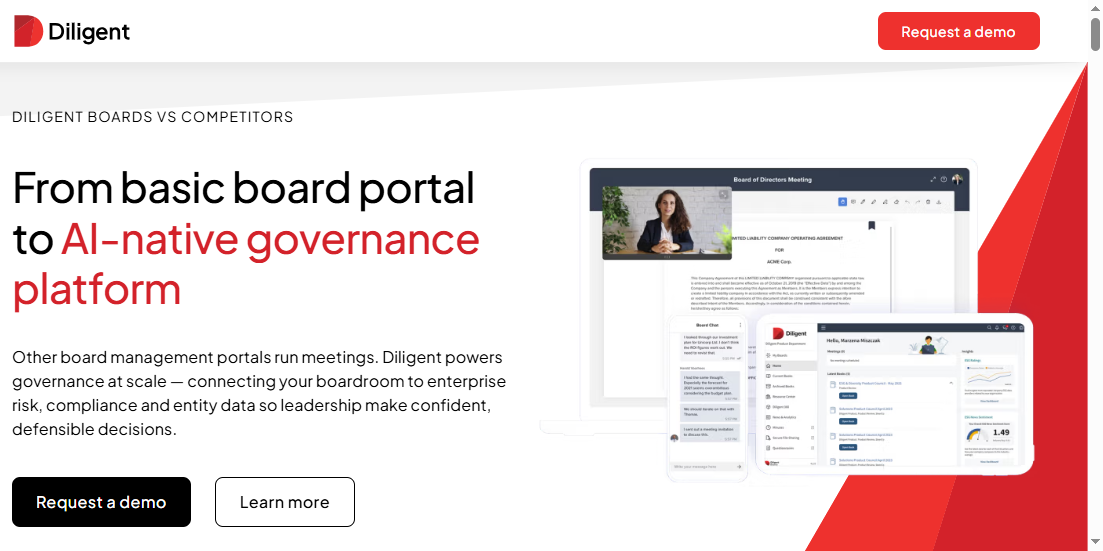
5. Diligent ESG
One-sentence overview: Diligent ESG emphasizes governance, benchmarking, and structured data collection for organizations that want practical reporting workflows with leadership visibility.
Key Features:
ESG questionnaires and data collection workflows
Benchmarking and disclosure support
Governance-focused management tools
Centralized data gathering across teams
Reporting support for stakeholder communications
Pros & Cons:
Pros: Usable for teams that want a manageable entry point; helpful governance context; suitable for structured annual reporting cycles.
Cons: May be less differentiated for deep carbon accounting or advanced supply chain engagement; analytics depth varies by use case.
Best For (Target user/scenario): Mid-sized to large organizations prioritizing governance and board-level ESG reporting structure.
Pricing approach: Custom pricing.
Implementation complexity: Low to moderate.
Time-to-value: Often relatively quick for disclosure-oriented teams.
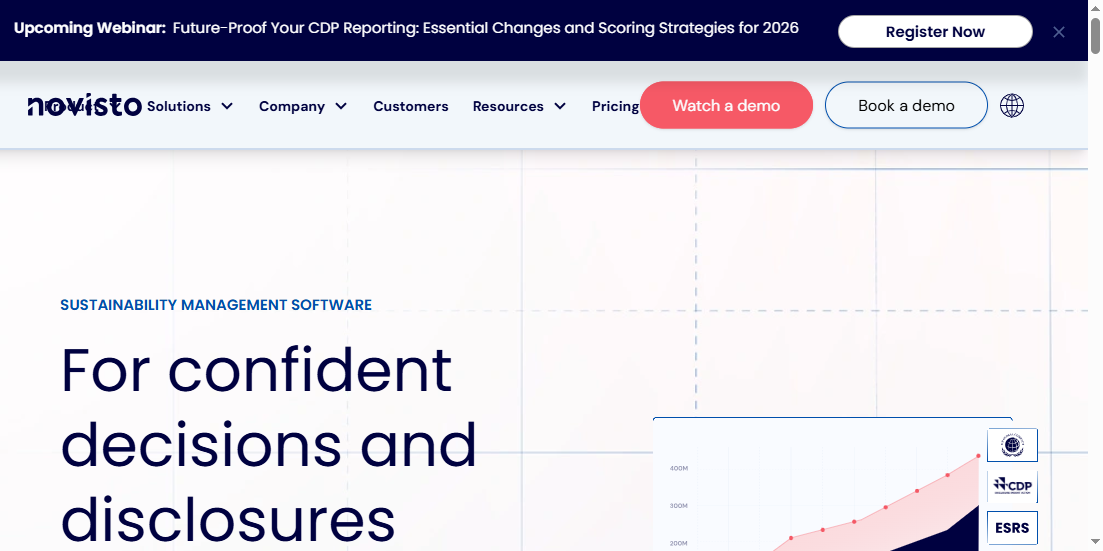
6. Novisto
One-sentence overview: Novisto is a purpose-built ESG reporting platform focused on structured data management, disclosure workflows, and framework alignment.
Key Features:
ESG data model and central repository
Framework mapping and disclosure management
Workflow coordination across data contributors
Analytics and report-building support
Enterprise-grade permissions and controls
Pros & Cons:
Pros: Balanced reporting-focused architecture; strong for centralized ESG management; well suited to complex disclosures.
Cons: May still require adjacent tools or services for highly advanced carbon workflows; can be more platform-heavy than smaller teams need.
Best For (Target user/scenario): Enterprises building a dedicated ESG reporting function with repeatable annual and quarterly processes.
Pricing approach: Enterprise pricing.
Implementation complexity: Moderate.
Time-to-value: Moderate, with good payoff once data governance is defined.
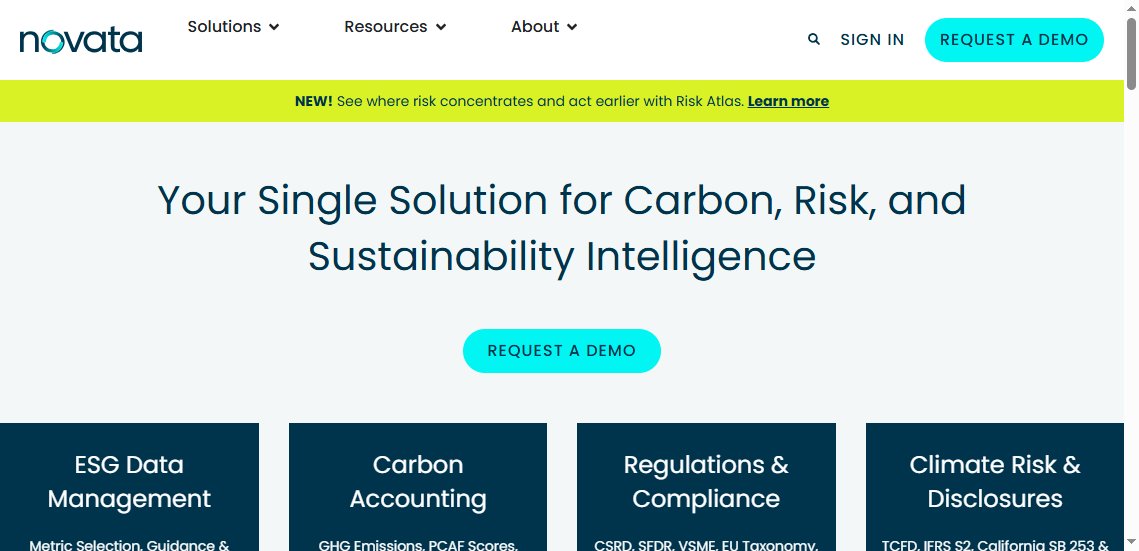
7. Novata
One-sentence overview: Novata is tailored primarily to private markets and portfolio-based ESG programs that need efficient, repeatable data collection across multiple companies.
Key Features:
ESG data collection for portfolio companies
Standardized assessments and benchmarking
Workflow tools for investors and operating teams
Reporting support for private equity and venture contexts
Simplified user experience for distributed contributors
Pros & Cons:
Pros: Strong fit for investors and portfolio reporting models; easier rollout across smaller operating companies; practical structure for repeated requests.
Cons: Less ideal for highly customized multinational corporate reporting outside private markets; depth can vary by advanced enterprise requirement.
Best For (Target user/scenario): Private equity firms, venture capital firms, and portfolio companies.
Pricing approach: Custom pricing by portfolio scope.
Implementation complexity: Low to moderate.
Time-to-value: Often relatively fast.
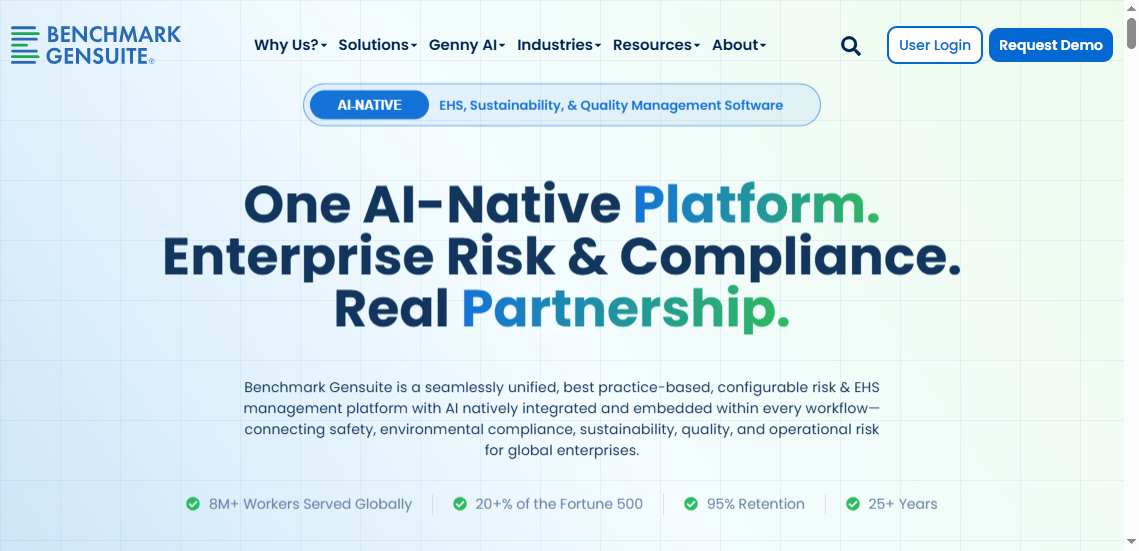
8. Benchmark Gensuite
One-sentence overview: Benchmark Gensuite suits organizations that want ESG reporting connected to EHS, operational risk, and enterprise compliance processes.
Pros: Strong operational context; useful for organizations already running EHS programs; supports distributed teams and structured workflows.
Cons: User experience may feel more process-oriented than disclosure-centric; configuration effort can increase with complexity.
Best For (Target user/scenario): Enterprises wanting sustainability reporting tied to frontline operations and compliance management.
Pricing approach: Custom enterprise pricing.
Implementation complexity: Moderate to high.
Time-to-value: Good where EHS data processes already exist.
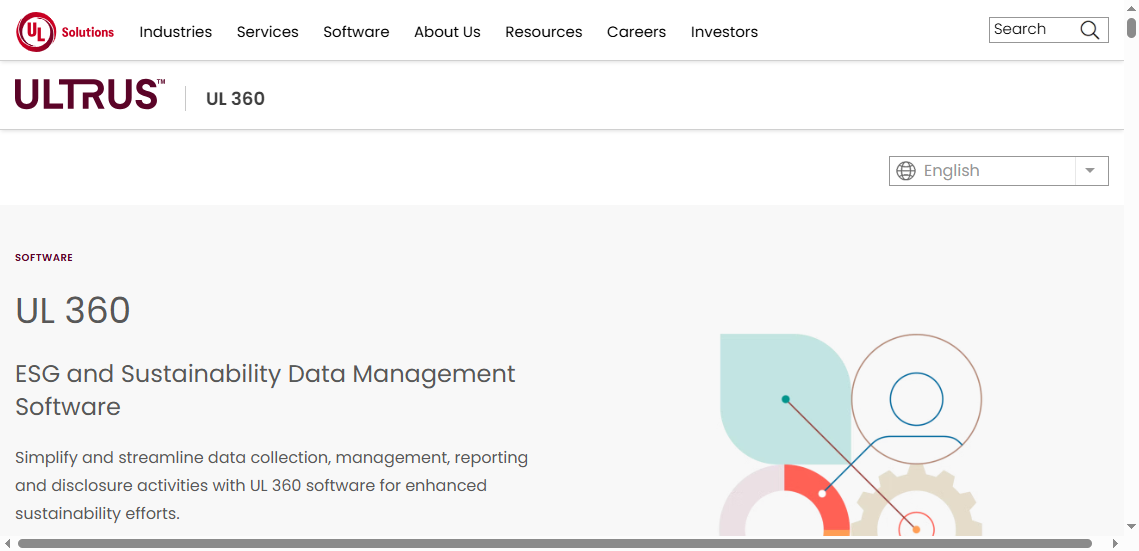
9. UL 360
One-sentence overview: UL 360 offers sustainability reporting software with framework support, advisory adjacency, and a practical path for companies seeking assurance-oriented reporting structure.
Key Features:
Support for major ESG frameworks
Carbon, environment, and CSR reporting workflows
Dashboards and auditable data collection
Advisory and implementation support options
Multi-entity reporting capabilities
Pros & Cons:
Pros: Credible reporting orientation; useful for organizations needing guidance as well as software; practical framework coverage.
Cons: Some buyers may become more dependent on services; flexibility can vary compared with more configurable platforms.
Best For (Target user/scenario): Companies needing a guided path to audit-ready sustainability reporting.
Pricing approach: Custom pricing.
Implementation complexity: Moderate.
Time-to-value: Often faster when advisory support is bundled.
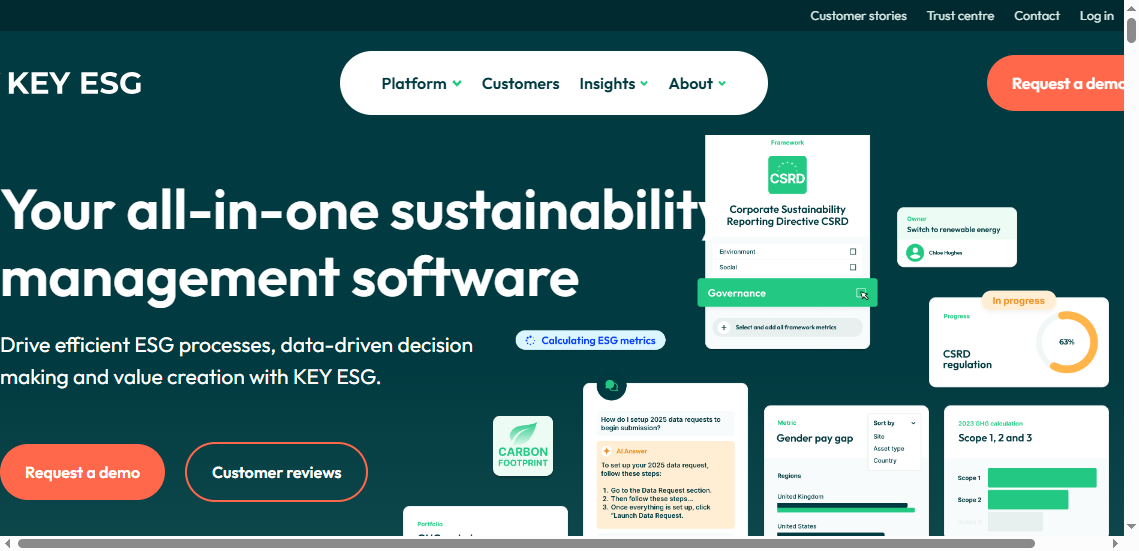
10. KEY ESG
One-sentence overview: KEY ESG is a focused sustainability reporting software platform for organizations that need metric libraries, workflow-driven collection, and practical compliance support.
Key Features:
Regulation- and framework-linked metric selection
Data request workflows and reminders
Carbon accounting support including Scope 1, 2, and 3
Progress tracking, charts, and analysis
API-based integration options
Pros & Cons:
Pros: Good compliance orientation; practical for teams that need structure without extreme complexity; useful reporting workflow support.
Cons: May offer less breadth than the largest enterprise suites; suitability depends on customization and multinational requirements.
Best For (Target user/scenario): Mid-market and enterprise teams seeking a focused ESG reporting platform with manageable rollout.
Pricing approach: Custom pricing.
Implementation complexity: Low to moderate.
Time-to-value: Often favorable for lean teams.
Feature comparison table
The table below compares the main buying criteria most teams use when evaluating sustainability reporting software in 2026.
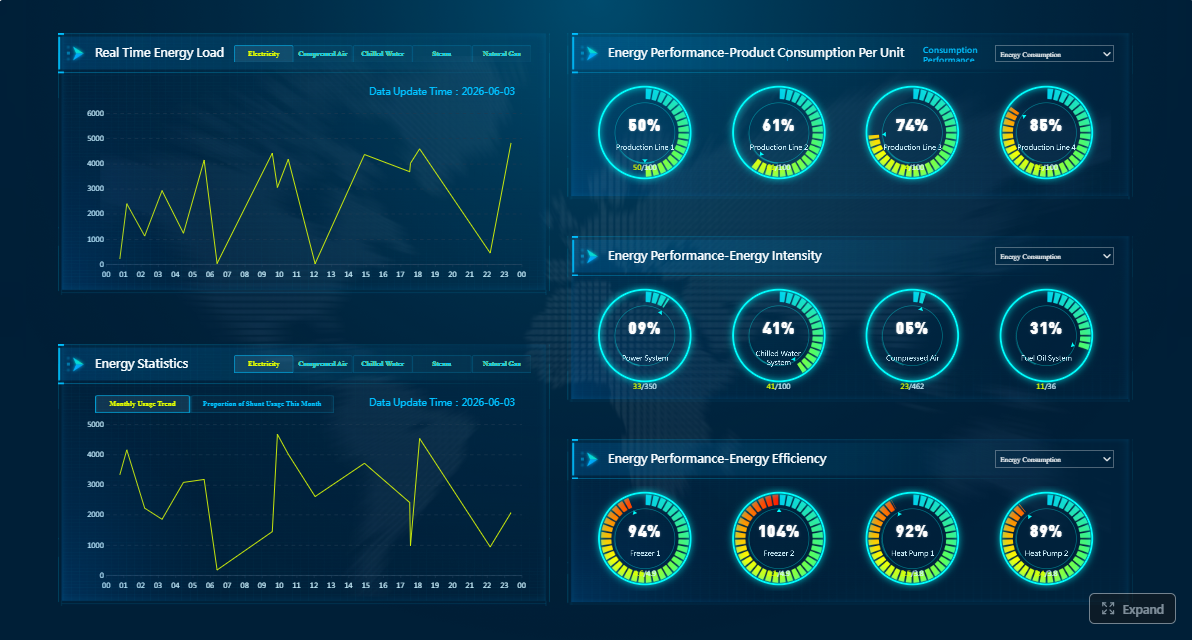
A quick note on analytics: many sustainability reporting software vendors provide built-in dashboards, but those dashboards may not match the flexibility executives want for cross-functional management. This is where a reporting layer such as FineReport can add value. Teams can use it alongside ESG software to create board-ready scorecards, site-level performance reports, CSRD evidence views, and combined ESG-finance dashboards without forcing the ESG platform to do every BI task.
Pros, cons, and trade-offs
Choosing sustainability reporting software is less about finding a perfect platform and more about understanding trade-offs.
Enterprise breadth vs. implementation burden
Platforms such as Workiva, SAP Sustainability Control Tower, Sphera, and Benchmark Gensuite generally offer stronger enterprise controls, multi-entity support, and governance. The trade-off is higher implementation complexity, more process design, and often greater services reliance.
Teams most affected:
Global enterprises with many business units
Organizations under strict assurance requirements
Companies consolidating data from finance, procurement, HR, and operations
Carbon depth vs. broad ESG coverage
Persefoni stands out when carbon accounting is central. That is a major advantage for emissions-heavy organizations, but some companies still need broader social, governance, and narrative reporting workflows that sit outside climate accounting.
Teams most affected:
Manufacturers, logistics firms, energy companies
Firms with serious Scope 3 requirements
Businesses with investor or regulatory pressure on emissions quality
Ease of onboarding vs. advanced configurability
Novata, Diligent ESG, KEY ESG, and UL 360 can be attractive when teams need a faster path to structured reporting. These platforms may reduce time-to-value, but the trade-off can be lower flexibility for unusual workflows, niche disclosures, or highly customized multinational models.
Teams most affected:
Lean sustainability teams
Mid-market finance-led reporting programs
Organizations moving off spreadsheets for the first time
Operational integration vs. disclosure-first design
Benchmark Gensuite and Sphera can be strong when sustainability reporting is deeply connected to operations, EHS, compliance, and plant-level controls. By contrast, Novisto and Workiva often feel more disclosure-centric and reporting-led.
Teams most affected:
Asset-heavy companies that collect environmental data from sites
Firms that need operational action tracking in addition to disclosures
Organizations deciding whether ESG should live closer to finance or EHS
Common gaps to watch for
Across the market, common weaknesses still appear:
Weak supplier engagement for primary Scope 3 data
Limited automation when upstream source systems are fragmented
Heavy dependence on consulting services for framework setup
Inconsistent usability for non-expert contributors
Dashboards that are adequate for ESG managers but not ideal for executives
If executive reporting is a recurring pain point, pairing your ESG platform with FineReport can help close that gap. It is especially useful when leadership wants more flexible visualizations, pixel-perfect disclosure packs, or multilingual reporting across regions.
Click To Try The Dashboard
What to look for in sustainability reporting software in 2026
Before you compare vendors, define what “success” means for your program. In 2026, software selection is less about generic ESG functionality and more about whether the platform fits your compliance path, data maturity, and operating model.
Define the reporting standards and disclosure frameworks you must support
Start with the frameworks and regulations your team cannot avoid. The right sustainability reporting software should support the mix that matters to your company, including:
CSRD
GRI
SASB
ISSB
CDP
TCFD
EU Taxonomy and regional climate disclosure requirements where relevant
A common buying mistake is overvaluing long framework lists. Breadth matters, but what matters more is how well the software maps metrics, controls evidence, and updates reporting logic as requirements change.
Compare core capabilities, not just marketing claims
Every vendor claims automation and end-to-end ESG support. Evaluate the underlying capabilities directly:
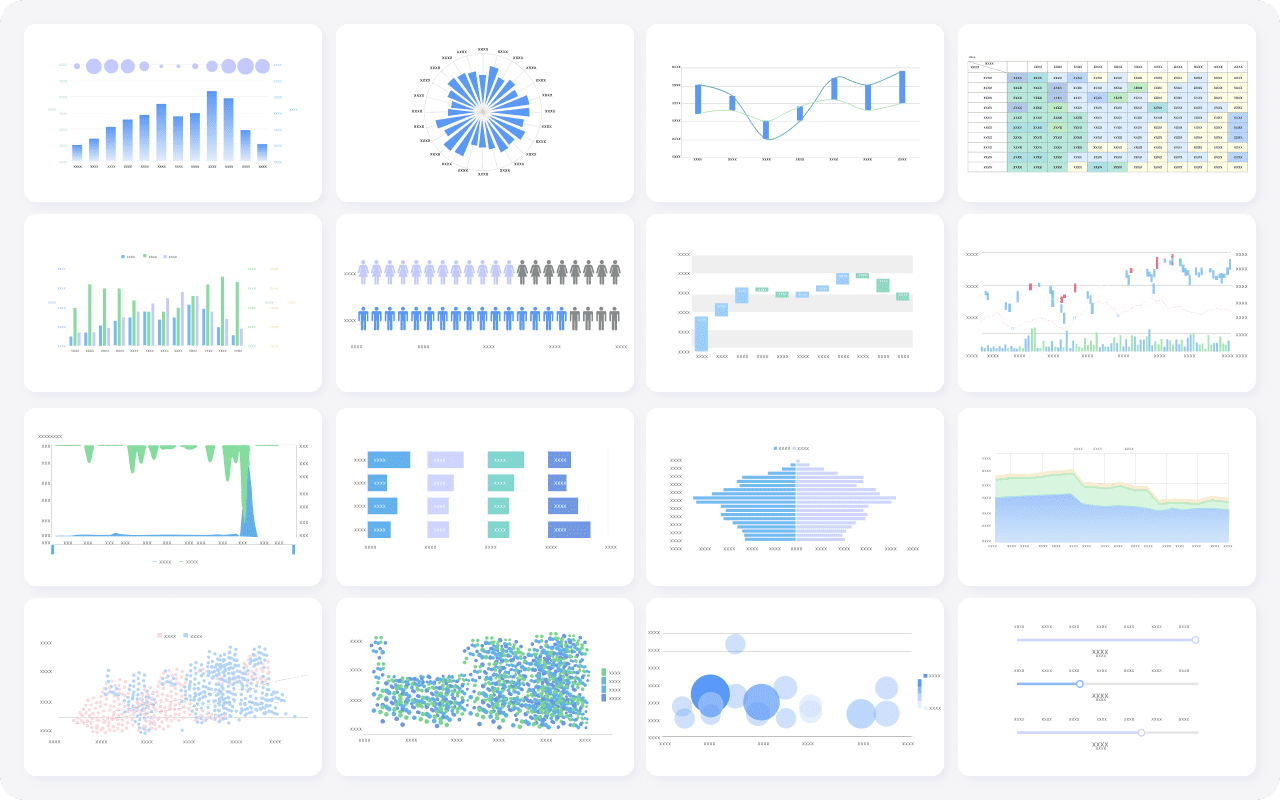
This is also where reporting presentation matters. Many organizations do not just need compliant outputs; they need board packs, plant-level scorecards, and investor-ready summaries. If your chosen sustainability reporting software has strong data management but average reporting flexibility, FineReport can serve as a complementary reporting and dashboard layer for high-control output design.
Evaluate integration needs across core business systems
Your ESG data does not live in one place. Most reporting programs need to connect with:
ERP systems
Finance platforms
HR systems
Procurement tools
Utility and energy systems
Travel and fleet data
Supplier portals
Spreadsheets and manually maintained local files
Integration maturity is often the difference between a system that scales and a system that becomes a more expensive spreadsheet repository.
Check readiness for global entities, assurance, and scale
For multi-entity companies, governance features are not optional. Look for:
Role-based permissions
Entity hierarchies and consolidation support
Multi-language or multinational workflow support
Evidence and document retention
Assurance and audit support
Scalability across business units and geographies
If your program is likely to expand over the next two to three years, buy for the next stage of maturity, not just current pain points.
Best-fit use cases by company type and reporting maturity
The best sustainability reporting software for one company can be the wrong choice for another. Here is a more practical way to shortlist by operating context.
Best for enterprise ESG programs
These tools are generally best suited to complex organizations with multiple entities, stricter controls, and broader disclosure obligations.
Workiva
Best when disclosure governance, auditability, and cross-functional collaboration are the highest priorities.
SAP Sustainability Control Tower
Best when sustainability reporting must align tightly with SAP-centered enterprise data and process architecture.
Sphera
Best when environmental reporting needs to connect with operations, compliance, and industrial performance management.
Benchmark Gensuite
Best when ESG reporting is closely tied to EHS, operational workflows, and site-level accountability.
Novisto
Best when the organization wants a purpose-built ESG reporting platform with strong structure and framework alignment.
Best for mid-market teams and fast implementation
These options tend to appeal to lean teams that need practical workflows, lower complexity, and faster onboarding.
Diligent ESG
A strong option for governance-led programs that need structured reporting without the heaviest enterprise footprint.
KEY ESG
Well suited to teams that want guided workflows, framework support, and manageable rollout demands.
UL 360
A practical fit where software plus advisory support helps accelerate program maturity.
Novata
Especially effective for private market reporting models and distributed portfolio data collection.
Best for carbon-heavy, supply chain, or industry-specific needs
Some teams should choose based on the hardest data problem they face.
Persefoni
Best for companies where Scope 1, 2, and 3 emissions accounting is the central challenge.
Sphera
Best for organizations with operational environmental complexity, including heavy industry and product-related sustainability needs.
Benchmark Gensuite
Best when operational sites and compliance workflows are core to the ESG reporting model.
SAP Sustainability Control Tower
Best for multinational businesses seeking to connect sustainability metrics with enterprise planning and procurement data.
How to choose the right ESG software and reporting platform
A disciplined buying process matters more than a long feature list. The best sustainability reporting software should fit where your company is now and where your disclosures will be in two to three years.
Match platform depth to your current maturity and roadmap
Ask three basic questions:
Is your team mainly trying to centralize data and replace spreadsheets?
Are you preparing for limited or reasonable assurance with stronger controls?
Do you need advanced carbon accounting, supplier collaboration, or multi-framework reporting at scale?
A lighter platform may be enough for stage one. A more configurable enterprise system may be worth the effort if your roadmap includes CSRD maturity, multinational assurance, and deeper Scope 3 reporting.
Weigh flexibility against implementation burden and total cost
More flexibility often means:
Longer setup
More internal process design
More partner support
Greater admin overhead
Less complexity often means:
Faster deployment
Easier adoption
Faster contributor onboarding
But less room for unusual or highly granular requirements
Do not evaluate software cost in isolation. Look at total cost of ownership, including implementation, internal staffing, data cleanup, ongoing admin, and reporting support.
Ask vendors the questions that reveal long-term fit
During demos and RFPs, ask about:
Methodology transparency for emissions calculations
Framework update cadence
Evidence management and audit trail depth
Assurer workflows and sign-off support
Supplier engagement methods
Entity management and consolidation logic
API maturity and integration approach
Roadmap alignment with changing regulations
Also ask vendors to show the reporting outputs your executives actually need. If their native reporting is limited, clarify whether your team will need a separate BI or reporting tool. In many cases, FineReport is useful here because it can turn ESG platform outputs into highly formatted management reports, multilingual dashboards, and scheduled distribution packs.
Build a shortlist using a weighted scorecard
A weighted scorecard keeps the buying process objective. Score each sustainability reporting software option across criteria such as:
Compliance and framework support
Carbon accounting depth
Data collection workflow strength
Supplier and Scope 3 coverage
Integrations
Audit and assurance readiness
Multinational support
Usability for contributors
Reporting flexibility
Implementation complexity
Cost and services dependence
Involve sustainability, finance, internal audit, IT, procurement, and executive stakeholders early. That usually reduces rework later.
Final recommendations and shortlist guidance for 2026
For most buyers, the market splits into three practical categories.
If you are a large enterprise with complex reporting obligations
Start your shortlist with:
Workiva
Novisto
SAP Sustainability Control Tower
Sphera
Benchmark Gensuite
These tools tend to be stronger for control environments, multi-entity reporting, and large-scale governance.
If you need practical ESG reporting workflows with faster rollout
Start your shortlist with:
KEY ESG
Diligent ESG
UL 360
Novata
These platforms often make sense for mid-market teams, lean sustainability functions, or companies moving from spreadsheet-based reporting.
If carbon accounting and Scope 3 are your biggest challenge
Start your shortlist with:
Persefoni
Sphera
KEY ESG
Benchmark Gensuite
These are more likely to satisfy organizations where emissions credibility matters more than broad ESG breadth.
When to prioritize breadth vs. depth
Prioritize breadth of ESG management when:
You face multiple disclosure frameworks
You need organization-wide workflows
You want one system for repeated annual reporting cycles
Prioritize depth in reporting and carbon accounting when:
Scope 3 is material
Climate reporting is under heavy scrutiny
You need methodology clarity and stronger emissions defensibility
Prioritize supplier engagement when:
Your biggest data gaps are upstream
You rely on primary supplier emissions data
Procurement needs to play an active role in data collection
Practical next-step checklist for demos and pilot evaluations
Use this checklist to narrow your final two or three vendors:
Define your must-have frameworks and reporting outputs
Identify your biggest pain point: compliance, carbon, supplier data, or reporting controls
Ask each vendor for a demo using your actual reporting scenario
Validate assurance features, audit trails, and evidence handling
Review implementation scope, internal workload, and services dependence
Score usability for both administrators and occasional contributors
Test dashboard and report output quality for executives
Consider whether a complementary reporting platform like FineReport is needed for advanced dashboarding and formatted disclosure packs
Run a short pilot with real data before full rollout
Secure stakeholder buy-in from sustainability, finance, IT, procurement, and leadership
The best sustainability reporting software in 2026 is the one that matches your regulatory exposure, data maturity, and team capacity without creating more operational friction than it removes. Shortlist carefully, test with real workflows, and choose the platform that will still fit when your reporting program becomes more demanding next year.
FAQs
Sustainability reporting software helps companies collect, organize, validate, and disclose ESG data in one system. It is typically used to support compliance, improve data quality, and produce audit-ready sustainability reports and dashboards.
Start with your main need: broad ESG reporting, deep carbon accounting, or enterprise workflow control. The right fit usually depends on your reporting scope, existing systems, company size, and how mature your internal data processes are.
The most important features usually include data integration, workflow management, audit trails, dashboarding, framework support, and carbon accounting capabilities. If Scope 3 or supplier data is important, strong collection and calculation tools matter even more.
Yes, many platforms are designed to connect with ERP, finance, procurement, and operational data sources. Integration is especially important for reducing manual work and creating a more reliable single source of truth for ESG reporting.
ESG reporting software usually covers a wider set of environmental, social, and governance disclosures, while carbon accounting software focuses more deeply on emissions measurement and methodology. Some companies use one platform for both, while others combine specialized carbon tools with broader reporting software.
Product Trial
FineReport
Pixel-perfect reports · Interactive dashboards · Easy data entry · Digital twins