

Enterprise IT teams are under pressure to support better marketing decisions, faster reporting, and new AI use cases at the same time. But in most organizations, marketing data management is still fragmented across ad platforms, CRM systems, web analytics tools, marketing automation, spreadsheets, and regional reporting logic. That creates a serious problem: if the reporting foundation is not trusted, AI will only scale confusion faster.
Before introducing AI into marketing workflows, enterprises need governed reports, clear KPI definitions, role-based access, and reliable operational cockpits that business teams can actually trust. With FineReport + Dora, teams can ask for a report summary in chat, generate structured narratives from trusted report assets, receive scheduled briefings, and push exceptions to the right owner.
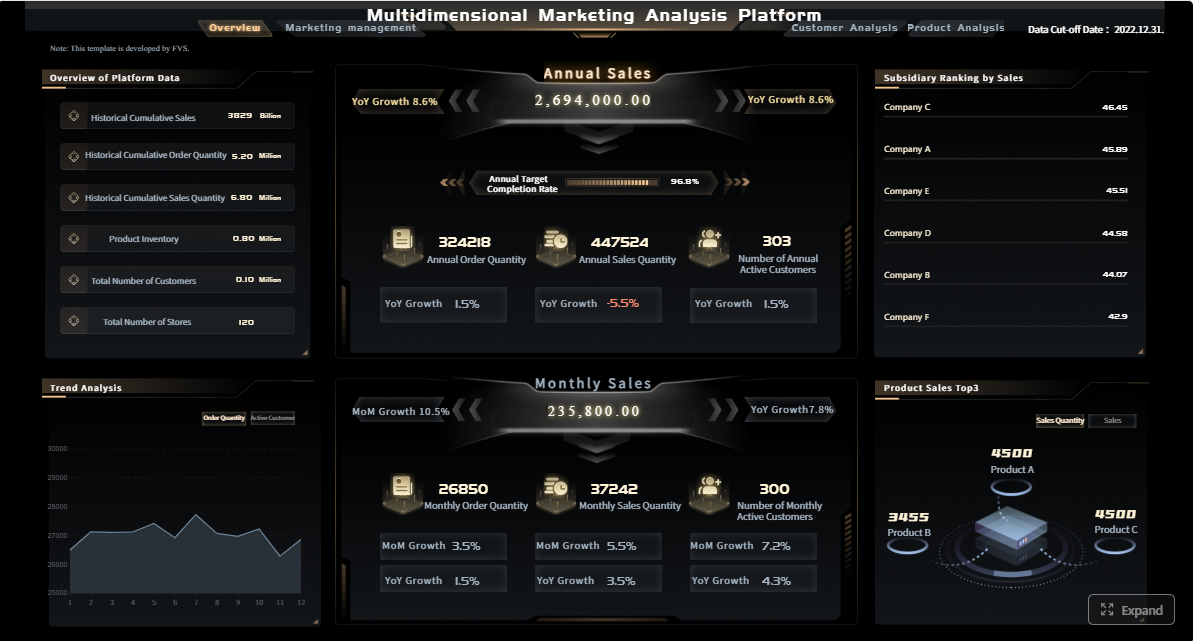 Click To Try The Dashboard
All reports in this article are built with FineReport
Why marketing data management matters before AI
Marketing leaders often ask for AI-powered insights, anomaly alerts, and faster campaign reporting. IT leaders know the real prerequisite is more basic: trustworthy data, governed semantics, and reporting assets that reflect agreed business logic.
In enterprise environments, AI should sit on top of a controlled reporting foundation, not bypass it. If campaign cost, qualified lead, attributed revenue, or conversion definitions vary by team or region, then every downstream summary, alert, or recommendation becomes harder to trust.
A disciplined approach to marketing data management improves three things immediately:
- Decision quality: teams stop debating whose spreadsheet is correct and start acting on a shared version of performance.
- Compliance readiness: customer, consent, retention, and access rules become part of the reporting workflow instead of an afterthought.
- Cross-functional alignment: marketing, sales, finance, analytics, and IT can evaluate the same campaign and pipeline outcomes with consistent logic.
The risk of feeding fragmented data into analytics and AI is not only technical. It is operational. Poorly modeled campaign hierarchies, duplicate contacts, mismatched attribution windows, and undocumented metrics can lead to misleading summaries, weak forecasting, and unnecessary escalations.
That is why enterprise AI adoption in marketing should begin with governed reporting. FineReport helps standardize formatted reports, management reports, operational cockpits, and reporting workflows. Dora adds the enterprise Data Agent layer, so users can consume those trusted assets through natural language, scheduled briefings, exception alerts, and follow-up workflows.
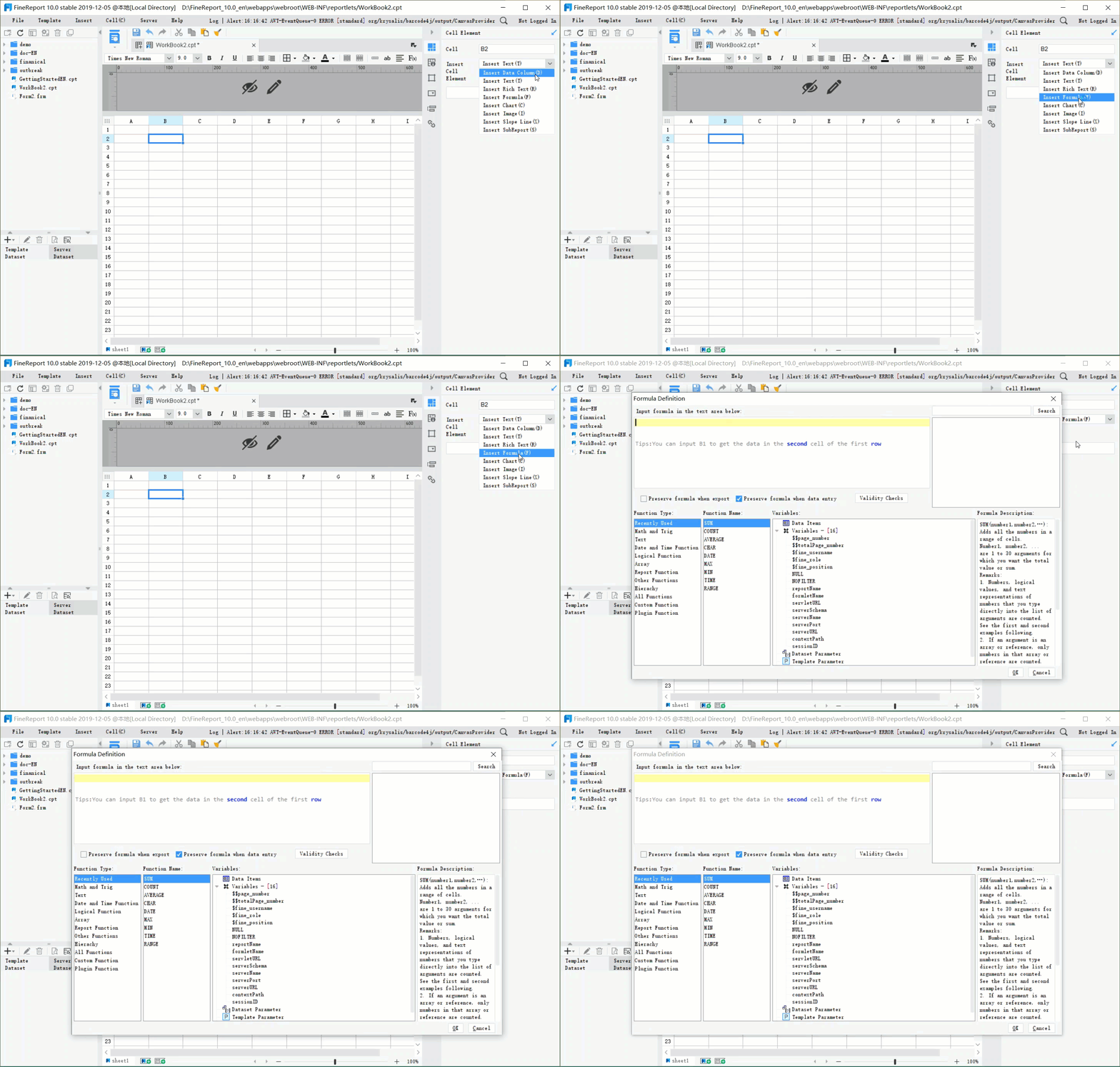
What marketing data management means in an enterprise environment
In a consumer-grade setting, marketing data management may sound like putting data into a dashboard. In an enterprise setting, it is much broader. It includes the collection, integration, modeling, governance, reporting, and activation of marketing-related data across systems and business processes.
At a practical level, marketing data management covers:
- Data ingestion from CRM, marketing automation, ad platforms, web analytics, e-commerce, call center, and finance systems
- Standardization of customer, campaign, lead, account, product, geography, and revenue data
- KPI modeling for funnel stages, attribution, budget pacing, pipeline influence, and ROI
- Governance for ownership, privacy, access control, lineage, retention, and auditability
- Reporting delivery for operational teams, managers, executives, and cross-functional stakeholders
- Activation of trusted insights for segmentation, forecasting, optimization, and follow-up action
It is important to distinguish marketing data management from a few common lookalikes:
Marketing data management is not just dashboarding
A dashboard can visualize numbers, but it does not automatically solve data consistency, semantic definitions, ownership, or governance. If the underlying data model is unstable, the dashboard only makes the instability look polished.
Marketing data management is not just storage
A warehouse or lake can centralize data, but storage alone does not define which lead status counts as marketing qualified, how campaign costs should be normalized, or which business unit can access pipeline detail.
Marketing data management is not just campaign reporting
Weekly campaign reports are outputs. Marketing data management is the system of record, logic, and governance that makes those outputs reliable and reusable.
In the enterprise, this discipline connects customer, campaign, channel, and performance data across the business. Marketing needs it for optimization. Sales needs it for lead and pipeline context. Finance needs it for budget accountability. Executives need it for performance confidence. IT needs it to ensure the whole process is sustainable and governed.
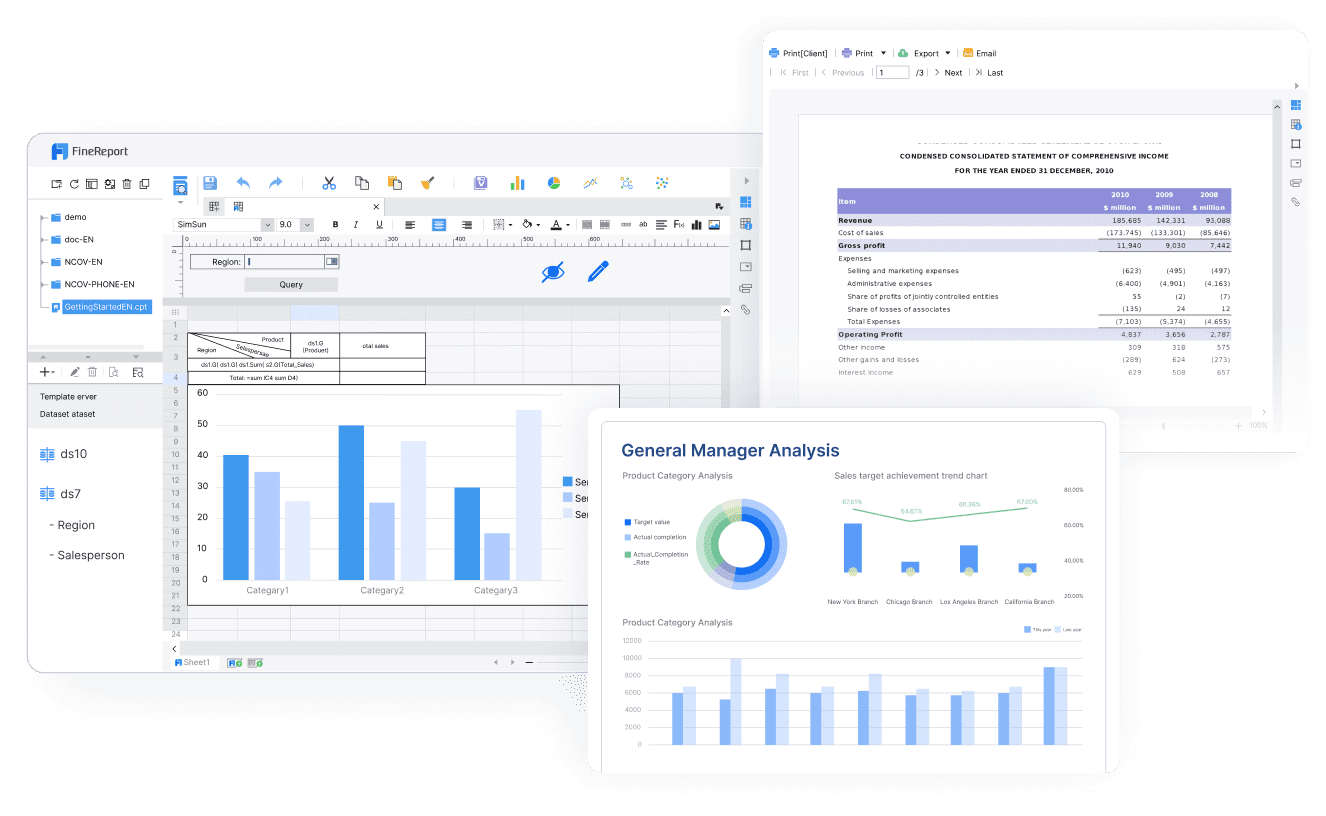
Common marketing data management challenges enterprise IT must solve
Fragmented sources and inconsistent definitions
The first major problem is fragmentation. Marketing data usually lives in too many places:
- Paid media platforms
- CRM and sales systems
- Marketing automation tools
- Website and app analytics
- Offline event or partner systems
- Regional files and manual uploads
When these sources are disconnected, teams cannot easily answer basic performance questions across the full funnel. They also tend to create duplicate records, conflicting filters, and competing KPI logic.
Common examples include:
- One team defines a lead at form submission, another after enrichment
- Campaign naming conventions differ by market
- Revenue attribution windows vary across reports
- Costs are synced on different schedules across channels
- The same account appears under multiple identifiers
For enterprise IT, this is not just a data integration issue. It is a semantic control issue. Reports must reflect shared business definitions, not team-by-team improvisation.
Governance, privacy, and access control gaps
Marketing data often includes personal data, behavioral data, account information, and campaign engagement records. That means governance requirements are real, not optional.
Enterprise IT must address:
- Ownership: who defines and approves metrics, fields, and report structures
- Consent: which data can be used for analysis, activation, and retention
- Retention: how long detailed records and histories should be stored
- Lineage: where each number came from and how it was transformed
- Access control: who can see customer-level, account-level, budget-level, or regional data
Without these controls, reporting becomes risky. AI layered onto ungoverned data only increases exposure because more users can consume and distribute summaries faster.
Reporting that is hard to trust or scale
Even when data pipelines exist, reporting often remains manual. Analysts export CSVs, business users maintain local spreadsheets, and KPI logic lives in undocumented formulas. Over time, trust declines because nobody is fully sure which report is current or how each metric was calculated.
The operational symptoms are familiar:
- Monthly reports take too long to prepare
- Regional teams produce inconsistent versions
- Executives ask for explanations every time metrics shift
- Business users wait on analysts for basic answers
- Exceptions are discovered late because no alerting process exists
A report can be visually attractive and still be unscalable. Enterprise IT must solve for reliability, explainability, permissions, and repeatability, not just presentation.
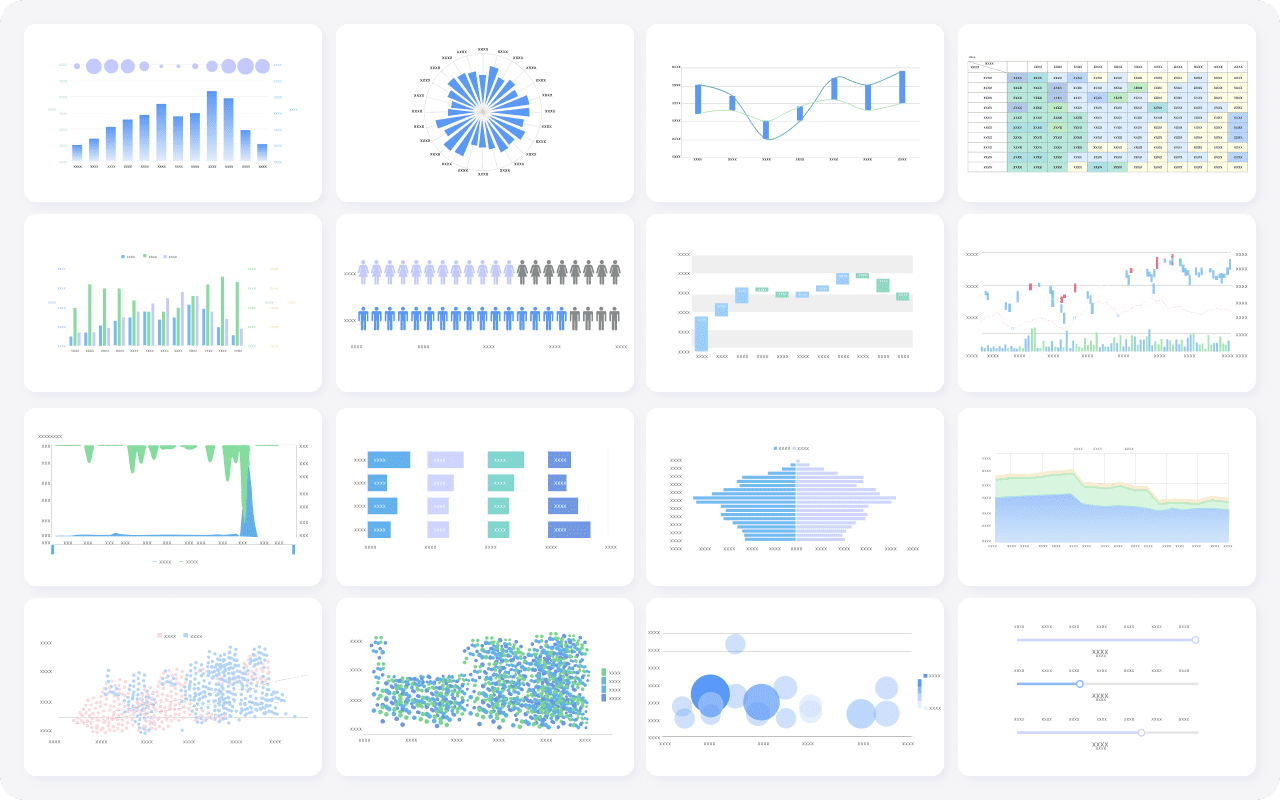
How to build a governed reporting foundation
A strong reporting foundation is what turns marketing data management into a repeatable enterprise capability. This foundation should be designed for both human reporting consumption and future AI-assisted workflows.
Core framework and key metrics for governed marketing reporting
Before automation, enterprises need a clear KPI structure. Below are report elements that IT and business teams should define together.
Campaign hierarchy and identifiers
- Report Element: Standard structure for campaign, sub-campaign, channel, region, owner, and time period.
Business value: Enables cross-channel analysis, naming consistency, and roll-up reporting.
AI use: Dora can summarize campaign performance by hierarchy, explain differences across regions, and include structured roll-ups in management briefings.
Lead and account funnel stages
- Report Element: Clearly defined stages such as inquiry, MQL, SQL, opportunity, won, and influenced revenue.
Business value: Connects marketing activity to pipeline and revenue outcomes.
AI use: Dora can explain funnel drop-offs, summarize stage conversion changes, and highlight owners needing follow-up.
Spend, budget, and pacing
- Report Element: Planned budget, actual spend, variance, pacing rate, and channel-level allocation.
Business value: Helps control overspend, rebalance investment, and improve financial accountability.
AI use: Dora can generate budget variance summaries, flag pacing exceptions, and push alerts when thresholds are exceeded.
Attribution and contribution metrics
- Report Element: Agreed attribution logic, influence rules, lookback windows, and conversion credit model.
Business value: Improves fairness and consistency in channel performance evaluation.
AI use: Dora can explain attribution-based performance changes in plain language and reference the governed reporting logic behind the answer.
Data quality and freshness indicators
- Report Element: Last refresh timestamp, failed pipeline flags, missing field counts, duplicate rate, and validation status.
Business value: Prevents decisions based on stale or compromised data.
AI use: Dora can include data-confidence notes in summaries and warn users when a report should be reviewed before use.
Exception and action status
- Report Element: Threshold breaches, underperforming campaigns, overdue follow-up items, unresolved data issues, and assigned owners.
Business value: Turns reporting into action instead of static review.
AI use: Dora can act as a Risk Alert Officer, summarize exceptions, notify owners, and produce follow-up records.
Standardize data models and business definitions
The first build step is semantic standardization. Enterprise IT should define shared naming rules, metric logic, and data model relationships for core entities such as campaigns, leads, contacts, accounts, opportunities, channels, and revenue.
This usually includes:
- Standard field naming conventions
- Agreed KPI formulas
- Consistent funnel stage definitions
- Mapped campaign taxonomies
- Shared calendar and period rules
- Clear entity relationships between marketing and sales objects
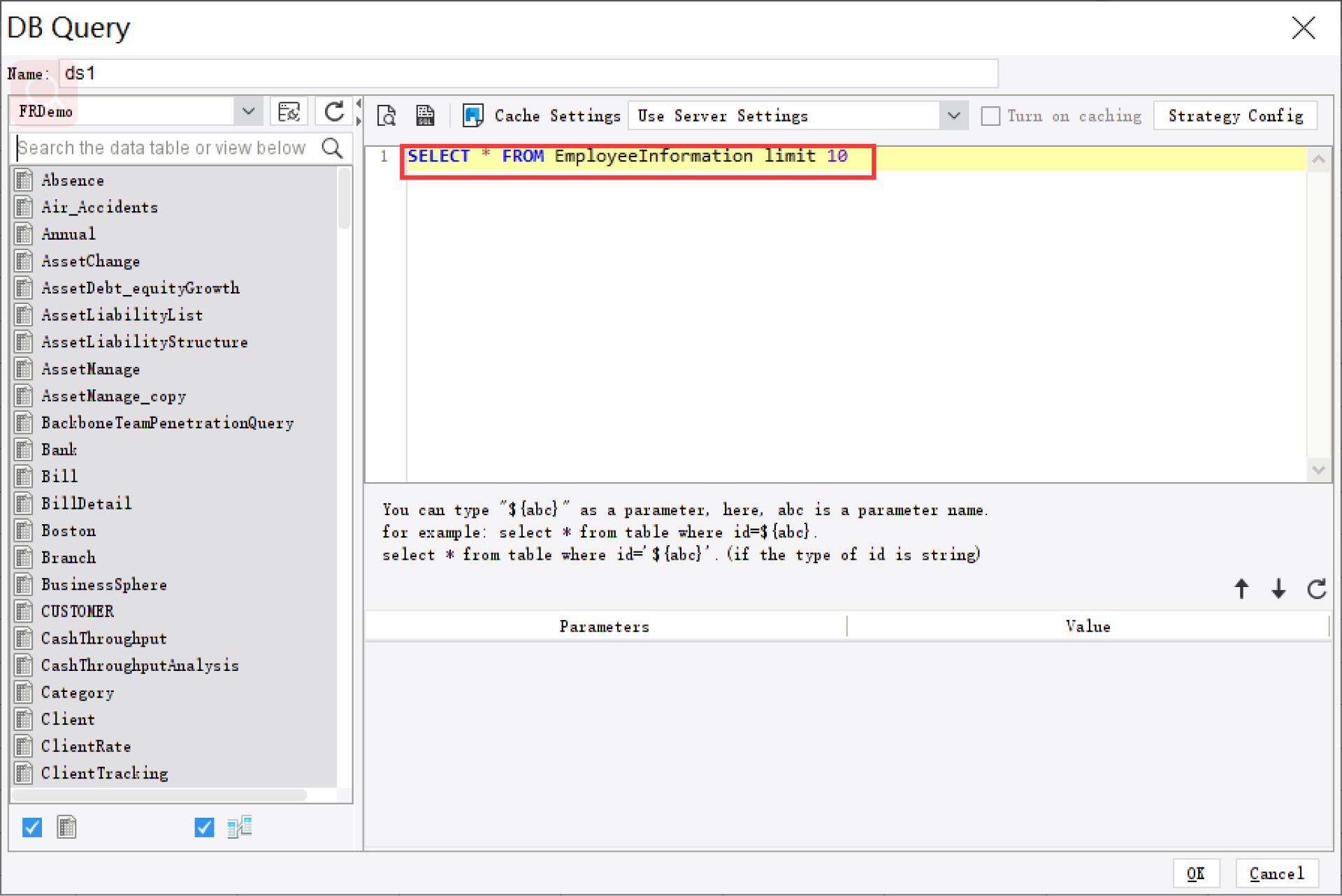
FineReport helps operationalize this work by turning approved logic into reusable report templates, parameterized views, and management-ready formatted reports. That reduces the chance that each department rebuilds metrics differently.
Establish data quality and governance workflows
Governed reporting needs operational discipline. Data quality checks should not be informal or hidden in analyst notebooks. They should be defined as part of the reporting process.
Key practices include:
- Validation checks for nulls, duplicates, format issues, and outliers
- Stewardship roles for metric ownership and issue escalation
- Review processes for KPI definition changes
- Audit trails for report updates and business-rule changes
- Refresh monitoring and incident handling procedures
This is where enterprise IT provides real value. It moves the organization from reactive reporting support to controlled data operations.
Integrate data across the enterprise stack
Not every source needs to be integrated at once. Start with the systems that support the most important reporting questions and recurring decisions.
Typical priorities include:
- CRM and sales pipeline systems
- Marketing automation platforms
- Paid media and campaign cost sources
- Web and app analytics
- Product, commerce, or revenue systems
- Finance or budget reference data
The goal is not integration for its own sake. The goal is interoperability that supports trusted reports. FineReport can then use these governed datasets to deliver formatted reports, complex reports, and operational cockpits for different personas.
Design reporting for reliability and adoption
A governed report that nobody uses has limited value. Reporting design must support confidence and adoption at the same time.
Strong enterprise reporting should be:
- Documented: users know what each metric means
- Role-based: executives, managers, analysts, and operators see the right level of detail
- Explainable: calculations and filters are transparent
- Consistent: templates reduce interpretation drift
- Action-oriented: exceptions and next steps are visible
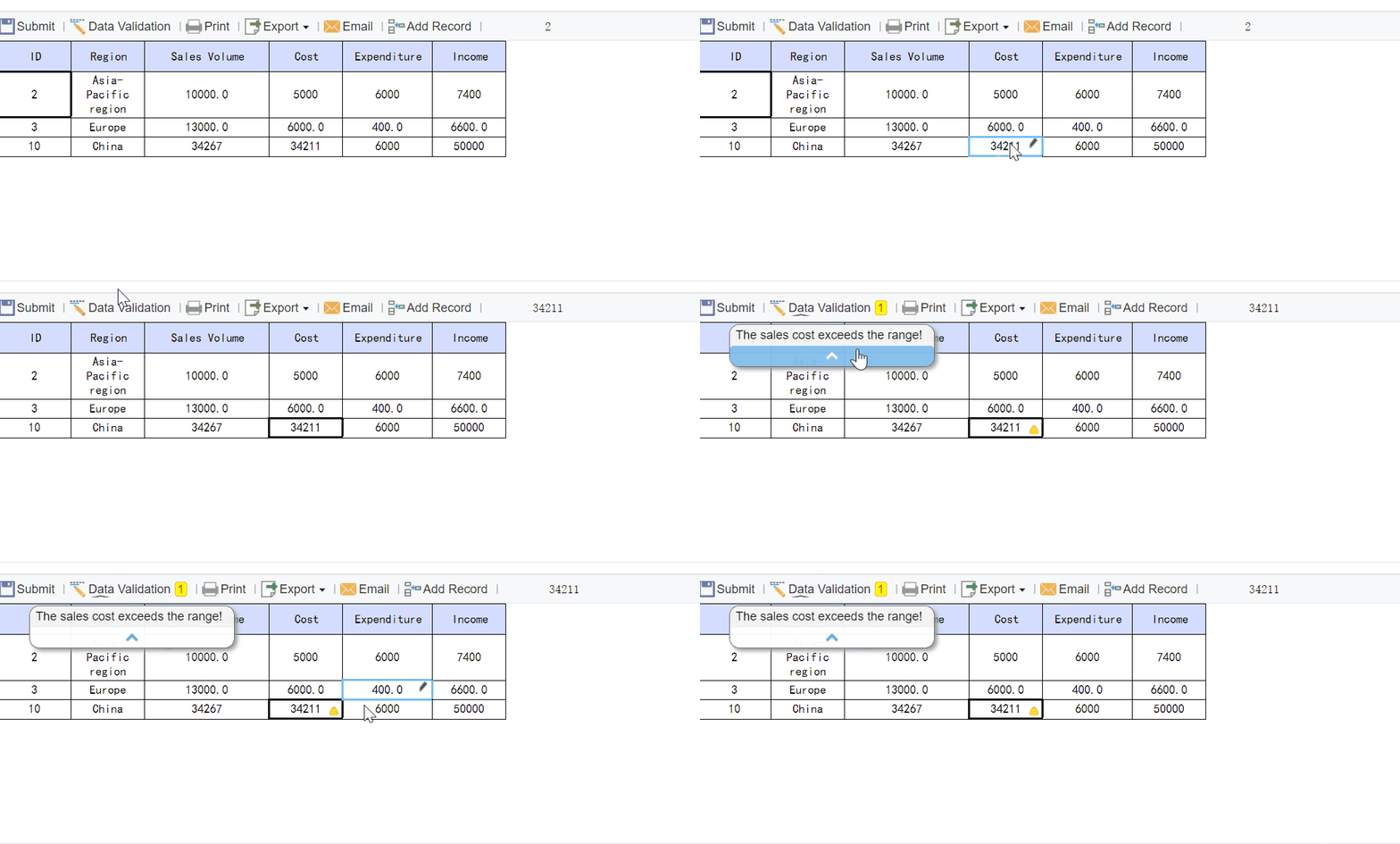
FineReport is especially useful here because it supports structured management reports, complex layouts, operational cockpits, and reporting workflows in one reporting foundation.
How an AI Data Agent Automates Report Consumption
Once the reporting foundation is governed, AI becomes much more useful. Instead of forcing users to search across multiple reports or wait for analyst support, Dora can turn trusted report assets into a scenario-based enterprise Data Agent experience.
For marketing data management, the most relevant Dora digital employees are:
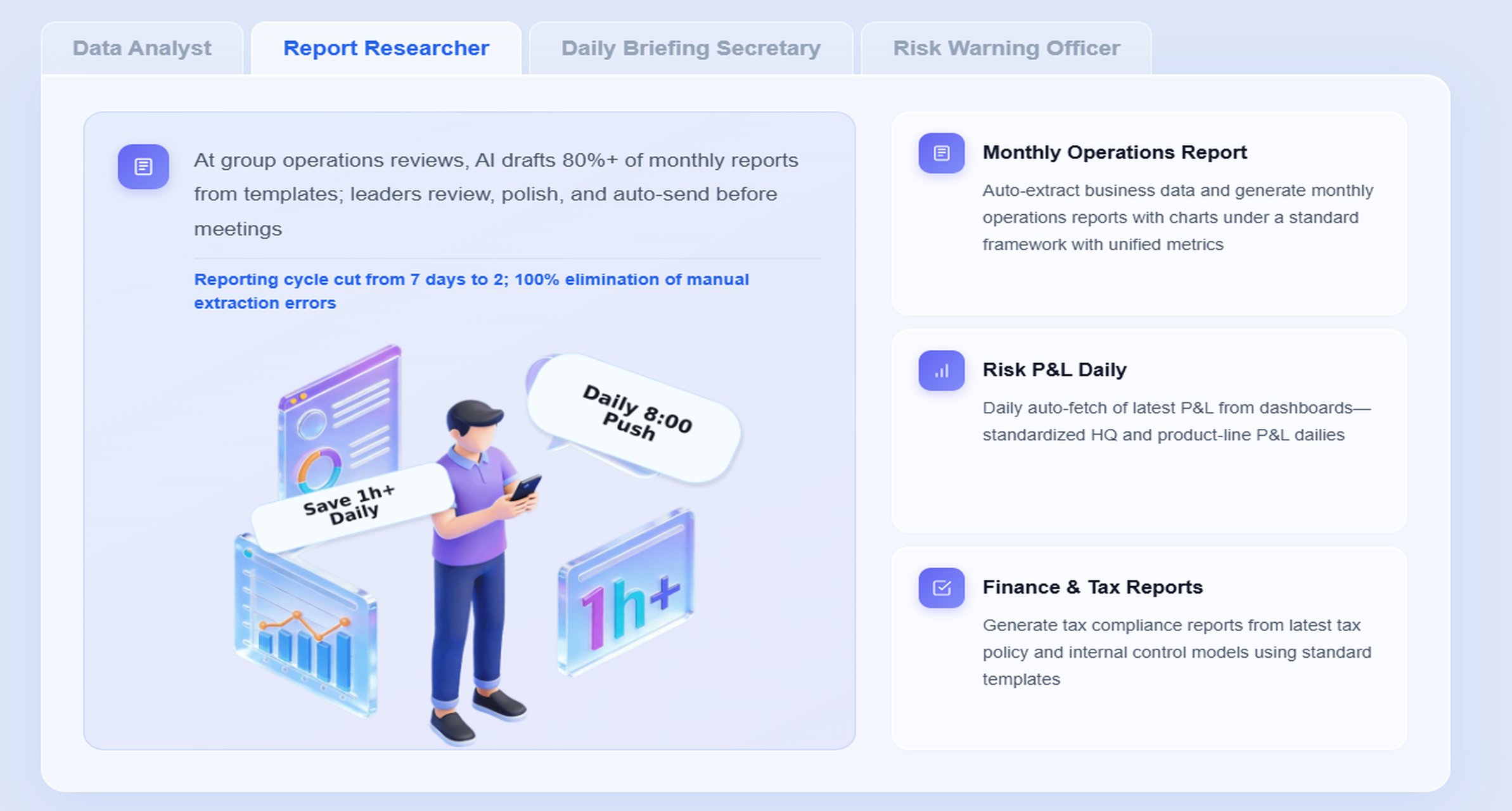
- Report Researcher for structured report generation and chart-based explanations
- Daily Briefing Secretary for scheduled summaries and meeting preparation
- Data Analyst digital employee for natural-language KPI queries and follow-up analysis
- Risk Alert Officer for exception monitoring and owner notification
In this scenario, a strong fit is the Daily Briefing Secretary combined with Report Researcher.
“Summarize this week’s marketing performance report, highlight channels with abnormal CPL increases, explain why pipeline contribution fell in APAC, and list the owners who need follow-up.”
Here is how the AI workflow typically works:
-
Retrieve trusted FineReport report or cockpit data.
Dora starts from the approved FineReport marketing report, not from uncontrolled raw files or ad hoc spreadsheets. -
Understand KPI definitions, report templates, filters, and business terms.
Dora uses the governed semantic layer behind the report, including metric definitions such as MQL, attributed pipeline, CPL, and pacing variance. -
Generate a structured report summary through chat.
Dora produces a management-ready narrative, chart explanation, or section-by-section summary tailored to the user’s role. -
Detect exceptions and abnormal changes.
Dora identifies threshold breaches such as sudden spend variance, conversion decline, stale lead sync, or unusual regional underperformance. -
Push briefings, alerts, and suggested follow-up.
The Daily Briefing Secretary can send scheduled summaries to stakeholders, while the Risk Alert Officer can notify responsible owners when action is required. -
Create follow-up records and recurring review summaries.
Dora supports governed AI workflow execution by capturing issue status, response context, and periodic summaries for management review.
This is where the combination of FineReport + Dora becomes practical. FineReport provides the trusted reporting and semantic foundation. Dora adds the AI assistant layer for report consumption and scenario execution.
That matters because raw prompt-only agents often struggle in enterprise reporting environments. They may not know which metric definition is approved, which report is current, what the access boundaries are, or how to structure a stable follow-up workflow. Dora is designed for better landing capability through governed query, reusable Skills, permissions, business semantics, and report-linked execution.
In day-to-day work, that means business users can:
- Ask natural-language questions over trusted reporting assets
- Get chart-based answers tied back to FineReport reports
- Receive scheduled daily or weekly briefings
- Be alerted to marketing performance exceptions
- Follow up faster without manually assembling every report narrative
For executives, the value is concrete: Dora is not an AI experiment. It is a landed digital employee for recurring reporting work such as weekly campaign summaries, monthly management reports, pipeline contribution reviews, budget variance alerts, and owner follow-up.
For IT teams, the role shifts from manually serving every report request to improving data connections, semantic layers, KPI governance, permission rules, report templates, and reusable agent Skills.
For business users, Dora reduces friction. They get timely summaries, chat-based answers, and exception pushes without hunting through multiple dashboards.
Best practices for activating governed marketing data
A governed reporting foundation is only valuable if the organization uses it to improve decisions and execution.
Align IT, marketing, analytics, and compliance teams
Marketing data management fails when it is treated as only a marketing issue or only an IT issue. Shared ownership is essential.
Set up:
- Metric approval roles
- Data stewardship ownership
- Escalation paths for quality and reporting issues
- Regular operating cadences for review
- Compliance checkpoints for sensitive data use
This cross-functional operating model keeps reporting logic stable as business needs evolve.
Turn governed data into actionable insights
Trusted reporting should support real business actions, not just retrospective review. Once metrics are governed, teams can use them more confidently for:
- Audience segmentation
- Attribution analysis
- Budget pacing and reallocation
- Pipeline forecasting
- Campaign performance optimization
- Regional performance comparison
FineReport helps package these outputs into role-based reports and operational cockpits. Dora helps users consume them faster through summaries, Q&A, and scheduled pushes.
Prepare the foundation for future AI use cases
AI becomes more accurate and more explainable when the underlying data is governed. The key is not “add AI everywhere.” The key is to prepare a clean, semantic, permission-aware reporting layer first.
To support future AI use cases:
- Standardize report templates, KPI definitions, and business terms
- Build semantic clarity into the reporting workflow
- Treat data quality as part of AI implementation
- Preserve permission governance so AI respects FineReport access boundaries
- Start with high-value recurring reports before automating broad use cases
- Use human review for AI-generated report narratives, then expand Skills gradually
These practices improve enterprise fit and workflow stability while avoiding overreliance on raw prompts.
Define thresholds, owners, and escalation logic
AI-generated summaries are helpful, but exception handling creates stronger operational value. For marketing data management, define:
- Spend overrun thresholds
- Conversion drop thresholds
- Data freshness breach rules
- Lead sync failure criteria
- Follow-up owner mapping
- Escalation timing
This makes Dora’s Risk Alert Officer and Daily Briefing Secretary more actionable. Instead of merely describing an issue, Dora can participate in a governed AI workflow that routes the issue to the right person.
Focus on repeatable reporting scenarios first
Do not begin with the most ambiguous or politically disputed use case. Start with recurring scenarios where business rules are stable and review cycles are frequent.
Examples include:
- Weekly channel performance summaries
- Monthly management reporting
- Budget pacing and variance alerts
- Lead funnel health reviews
- Campaign exception monitoring by region
These are ideal scenarios for FineReport as the reporting foundation and Dora as the AI digital employee layer.
How to evaluate progress and next steps
Enterprise IT needs measurable signs that marketing data management is improving before scaling AI.
Useful maturity markers include:
- Shared KPI definitions are documented and approved
- Core marketing reports use standardized templates
- Data refresh and quality status are visible to users
- Access permissions align with role and data sensitivity
- Fewer spreadsheet-based reconciliations are needed
- Stakeholders trust recurring reports enough to act on them
- Exception handling is structured rather than ad hoc
- AI summaries consistently reference trusted report assets
A practical phased roadmap can look like this:
Phase 1: Stabilize core reporting
- Identify critical marketing reports and cockpits
- Standardize metric definitions
- Reduce spreadsheet dependency
- Clarify report ownership and access control
Phase 2: Govern data and workflows
- Add quality checks and stewardship processes
- Document lineage and refresh logic
- Define exception rules and escalation paths
- Build reusable report templates in FineReport
Phase 3: Introduce AI-assisted report consumption
- Start with Dora for recurring summaries and report Q&A
- Enable scheduled briefings for managers and executives
- Roll out exception alerts to specific owners
- Use human review for early narrative generation
Phase 4: Expand scenario-specific Agentic BI
- Add more reusable Skills
- Support broader self-service report consumption
- Connect follow-up workflows and management reviews
- Continuously refine semantics, governance, and adoption
What should be documented and revisited over time?
- KPI definitions and business terms
- Report inventory and ownership
- Access rules and permission mappings
- Data quality checks and threshold logic
- AI summary templates and review rules
- Stakeholder feedback on trust and usability
This ongoing discipline is what separates enterprise-ready AI from surface-level automation.
FineReport + Dora solution for governed marketing data management
Building this manually is complex. FineReport helps teams standardize trusted reports, operational cockpits, templates, and reporting workflows. Dora turns those assets into an AI assistant that can answer report questions in chat, generate structured summaries, push scheduled briefings, monitor exceptions, and follow up with responsible owners.
For enterprise marketing data management, this matters because the challenge is not only data collection. It is sustained reporting reliability, KPI governance, permission control, and business adoption. FineReport provides the reporting foundation. Dora adds the enterprise Data Agent layer that makes those governed assets easier to consume and operationalize.
FineReport + Dora is not only a reporting upgrade; it is a practical fourth-generation Agentic BI path. FineReport provides governed reports and operational cockpits. Dora provides the AI assistant layer for scenario execution, with more controlled Skills, lower token waste, faster execution paths, and more stable workflows than prompt-only agents.
Get Ready-to-Use Dashboard Templates in Fine Gallery
The strongest Dora pitch is scenario + product + service: FineReport provides the trusted reporting foundation, Dora provides the AI digital employee, and implementation service connects data, governance, semantic setup, Skills, report templates, permissions, and rollout.
If your enterprise wants better AI outcomes in marketing, start by strengthening the governed reporting foundation first. That is how marketing data management becomes scalable, trustworthy, and ready for real-world AI adoption.
FAQs
Marketing data management is the process of collecting, integrating, standardizing, governing, and delivering marketing data across systems so teams can trust reports and act on consistent KPIs. In enterprises, it goes beyond dashboards to include access control, lineage, compliance, and reusable reporting logic.